
Context:
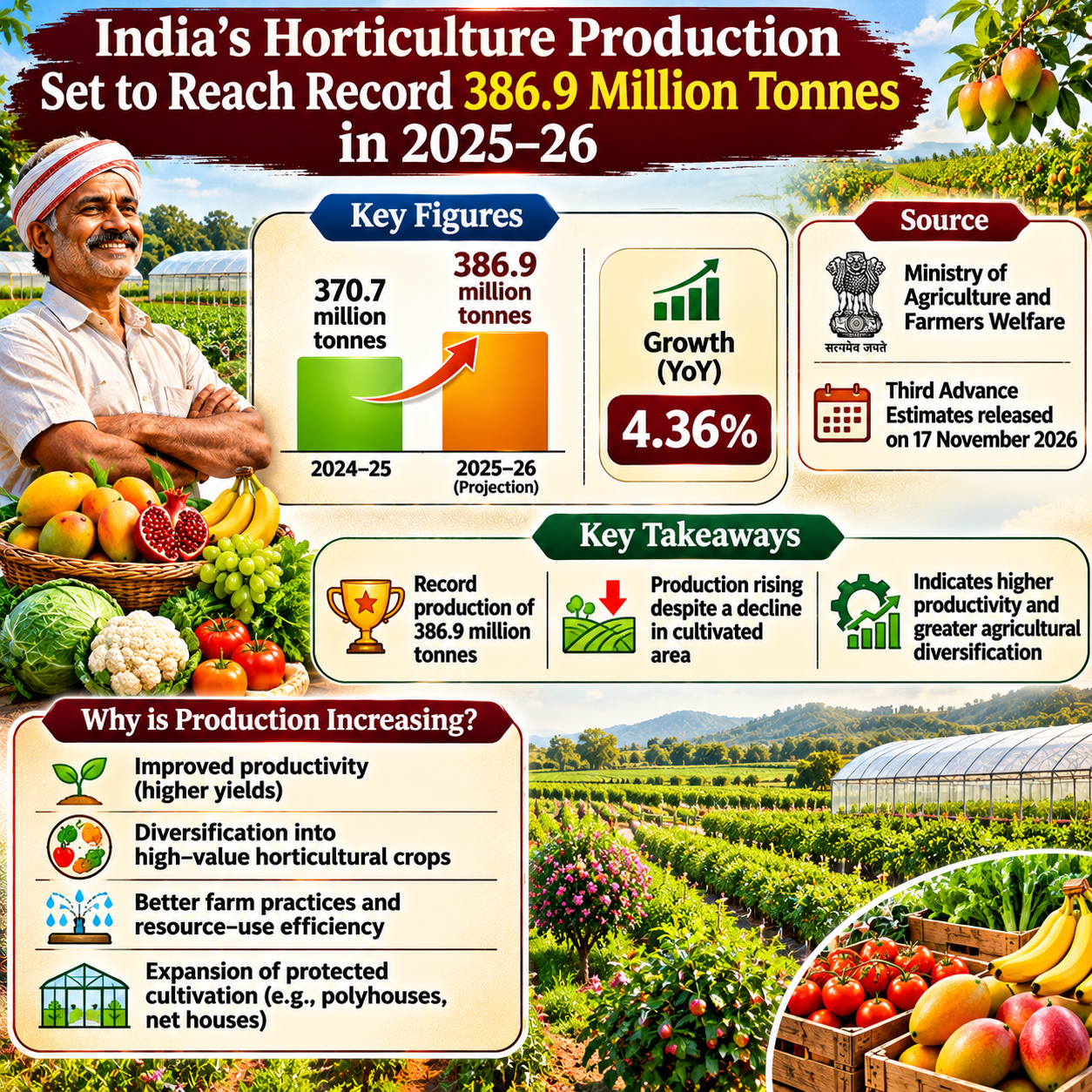
Recently, India's horticulture production is projected to reach a record 386.9 million tonnes in 2025-26, registering a growth of 4.36% over 2024-25. The Ministry of Agriculture and Farmers Welfare released the Third Advance Estimates of Area and Production of Horticultural Crops on 17 November 2026. Interestingly, production is increasing despite a decline in cultivated area, indicating improvements in productivity and agricultural diversification.
What is Horticulture?
-
-
- Horticulture includes the cultivation of fruits, vegetables, flowers, spices, plantation crops and medicinal and aromatic plants. According to the estimates, total production is expected to increase from 370.74 million tonnes in 2024-25 to 386.92 million tonnes in 2025-26, while cultivated area is estimated to decline from 30.136 million hectares to 29.721 million hectares.
- Fruit production is projected at 123.07 million tonnes, registering 4.60% growth, while vegetable production is expected to reach approximately 227.27 million tonnes. Potato production is estimated to rise by nearly 12%. Flowers and plantation crops are also expected to register significant growth.
- Horticulture includes the cultivation of fruits, vegetables, flowers, spices, plantation crops and medicinal and aromatic plants. According to the estimates, total production is expected to increase from 370.74 million tonnes in 2024-25 to 386.92 million tonnes in 2025-26, while cultivated area is estimated to decline from 30.136 million hectares to 29.721 million hectares.
-
Significance for India:
-
-
- Horticulture promotes crop diversification by reducing excessive dependence on traditional foodgrains such as wheat and rice. It can generate higher returns per unit of land, improve farmers' income and create employment in processing, packaging, transportation and marketing.
- It also strengthens nutritional security through the supply of essential vitamins and minerals. Moreover, fruits, vegetables and spices offer considerable agricultural export potential and promote rural industrialisation.
- Horticulture promotes crop diversification by reducing excessive dependence on traditional foodgrains such as wheat and rice. It can generate higher returns per unit of land, improve farmers' income and create employment in processing, packaging, transportation and marketing.
-
Major Government Schemes:
-
-
- The Mission for Integrated Development of Horticulture (MIDH) promotes holistic horticultural development, including nurseries, quality planting material, protected cultivation and post-harvest management. The Clean Plant Programme, approved in 2024 with an investment of ₹1,765.67 crore, aims to provide disease-free planting material through nine advanced Clean Plant Centres. T
- he Pradhan Mantri Kisan SAMPADA Yojana (PMKSY) supports food processing, cold chains and value addition, while its Operation Greens component focuses on stabilising the supply chain of perishable crops.
- The Horticulture Cluster Development Programme promotes integrated production, processing, branding and marketing. Additionally, PMKSY's Per Drop More Crop component encourages micro-irrigation, while e-NAM improves agricultural market access.
- The Mission for Integrated Development of Horticulture (MIDH) promotes holistic horticultural development, including nurseries, quality planting material, protected cultivation and post-harvest management. The Clean Plant Programme, approved in 2024 with an investment of ₹1,765.67 crore, aims to provide disease-free planting material through nine advanced Clean Plant Centres. T
-
Challenges:
The sector faces inadequate cold-storage infrastructure, post-harvest losses, price volatility, fragmented landholdings, limited processing facilities and climate-related risks such as heatwaves, irregular rainfall and pest attacks. Export competitiveness is also affected by quality and certification requirements.
Way Forward:
India should strengthen cold chains, food processing, FPOs, climate-resilient varieties, precision farming and digital marketing. Greater investment in research, irrigation efficiency and export infrastructure is essential. Thus, horticulture can become a major driver of agricultural diversification, nutritional security, farmers' income and Viksit Bharat 2047.