
Context:
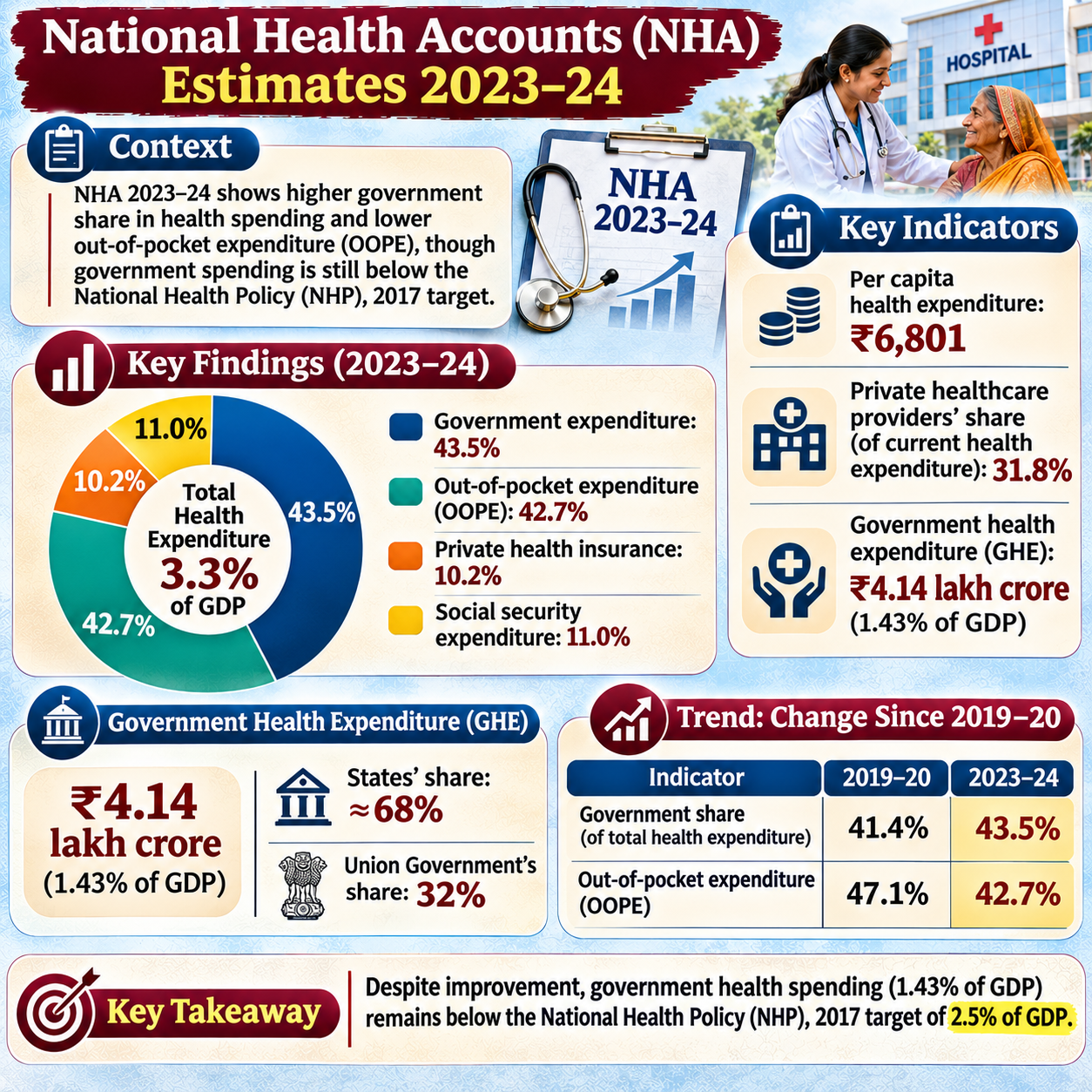
Recently, the National Health Accounts (NHA) Estimates for 2023–24 highlighted a positive trend in India's healthcare financing, with an increase in the government's share of total health expenditure and a decline in out-of-pocket expenditure (OOPE). However, government health spending remains below the target set under the National Health Policy (NHP), 2017.
Key Findings of the National Health Accounts 2023–24:
-
-
- The National Health Accounts Estimates for 2023–24 revealed that India's total health expenditure stood at 3.3% of GDP, with government expenditure accounting for 43.5% and out-of-pocket expenditure (OOPE) at 42.7%.
- Private health insurance contributed 10.2%, while social security expenditure accounted for 11%. Per capita health expenditure increased to ₹6,801. The government's share increased from 41.4% in 2019–20, while OOPE declined from 47.1% during the same period. However, private healthcare providers continued to account for 31.8% of current health expenditure.
- In 2023–24, GHE stood at ₹4.14 lakh crore (1.43% of GDP), with States contributing approximately 68% and the Union Government 32%.
- The National Health Accounts Estimates for 2023–24 revealed that India's total health expenditure stood at 3.3% of GDP, with government expenditure accounting for 43.5% and out-of-pocket expenditure (OOPE) at 42.7%.
-
About Healthcare Financing in India:
|
Concept |
Meaning |
|
Healthcare Financing |
Mobilisation and utilisation of financial resources for healthcare services. |
|
Total Health Expenditure (THE) |
Includes government spending, household payments, private insurance and social security expenditure. |
|
Out-of-Pocket Expenditure (OOPE) |
Direct payments by individuals for medicines, consultations, hospitalisation and diagnostics; may cause poverty and financial hardship. |
|
Government Health Expenditure (GHE) |
Spending by Central and State Governments on hospitals, primary healthcare, medicines, vaccines and medical infrastructure. |
About National Health Policy, 2017:
The National Health Policy, 2017, aimed to increase government health expenditure to 2.5% of GDP by 2025. It also emphasised strengthening primary healthcare, improving healthcare accessibility and reducing financial hardship caused by medical expenses.
Significance of the Development:
The rising government share and declining OOPE indicate progress towards Universal Health Coverage (UHC). Increased public financing reduces the financial burden on vulnerable households, prevents medical impoverishment and promotes inclusive development. Better healthcare investment also improves human capital, labour productivity and economic growth.
Major Government Initiatives:
Several government initiatives support the provision of affordable healthcare services. These include:
-
-
- Ayushman Bharat–Pradhan Mantri Jan Arogya Yojana (PM-JAY): It provides health coverage of up to ₹5 lakh per eligible family annually.
- Ayushman Arogya Mandirs: They provide comprehensive primary healthcare services.
- National Health Mission (NHM): It aims to improve the availability and quality of healthcare services in rural and urban areas.
- Pradhan Mantri Bhartiya Janaushadhi Pariyojana: It provides affordable generic medicines.
- Ayushman Bharat Digital Mission (ABDM): It aims to develop digital health infrastructure.
- Ayushman Bharat–Pradhan Mantri Jan Arogya Yojana (PM-JAY): It provides health coverage of up to ₹5 lakh per eligible family annually.
-
Challenges:
Despite progress, India faces inadequate public health investment, unequal distribution of healthcare facilities, shortages of doctors and healthcare professionals, dependence on private hospitals and high medical expenses. Moreover, expenditure on medicines, diagnostics and outpatient treatment continues to burden households.
Way Forward:
India needs to gradually increase public health expenditure towards the 2.5% GDP target, strengthen primary healthcare, improve rural medical infrastructure, ensure affordable medicines, regulate private healthcare costs and promote preventive healthcare through nutrition, sanitation and immunisation.
Conclusion:
The declining share of out-of-pocket expenditure reflects progress towards financial protection and Universal Health Coverage. However, sustained public investment, cooperative federalism and equitable healthcare delivery are essential to achieve the vision of accessible, affordable and quality healthcare for all, in accordance with SDG 3 (Good Health and Well-being).



