
Context:
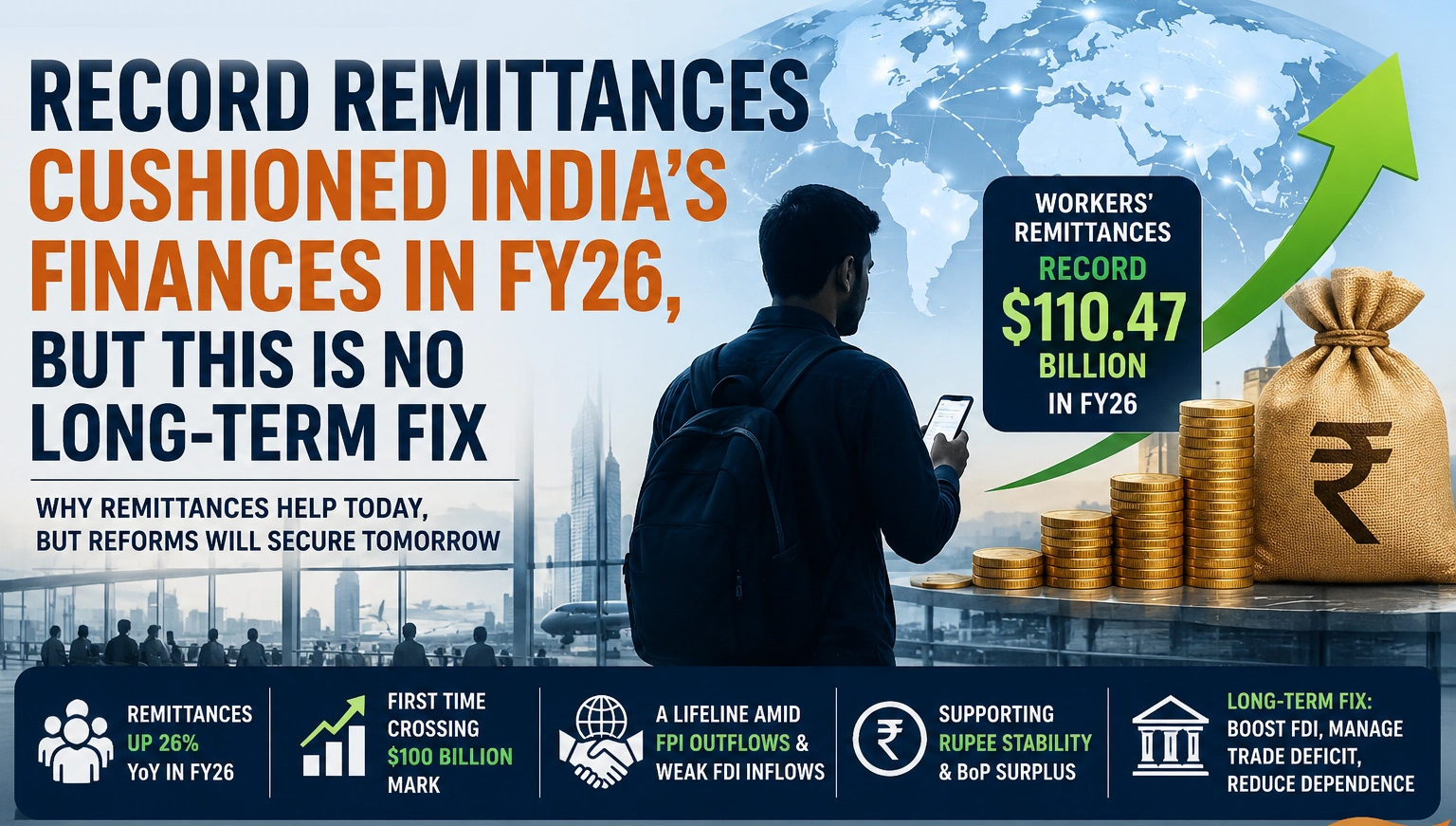
India recorded a historic surge in inward remittances in 2025–26, with Indian workers abroad sending home $110.47 billion, the highest ever in a single year.
Key Highlights of Remittance Trends:
-
-
- In the January–March 2026 quarter alone, Indians abroad remitted $31.07 billion, marking a 13-year high and a 34% year-on-year increase. For the full fiscal year 2025–26, remittances rose by 26% compared to the previous year.
- Broader “private transfers,” which include remittances, deposits from non-resident Indians, and personal gifts, reached $151.71 billion. Net transfers stood at $144.07 billion after accounting for outward flows.
- In the January–March 2026 quarter alone, Indians abroad remitted $31.07 billion, marking a 13-year high and a 34% year-on-year increase. For the full fiscal year 2025–26, remittances rose by 26% compared to the previous year.
-
Drivers behind the Surge:
-
-
- The increase in remittances was influenced by multiple factors. A key driver was the West Asia geopolitical situation, which encouraged precautionary transfers from Indian workers in Gulf countries. Additionally, currency depreciation enhanced the value of remitted funds in domestic terms.
- Data from the Reserve Bank of India indicates that remittances have remained resilient despite global financial volatility and subdued capital inflows.
- The increase in remittances was influenced by multiple factors. A key driver was the West Asia geopolitical situation, which encouraged precautionary transfers from Indian workers in Gulf countries. Additionally, currency depreciation enhanced the value of remitted funds in domestic terms.
-
Changing Geography of Remittances:
-
-
- Traditionally, Gulf countries have been the largest source of remittances. However, their share has declined from 47% in 2016–17 to about 38% in 2023–24. Countries such as the United Arab Emirates, Saudi Arabia, Kuwait, Qatar, Oman, and Bahrain remain important but less dominant.
- At the same time, advanced economies like the United States and the United Kingdom are emerging as significant contributors. This shift reflects changing migration patterns, with more skilled Indian workers moving to developed economies.
- Traditionally, Gulf countries have been the largest source of remittances. However, their share has declined from 47% in 2016–17 to about 38% in 2023–24. Countries such as the United Arab Emirates, Saudi Arabia, Kuwait, Qatar, Oman, and Bahrain remain important but less dominant.
-
Impact on India’s External Sector:
-
-
- Strong remittances played a critical role in cushioning India’s external account amid weak capital inflows. Net FDI inflows remained subdued, and FPI flows were volatile, increasing reliance on remittance inflows to stabilise the rupee.
- In FY26, India still managed a BoP surplus of $7.22 billion in Q4, largely supported by these private transfers.
- Remittances also helped offset pressures from a widening trade deficit, particularly driven by high crude oil imports.
- Strong remittances played a critical role in cushioning India’s external account amid weak capital inflows. Net FDI inflows remained subdued, and FPI flows were volatile, increasing reliance on remittance inflows to stabilise the rupee.
-
Conclusion:
Record remittances in FY26 provided a crucial buffer for India’s external finances and helped stabilise the rupee amid global uncertainties. However, they remain a supportive but temporary pillar. Sustainable external stability will depend on stronger FDI, resilient capital markets, and a more balanced trade structure in the years ahead.
What is the total FY26 remittances?
India received a record $110.47 billion in inward remittances in FY 2025–26, the highest ever in a single year.
What are “private transfers”?
They include remittances, NRI deposits, and personal gifts, which together reached $151.71 billion, with net transfers at $144.07 billion.
Why did remittances increase sharply in FY26?
Key reasons include:
-
- Geopolitical tensions in West Asia
- Higher overseas employment
- Rupee depreciation increasing value of inflows
- Geopolitical tensions in West Asia
Why is this surge a structural concern?
Despite strong inflows, dependence on remittances highlights vulnerability because:
-
- Gulf share is declining (from ~47% to ~38%)
- Future risks from automation/AI in job markets
- India’s external stability still depends on weak FDI and volatile capital flows, making remittances a temporary cushion rather than a stable growth driver.
- Gulf share is declining (from ~47% to ~38%)
Consider the following statements regarding India's inward remittances:
1. Despite traditional dominance, the share of Gulf (GCC) countries in India's total inward remittances has witnessed a decline in recent years.
2. Advanced economies, such as the United States and the United Kingdom, have now emerged as the single largest regional contributors to India's remittances.
3. Remittances are classified under the "capital account" of the Balance of Payments (BoP) because they bring direct foreign exchange into the country.
Which of the statements given above is/are correct?
A) 1 and 2 only
B) 2 and 3 only
C) 1 only
D) 1, 2, and 3
Correct Answer: A) 1 and 2 only
Detailed Explanation:
Statement 1 is correct: Traditionally, Gulf countries have been the largest source of remittances. However, their share has significantly declined over the last decade (dropping from about 47% in 2016–17 to around 38% in recent years) due to changing migration patterns and localization policies.
Statement 2 is correct: The geographical composition of remittances has undergone a structural shift. Advanced economies like the USA and the UK have emerged as major contributors, overtaking the Gulf region in cumulative share, reflecting a rise in high-skilled Indian professionals migrating to developed nations.
Statement 3 is incorrect: Remittances are personal transfers sent by individuals working abroad to their families. Because they are not associated with any return claim of ownership (i.e., they are unrequited transfers), they are categorized under "Invisibles" in the Current Account of the Balance of Payments (BoP), not the Capital Account.



