
Context:
Recently, Prime Minister Modi and French President Emmanuel Macron held bilateral talks in Nice, France, on 14 June 2026. The meeting was significant as it was the first summit after the elevation of India-France ties to a "Special Global Strategic Partnership".
Key Outcomes of the meeting:
-
-
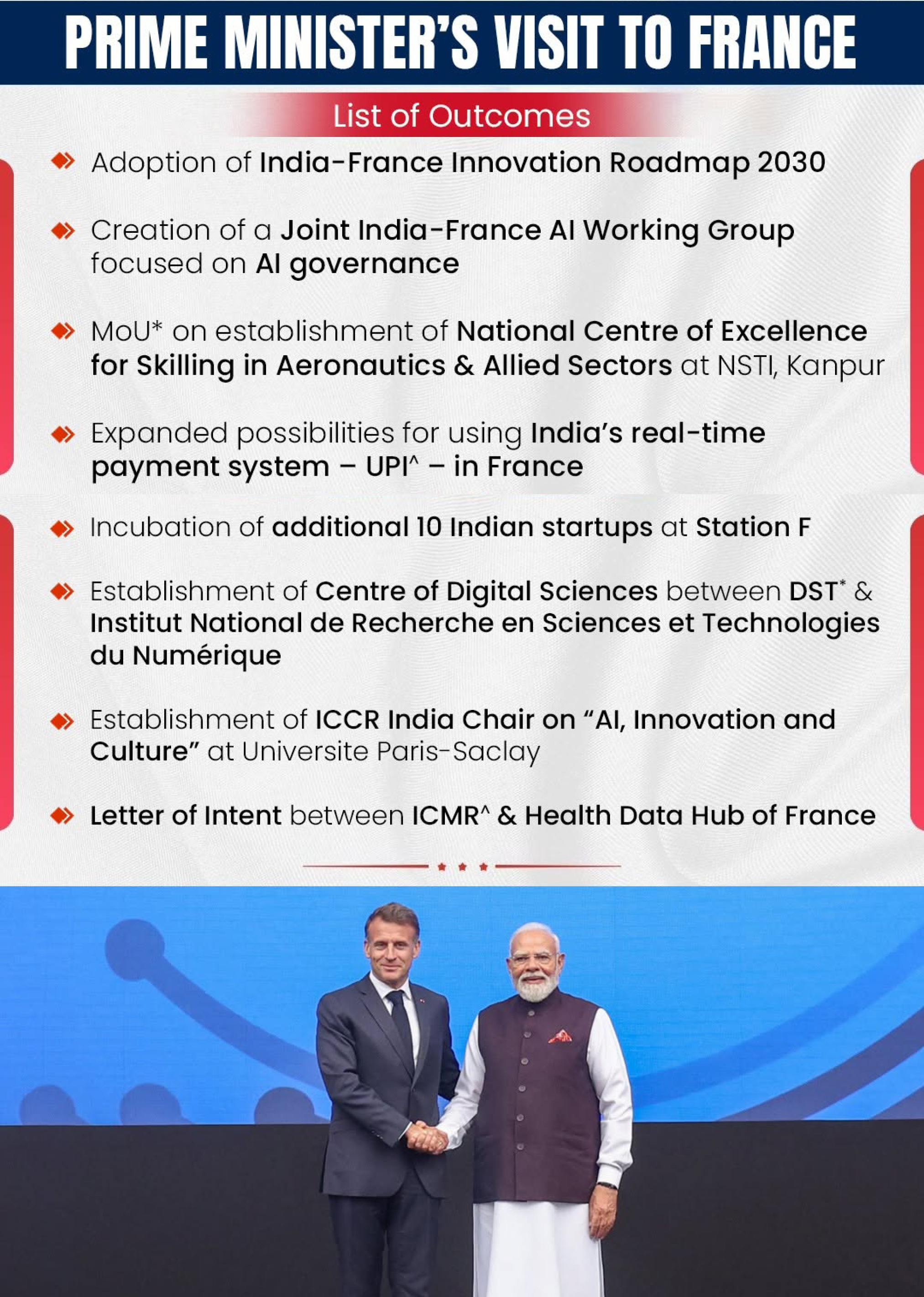
- Innovation Roadmap 2030 adopted to provide a long-term framework for cooperation in AI, semiconductors, deep-tech, renewable energy, space technology, and defence innovation.
- Joint India-France AI Working Group established to institutionalize and expand collaboration in Artificial Intelligence.
- Dialogue on Economic Security launched to strengthen cooperation in critical minerals, resilient supply chains, and emerging technologies.
- Both leaders emphasized the early conclusion of the India–EU Free Trade Agreement (FTA) to boost trade and investment.
- A High-Level Mechanism will be created to double India-France bilateral trade within five years.
- Cooperation will be expanded in aviation, railways, MSMEs, and skill development, including a Centre of Excellence for Skilling in Aeronautics at Kanpur.
- Defence collaboration will be deepened through co-design, co-development, and co-production of advanced defence platforms and technologies.
- Both countries agreed to enhance space cooperation, particularly in human spaceflight, space situational awareness, and private-sector participation in the space sector.
- Innovation Roadmap 2030 adopted to provide a long-term framework for cooperation in AI, semiconductors, deep-tech, renewable energy, space technology, and defence innovation.
-
About India and France relations:
-
-
- India and France have elevated their relationship to a Special Global Strategic Partnership, reflecting shared commitments to strategic autonomy, multipolarity, and a rules-based international order. Since the establishment of the Strategic Partnership in 1998, bilateral ties have expanded across defence, space, nuclear energy, climate action, and the Indo-Pacific.
- Defence remains the cornerstone of the relationship, evolving from buyer-seller transactions such as Rafale aircraft and Scorpene submarines to co-development and technology transfer. Regular military exercises, Varuna, Garuda and Shakti enhance interoperability between the armed forces. In the Indo-Pacific, France is a key partner due to its Indian Ocean territories and support for maritime security.
- Space cooperation through the ISRO-CNES partnership and civil nuclear collaboration, including the Jaitapur Nuclear Power Project and Small Modular Reactors (SMRs), are important pillars. Both countries also co-founded the International Solar Alliance (ISA), demonstrating leadership in climate governance.
- India and France have elevated their relationship to a Special Global Strategic Partnership, reflecting shared commitments to strategic autonomy, multipolarity, and a rules-based international order. Since the establishment of the Strategic Partnership in 1998, bilateral ties have expanded across defence, space, nuclear energy, climate action, and the Indo-Pacific.
-
Significance for India:
-
-
- France remains India's most reliable strategic partner in Europe and supports India's vision of strategic autonomy. The growing emphasis on innovation, technology, and economic security aligns with India's goals of becoming a global manufacturing and technology hub.
- The partnership also strengthens India's position in the Indo-Pacific, enhances access to advanced technologies, and contributes to supply-chain diversification amid geopolitical uncertainties.
- France remains India's most reliable strategic partner in Europe and supports India's vision of strategic autonomy. The growing emphasis on innovation, technology, and economic security aligns with India's goals of becoming a global manufacturing and technology hub.
-
Conclusion:
The Nice Summit demonstrates the evolution of India-France relations from a defence-centric partnership to a comprehensive strategic collaboration. By focusing on innovation, economic security, critical technologies, and resilient supply chains, both countries are laying the foundation for a future-oriented partnership capable of addressing twenty-first-century challenges.
Frequently Asked Questions (FAQs):
Q1. What is the Innovation Roadmap 2030?
It is a long-term framework adopted by India and France to strengthen cooperation in Artificial Intelligence (AI), semiconductors, deep-tech, renewable energy, space technology, and defence innovation. It aims to guide bilateral technological collaboration until 2030.
Q2.What is the purpose of the India-France Dialogue on Economic Security?
Ans. The Dialogue on Economic Security aims to enhance cooperation in critical minerals, supply-chain resilience, emerging technologies, and technology security, reflecting the growing linkage between economic and national security.
Q3. What are the major pillars of India-France defence cooperation?
Ans. Defence cooperation includes Rafale fighter aircraft, Scorpene submarines, technology transfer, defence co-production, and joint military exercises such as Varuna (Navy), Garuda (Air Force), and Shakti (Army).
Q4. What role does civil nuclear cooperation play in India-France relations?
Ans. Civil nuclear cooperation is anchored by the Jaitapur Nuclear Power Project and collaboration on Small Modular Reactors (SMRs), contributing to India's clean energy and energy security goals.
Q5. What is the International Solar Alliance (ISA)?
Ans. The ISA is a global initiative jointly launched by India and France during COP21 in Paris (2015) to promote solar energy deployment and support climate action, especially in developing countries.



