
India’s First Satellite-Tagged Ganges Soft-Shell Turtle
Context:
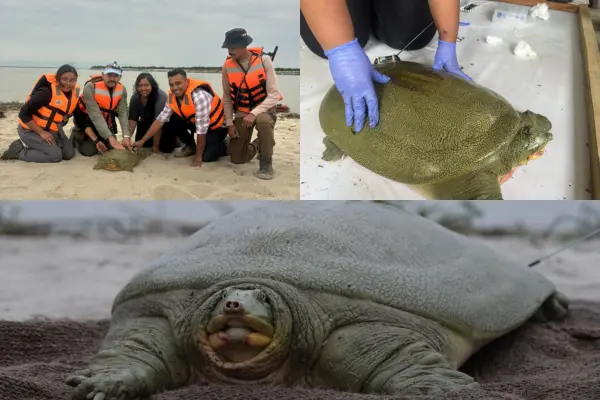
Recently, India’s first satellite-tagged Ganges soft-shell turtle was released in the 1,302 sq. km Kaziranga National Park and Tiger Reserve in Assam.
Significance of the Initiative:
-
-
- The satellite-tagging project aims to study the turtle’s seasonal movement patterns, habitat use, nesting areas, and breeding behaviour in the Brahmaputra river basin. The initiative was carried out by the Wildlife Institute of India in collaboration with the Assam Forest Department and Kaziranga National Park authorities, with funding support from the National Geographic Society.
- The project will help conservation authorities design better habitat management strategies and strengthen freshwater biodiversity conservation in Assam.
- The satellite-tagging project aims to study the turtle’s seasonal movement patterns, habitat use, nesting areas, and breeding behaviour in the Brahmaputra river basin. The initiative was carried out by the Wildlife Institute of India in collaboration with the Assam Forest Department and Kaziranga National Park authorities, with funding support from the National Geographic Society.
-
About the Ganges Soft-Shell Turtle:
The Ganges soft-shell turtle (Nilssonia gangetica) is a large freshwater turtle species native to South Asia. It is known for its flat leathery shell, long neck, and tubular snout that helps it breathe while remaining submerged underwater.
Key Characteristics:
-
-
- The turtle has an olive-green or dull green shell with yellow borders.
- It possesses a flattened and flexible shell that allows swift movement in water.
- It is one of the largest freshwater turtles in the world, with shell lengths reaching up to 94 cm.
- The species is omnivorous and scavenging in nature, feeding on fish, frogs, mollusks, aquatic plants, insects, and carrion.
- An important identifying feature is the arrowhead-shaped marking on the top of its head.
- The turtle has an olive-green or dull green shell with yellow borders.
-
Habitat and Distribution:
-
-
- The species is found across major river systems of South Asia, including:
- Ganga
- Brahmaputra
- Indus
- Yamuna
- Mahanadi
- Ganga
- It inhabits deep, slow-moving rivers, lakes, reservoirs, canals, and streams with sandy or muddy bottoms. In India, Assam is considered one of the world’s priority regions for freshwater turtle conservation. Out of the eight soft-shell turtle species found in India, five are reported from the Kaziranga landscape.
- The species is found across major river systems of South Asia, including:
-
Ecological Importance:
The Ganges soft-shell turtle plays a crucial ecological role as a river scavenger and predator. By feeding on dead and decaying organic matter, it helps maintain water quality and ecological balance in freshwater ecosystems.
Conservation Status:
-
-
- Listed as Vulnerable on the International Union for Conservation of Nature (IUCN) Red List.
- Protected under Schedule I of the Wildlife Protection Act, 1972.
- Included in Appendix I of Convention on International Trade in Endangered Species of Wild Fauna and Flora (CITES).
- Listed as Vulnerable on the International Union for Conservation of Nature (IUCN) Red List.
-
Major Threats:
The species faces several threats:
-
-
- Habitat destruction due to sand mining, dams, and river pollution.
- Accidental drowning in fishing nets.
- Illegal poaching for meat and traditional beliefs associated with turtle claws.
- Declining freshwater ecosystems due to human activities.
- Habitat destruction due to sand mining, dams, and river pollution.
-
Conclusion:
The satellite-tagging of the Ganges soft-shell turtle represents an important step in India’s freshwater conservation efforts. The initiative highlights the growing use of technology in wildlife management and underlines the importance of protecting river ecosystems and endangered aquatic species for long-term ecological sustainability.



