
India’s First Quantum Computing Testing Facility in Amaravati
Context:
Recently, Chief Minister of Andhra Pradesh N. Chandrababu Naidu inaugurated India’s first indigenous Quantum Computing Testing Facility and the “Amaravati Quantum Valley (AQV)” at Amaravati, located at SRM University Andhra Pradesh.
About Amaravati Quantum Valley:
-
-
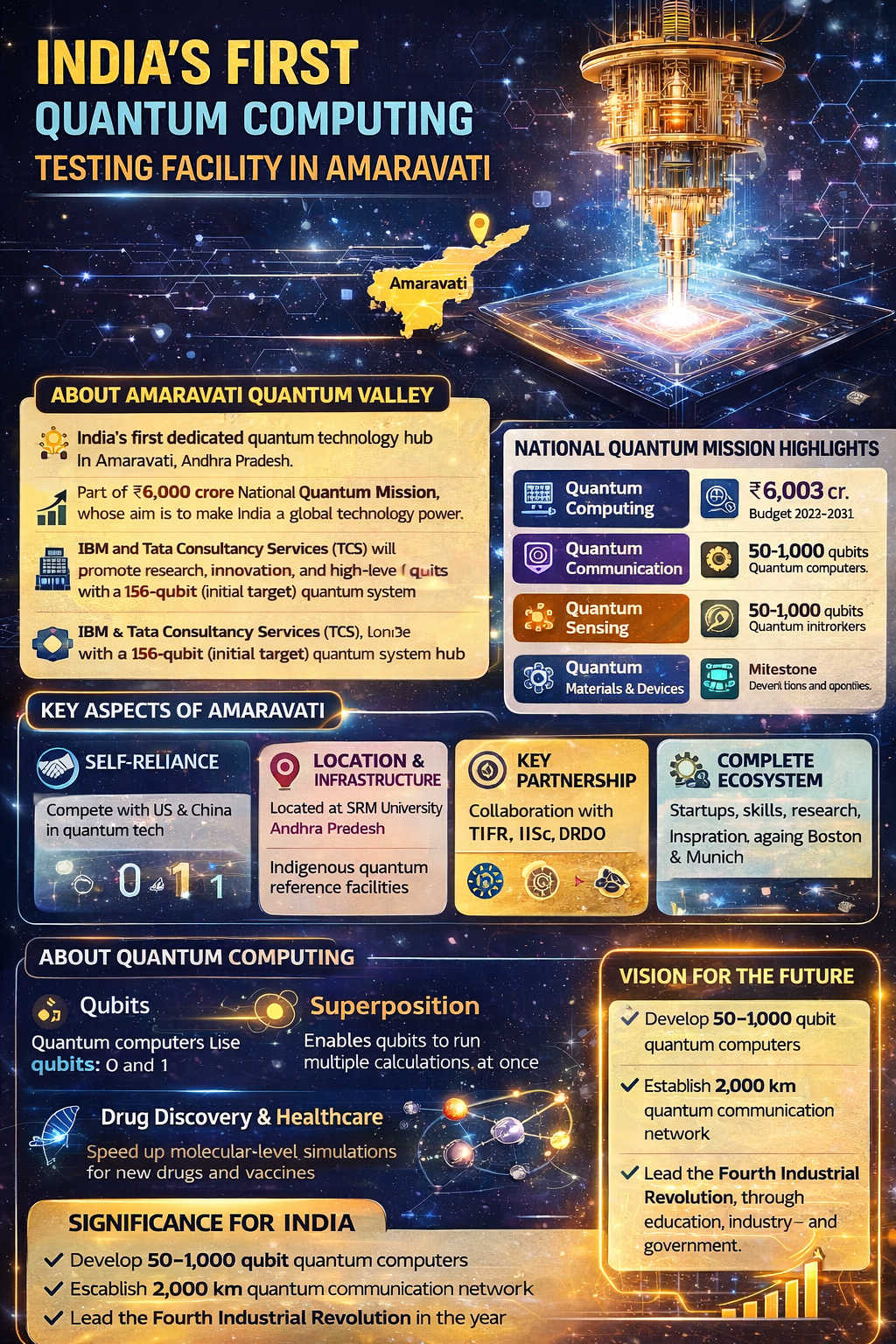
- Amaravati Quantum Valley is India’s first dedicated quantum technology hub established in Amaravati, Andhra Pradesh.
- It is part of the ₹6,000 crore National Quantum Mission, whose aim is to make India a global technological power.
- Along with companies like IBM and Tata Consultancy Services (TCS), it will promote research, innovation, and high-level training (AI, cybersecurity) with a 156-qubit (initial target) quantum system.
- Amaravati Quantum Valley is India’s first dedicated quantum technology hub established in Amaravati, Andhra Pradesh.
-
Key Aspects of Amaravati Quantum Valley:
-
-
- Objective: To make India self-reliant in quantum research and compete technologically with China and the United States.
- Location and Infrastructure: It is located at SRM University and Medha Towers in Gannavaram, where indigenous “quantum reference facilities” are being established.
- Key Partnership: It is being developed in collaboration with the Tata Institute of Fundamental Research (TIFR), the Indian Institute of Science (IISc), and the Defence Research and Development Organisation (DRDO).
- Feature: It focuses on developing a complete ecosystem (skills, research, startups), designed on the lines of global centers such as Boston and Munich.
- Objective: To make India self-reliant in quantum research and compete technologically with China and the United States.
-
About Quantum Computing:
Quantum computing uses principles of quantum mechanics to solve complex problems at extremely high speeds compared to classical computers.
-
-
- Qubits: While normal computers use 0 or 1 (bits), quantum computers use “qubits,” which can exist in both 0 and 1 states simultaneously.
- Superposition: It allows qubits to perform multiple calculations at the same time, greatly increasing processing power.
- Entanglement: In this phenomenon, the state of one qubit instantly affects another, no matter how far apart they are. This accelerates data transmission and computation.
- Qubits: While normal computers use 0 or 1 (bits), quantum computers use “qubits,” which can exist in both 0 and 1 states simultaneously.
-
Strategic and Economic Importance for India:
-
-
- Security and Cryptography: Quantum computers can challenge current encryption methods. A domestic testing facility will help India become self-reliant in developing “post-quantum cryptography.”
- Drug Discovery and Healthcare: Molecular-level simulations can reduce the time for discovering new drugs and vaccines from years to months.
- Logistics and Data: It will help optimize complex financial systems and supply chain management.
- Security and Cryptography: Quantum computers can challenge current encryption methods. A domestic testing facility will help India become self-reliant in developing “post-quantum cryptography.”
-
Challenges:
Currently, India is in the NISQ (Noisy Intermediate-Scale Quantum) era. This means quantum computers exist but are highly sensitive to external noise and environmental disturbances, causing errors (decoherence). Controlling these errors and increasing the number of qubits is the biggest engineering challenge today.
About the National Quantum Mission (NQM):
This achievement in Amaravati is part of India’s National Quantum Mission, approved by the central government in April 2023 with a budget of ₹6003.65 crore.
-
-
- Goals (2023–2031): To develop intermediate-scale quantum computers with 50 to 1,000 physical qubits within 8 years.
- Four Thematic Hubs (T-Hubs):
- Quantum Computing
- Quantum Communication
- Quantum Sensing and Metrology
- Quantum Materials and Devices
- Quantum Computing
- Major Achievements: India has already achieved milestones such as a 1,000 km secure quantum communication link. The mission aims to establish a 2,000 km inter-city Quantum Key Distribution (QKD) network by 2027.
- Goals (2023–2031): To develop intermediate-scale quantum computers with 50 to 1,000 physical qubits within 8 years.
-
Conclusion:
The launch of this testing facility in Amaravati is not just a state achievement, but a new identity of “Atmanirbhar Bharat” (self-reliant India). It is an excellent example of the collaboration between education, industry, and government, which will enable India to lead the Fourth Industrial Revolution in the coming years.



