
India’s First Green Methanol Plant at Kandla
Context:
India is developing its first green methanol production facility at the Deendayal Port Authority in Kandla, Gujarat. The plant is being developed by Thermax Limited using gasification technology from Ankur Scientific Energy Technologies.
Key Features of the Project:
-
-
- The project primarily uses invasive biomass as feedstock, especially Prosopis juliflora, locally known as Gando Baval in Gujarat and Vilayati Keekar in North India. This plant has heavily spread across the Kutch’s Banni grasslands, covering large areas, displacing native grasses, and reducing biodiversity, making it an ecological challenge that is now being repurposed for clean energy production.
- The project is located at Kandla Port in Gujarat and has a production capacity of around 5 tonnes of methanol per day. Its main objective is to support India’s transition toward green ports and promote the use of clean shipping fuels, aligning with broader sustainability and decarbonisation goals.
- The technology used involves two main stages: gasification and methanol synthesis. In gasification, the biomass is heated without oxygen to produce syngas, a mixture of hydrogen, carbon monoxide, and carbon dioxide. This syngas is then processed in the second stage to produce green methanol, a cleaner alternative fuel.
- The project primarily uses invasive biomass as feedstock, especially Prosopis juliflora, locally known as Gando Baval in Gujarat and Vilayati Keekar in North India. This plant has heavily spread across the Kutch’s Banni grasslands, covering large areas, displacing native grasses, and reducing biodiversity, making it an ecological challenge that is now being repurposed for clean energy production.
-
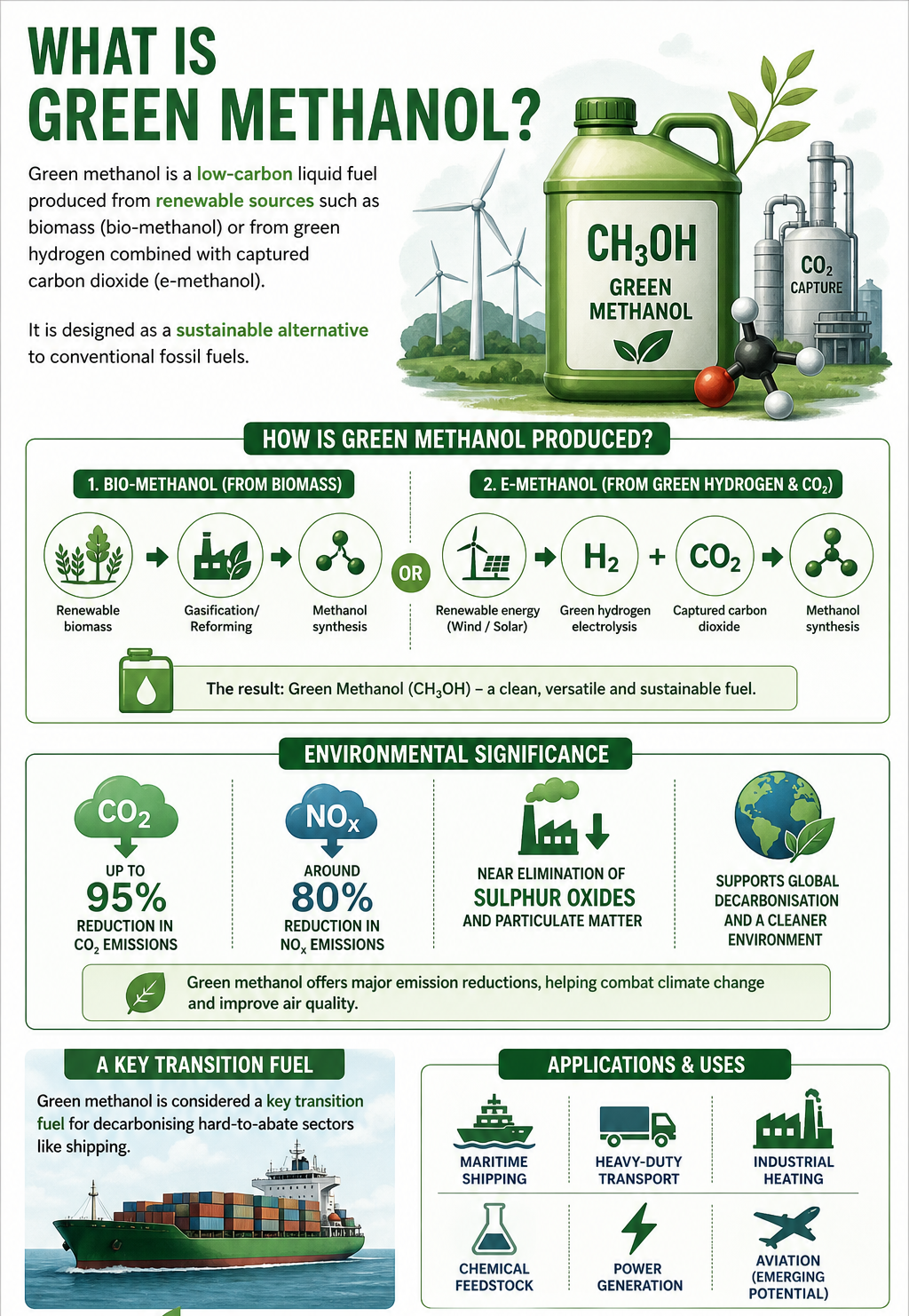
What is Green Methanol?
Green methanol is a low-carbon liquid fuel produced from renewable sources such as biomass (bio-methanol) or from green hydrogen combined with captured carbon dioxide (e-methanol). It is designed as a sustainable alternative to conventional fossil fuels.
Environmental Significance
-
-
- Green methanol offers major emission reductions:
- Up to 95% reduction in CO₂ emissions
- Around 80% reduction in NOₓ emissions
- Near elimination of sulphur oxides and particulate matter
- Up to 95% reduction in CO₂ emissions
- It is considered a key transition fuel for decarbonising hard-to-abate sectors like shipping.
- Green methanol offers major emission reductions:
-
Policy and Global Context:
-
-
- Maritime Decarbonisation
- Aligns with regulations of the International Maritime Organization
- Supports IMO target of net-zero emissions by 2050
- Aligns with regulations of the International Maritime Organization
- Green Port Strategy
- India is upgrading major ports into low-emission “green ports”
- Kandla project is a model for circular economy-based port development
- India is upgrading major ports into low-emission “green ports”
- Maritime Decarbonisation
-
Economic and Strategic Importance:
-
-
- Waste-to-Wealth Model
- Converts invasive biomass into valuable energy fuel
- Supports circular economy principles
- Converts invasive biomass into valuable energy fuel
- Energy Security
- Reduces dependence on imported fossil fuels
- Biomass-based fuels can partially replace crude oil imports
- Reduces dependence on imported fossil fuels
- Industrial Opportunity
- Potential expansion using:
- Agricultural residues (bagasse, cotton stalk)
- Municipal solid waste
- Agricultural residues (bagasse, cotton stalk)
- Potential expansion using:
- Waste-to-Wealth Model
-
Challenges:
-
-
- High production cost compared to fossil methanol
- Limited large-scale infrastructure
- Supply chain logistics for biomass collection
- Technology scaling from pilot (5 TPD) to industrial scale
- High production cost compared to fossil methanol
-
Significance for India:
-
-
- First step toward green maritime fuel ecosystem
- Aligns with:
- Net Zero commitments
- National Bioenergy strategy
- Clean port modernization
- Net Zero commitments
- Demonstrates innovative use of invasive species for climate action
- First step toward green maritime fuel ecosystem
-
Conclusion:
The Kandla green methanol project represents a unique convergence of environmental restoration, clean energy innovation, and maritime decarbonisation. By transforming the invasive Prosopis juliflora into sustainable fuel, India is advancing toward a circular and low-carbon economy while addressing ecological degradation in regions like Kutch. If successfully scaled, this model could redefine how waste biomass and invasive species are integrated into national energy systems.



