
Context:
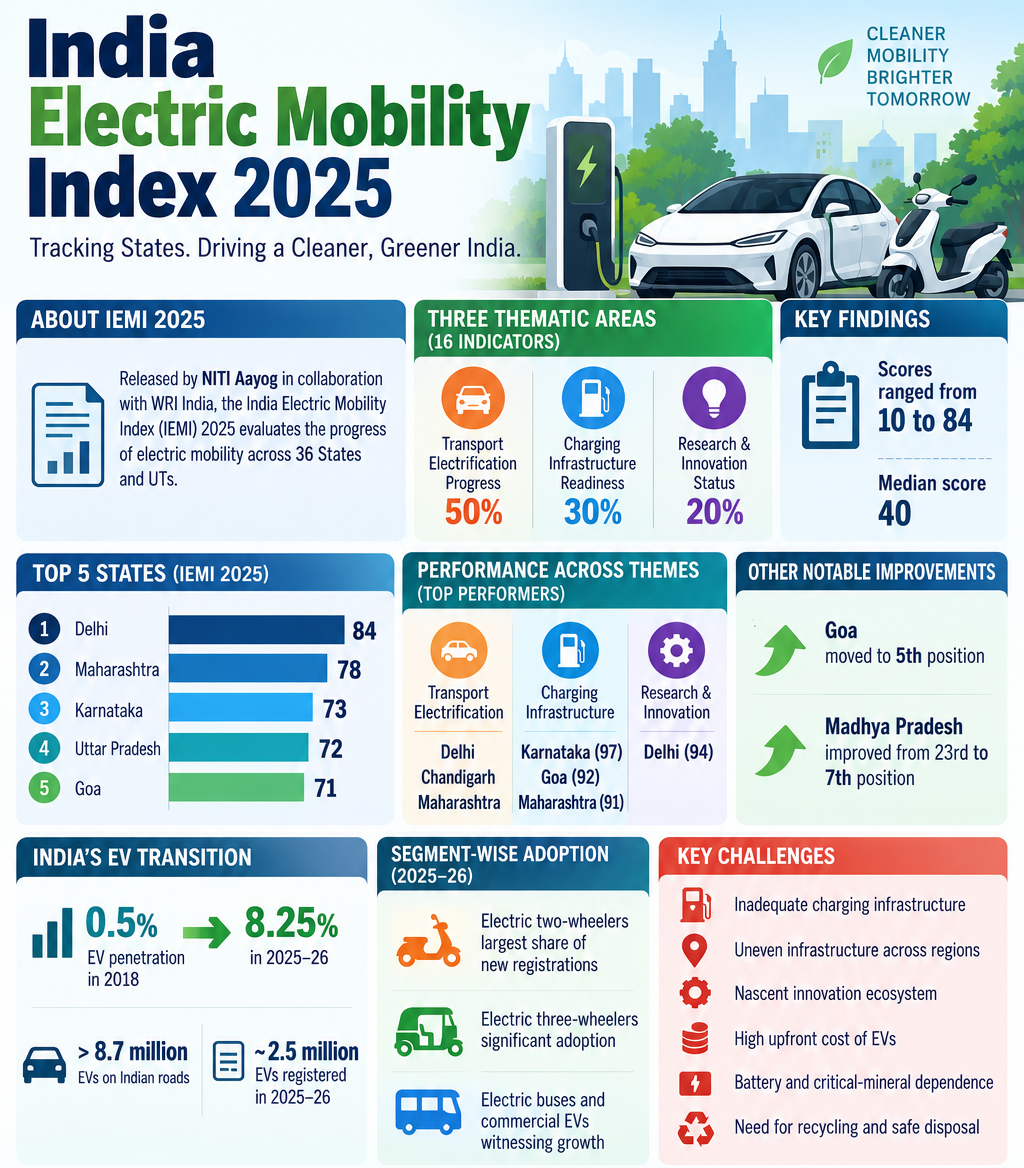
Recently, NITI Aayog released the India Electric Mobility Index (IEMI) 2025, developed in collaboration with WRI India. It is a first-of-its-kind index that evaluates the progress of electric mobility across India's 36 States and Union Territories, covering policy implementation, EV adoption, charging infrastructure and innovation.
About the IEMI:
-
-
- The IEMI is a composite index based on 16 performance indicators grouped into three thematic areas:
- Transport Electrification Progress – 50%
- Charging Infrastructure Readiness – 30%
- EV Research & Innovation Status – 20%
- Transport Electrification Progress – 50%
- Scores are updated annually using the outcomes of quarterly assessments, enabling comparison of the evolving e-mobility ecosystem across States and UTs.
- The IEMI is a composite index based on 16 performance indicators grouped into three thematic areas:
-
Key Findings:
-
-
- The composite scores ranged from 10 to 84, with a median score of 40.
- Delhi topped the index with a score of 84.
- Maharashtra ranked second with 78.
- Karnataka ranked third with 73.
- Goa climbed significantly to the fifth position.
- Madhya Pradesh improved from 23rd to 7th position.
- Among large States, Tamil Nadu, Madhya Pradesh, Odisha, Andhra Pradesh, Telangana, Haryana, Rajasthan and Uttar Pradesh were classified as frontrunners, while Chhattisgarh, West Bengal, Bihar, Kerala, Jharkhand, Punjab and Gujarat were categorised as emerging performers.
- The composite scores ranged from 10 to 84, with a median score of 40.
-
Performance across Themes:
-
-
- Transport Electrification: Delhi, Chandigarh and Maharashtra were the top performers, reflecting stronger EV adoption and consumer demand.
- Charging Infrastructure: Karnataka recorded the highest score of 97, followed by Goa (92) and Maharashtra (91). The category considers charger availability, subsidies, electricity access and building regulations.
- Research and Innovation: Delhi led with a score of 94, reflecting its performance in EV startups, R&D and patents.
- Transport Electrification: Delhi, Chandigarh and Maharashtra were the top performers, reflecting stronger EV adoption and consumer demand.
-
Status of India’s EV Transition:
-
-
- India's EV penetration increased from 0.5% in 2018 to 8.25% in 2025–26. More than 8.7 million EVs were on Indian roads, while around 2.5 million EVs were registered during 2025–26.
- Electric two-wheelers constituted the largest share of new registrations, while electric three-wheelers also recorded significant adoption. Electric buses and commercial electric vehicles are witnessing growing deployment.
- India's EV penetration increased from 0.5% in 2018 to 8.25% in 2025–26. More than 8.7 million EVs were on Indian roads, while around 2.5 million EVs were registered during 2025–26.
-
Major Challenges:
-
-
- Inadequate charging infrastructure
- Uneven infrastructure across regions
- Dispersed settlements
- Nascent EV innovation ecosystem
- High upfront cost of EVs
- Battery and critical-mineral dependence
- Need for recycling and safe battery disposal
- Inadequate charging infrastructure
-
Government Initiatives:
Important measures include PLI-Auto, e-AMRIT, PM E-DRIVE and PM-eBus Sewa–Payment Security Mechanism Scheme. These initiatives seek to promote EV adoption, domestic manufacturing, charging infrastructure and electric public transport.
Way Forward:
India needs to develop interoperable and geographically distributed charging networks, promote domestic battery and component manufacturing, strengthen R&D, establish robust battery-recycling systems and provide predictable long-term policy support. Greater electrification of public transport and commercial fleets can generate substantial environmental benefits.
Conclusion:
The IEMI provides a useful state-level evidence-based framework for tracking India's electric mobility transition. However, achieving India's broader EV and climate objectives will require not only higher EV sales but also reliable charging infrastructure, domestic manufacturing, technological innovation and sustainable battery ecosystems.



