
Context:
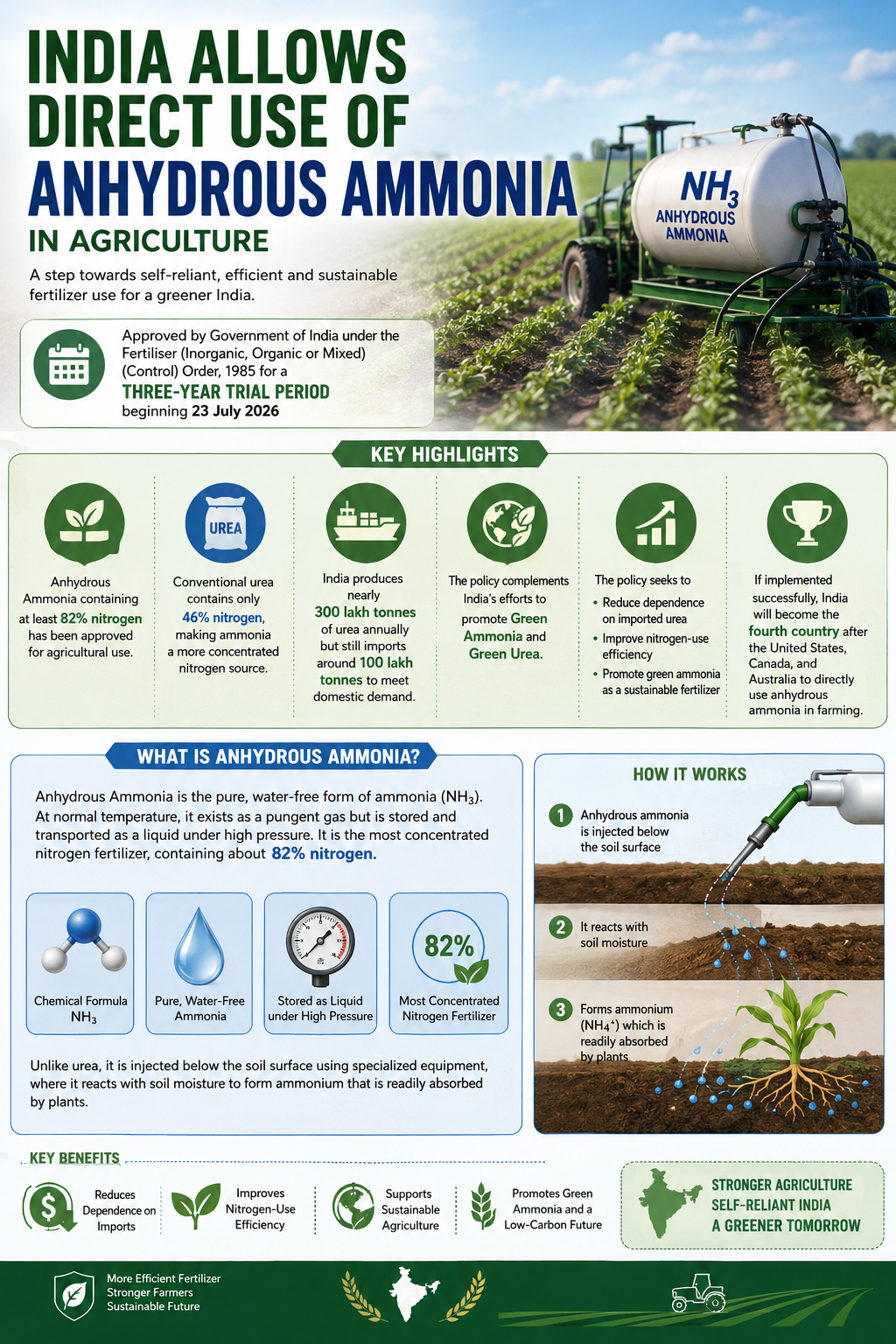
Recently, The Government of India has approved the manufacture and direct agricultural use of Anhydrous Ammonia (NH₃) under the Fertiliser (Inorganic, Organic or Mixed) (Control) Order, 1985 for a three-year trial period beginning 23 July 2026.
Key Highlights:
-
-
- Anhydrous Ammonia containing at least 82% nitrogen has been approved for agricultural use.
- Conventional urea contains only 46% nitrogen, making ammonia a more concentrated nitrogen source.
- India produces nearly 300 lakh tonnes of urea annually but still imports around 100 lakh tonnes to meet domestic demand.
- The policy complements India's efforts to promote Green Ammonia and Green Urea.
- The policy seeks to reduce dependence on imported urea, improve nitrogen-use efficiency, and promote green ammonia as a sustainable fertilizer.
- If implemented successfully, India will become the fourth country after the United States, Canada, and Australia to directly use anhydrous ammonia in farming.
- Anhydrous Ammonia containing at least 82% nitrogen has been approved for agricultural use.
-
What is Anhydrous Ammonia?
Anhydrous Ammonia is the pure, water-free form of ammonia (NH₃). At normal temperature, it exists as a pungent gas but is stored and transported as a liquid under high pressure. It is the most concentrated nitrogen fertilizer, containing about 82% nitrogen. Unlike urea, it is injected below the soil surface using specialized equipment, where it reacts with soil moisture to form ammonium that is readily absorbed by plants.
Significance:
The approval offers several advantages:
-
-
- Higher Nitrogen Use Efficiency (NUE) due to greater nitrogen concentration.
- Reduced dependence on imported urea and natural gas, improving fertilizer security.
- Lower fertilizer subsidy burden by reducing urea production costs.
- Supports the National Green Hydrogen Mission by encouraging production and use of Green Ammonia.
- Promotes sustainable agriculture and strengthens India's goal of Atmanirbhar Bharat in fertilizers.
- Higher Nitrogen Use Efficiency (NUE) due to greater nitrogen concentration.
-
Challenges:
-
-
- Despite its benefits, widespread adoption faces several hurdles:
- Infrastructure Gap: India lacks adequate storage facilities, transport systems, and ammonia injection equipment.
- Safety Risks: Anhydrous ammonia is a toxic and corrosive gas requiring strict handling and safety protocols.
- Complex Application: It must be injected beneath the soil, unlike urea, making mechanized application essential.
- Small Landholdings: India's fragmented farms make adoption difficult without shared machinery and institutional support.
- High Investment: A large-scale green ammonia plant requires investments of ₹13,000–15,000 crore.
- Infrastructure Gap: India lacks adequate storage facilities, transport systems, and ammonia injection equipment.
- Despite its benefits, widespread adoption faces several hurdles:
-
Conclusion:
The approval of anhydrous ammonia marks a significant shift in India's fertilizer policy. By improving nitrogen efficiency, reducing import dependence, and supporting green hydrogen initiatives, the reform can transform Indian agriculture. However, success will depend on robust infrastructure, effective safety measures, and widespread farmer awareness to ensure sustainable and efficient adoption.



