
Context:
In recent times, India’s cold-water fisheries sector is rapidly emerging as a significant component of the Blue Economy, with strong growth concentrated in the Himalayan and North Eastern regions.
About Cold-water fisheries:
-
-
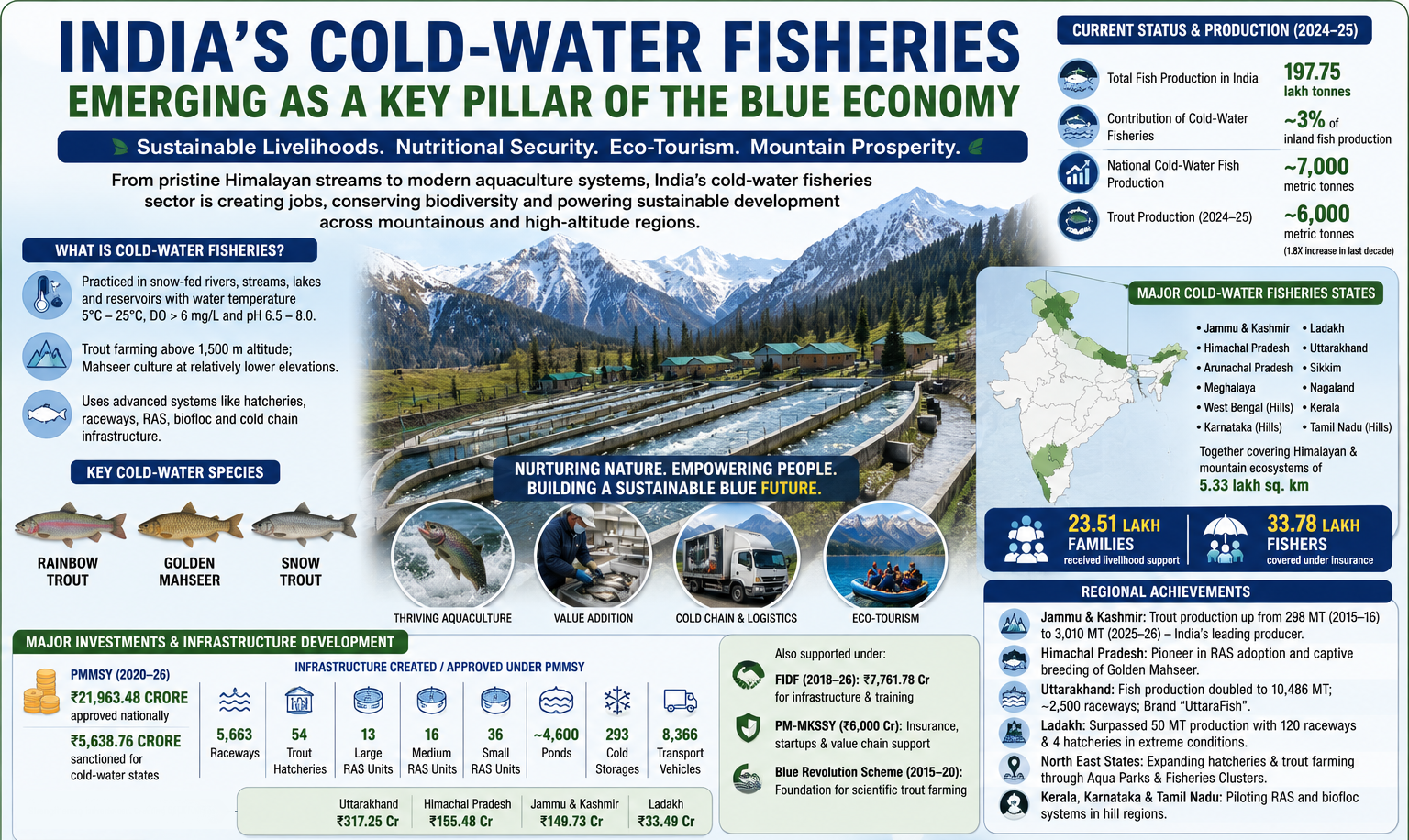
- Cold-water fisheries are practised in high-altitude rivers, streams, lakes, and reservoirs where water temperature ranges between 5°C to 25°C, dissolved oxygen remains above 6 mg/L, and pH levels range from 6.5 to 8.0.
- These ecosystems are spread across Jammu & Kashmir, Ladakh, Himachal Pradesh, Uttarakhand, Arunachal Pradesh, Sikkim, Meghalaya, and Nagaland, along with hill regions of West Bengal, Kerala, Karnataka, and Tamil Nadu. Collectively, they cover over 533,000 sq. km of mountainous terrain.
- India has identified more than 278 cold-water fish species, highlighting their ecological and conservation importance.
- Cold-water fisheries are practised in high-altitude rivers, streams, lakes, and reservoirs where water temperature ranges between 5°C to 25°C, dissolved oxygen remains above 6 mg/L, and pH levels range from 6.5 to 8.0.
-
Production Status and Contribution:
-
-
- Although cold-water fisheries account for only about 3% of India’s total fish production, their importance is growing steadily. India’s total fish production reached 197.75 lakh tonnes in 2024–25, doubling since 2013–14.
- Cold-water fish production stands at around 7,000 metric tonnes, with trout contributing nearly 6,000 metric tonnes. Key species include rainbow trout, snow trout, and golden mahseer, which are cultivated using modern systems such as hatcheries, raceways, recirculating aquaculture systems (RAS), and biofloc technology.
- Jammu & Kashmir leads trout production with about 3,010 metric tonnes, followed by Himachal Pradesh and Uttarakhand.
- Although cold-water fisheries account for only about 3% of India’s total fish production, their importance is growing steadily. India’s total fish production reached 197.75 lakh tonnes in 2024–25, doubling since 2013–14.
-
Government Support and PMMSY:
-
-
- The government has provided strong policy support through the Pradhan Mantri Matsya Sampada Yojana (PMMSY), under which more than 25% of total scheme funds have been allocated for cold-water fisheries. Investments include construction of hatcheries, raceways, RAS units, cold storage facilities, ponds, and transport infrastructure.
- These interventions have significantly boosted infrastructure development in Himalayan and North Eastern regions.
- The government has provided strong policy support through the Pradhan Mantri Matsya Sampada Yojana (PMMSY), under which more than 25% of total scheme funds have been allocated for cold-water fisheries. Investments include construction of hatcheries, raceways, RAS units, cold storage facilities, ponds, and transport infrastructure.
-
Technological and Infrastructure Development:
-
-
- Modern aquaculture practices are transforming the sector. Technologies such as RAS, biofloc systems, and cold-chain logistics are improving productivity and sustainability. Trout farming is typically practised above 1,500 metres altitude, while mahseer farming is suitable at lower elevations.
- Infrastructure development includes hatcheries, transport vehicles, and cold storage systems to ensure efficient production and marketing.
- Modern aquaculture practices are transforming the sector. Technologies such as RAS, biofloc systems, and cold-chain logistics are improving productivity and sustainability. Trout farming is typically practised above 1,500 metres altitude, while mahseer farming is suitable at lower elevations.
-
About India’s Fisheries Sector:
-
-
- India is the second-largest fish producer in the world, contributing about 8% of global output. The sector supports nearly 3 crore livelihoods and contributes 7.43% of agricultural GVA and about 1.1% of GDP. Inland fisheries now account for over 75% of total production, marking a structural shift in the sector.
- India also ranks first globally in shrimp production and achieved seafood exports worth ₹62,408 crore in 2024–25.
- India is the second-largest fish producer in the world, contributing about 8% of global output. The sector supports nearly 3 crore livelihoods and contributes 7.43% of agricultural GVA and about 1.1% of GDP. Inland fisheries now account for over 75% of total production, marking a structural shift in the sector.
-
Conclusion:
India’s cold-water fisheries sector, though small in volume, holds immense strategic importance. It strengthens the Blue Economy, promotes sustainable development in fragile Himalayan ecosystems, and enhances rural livelihoods. With strong policy support and technological integration, it is poised to become a key driver of inclusive and sustainable economic growth in the coming years.



