
Context:
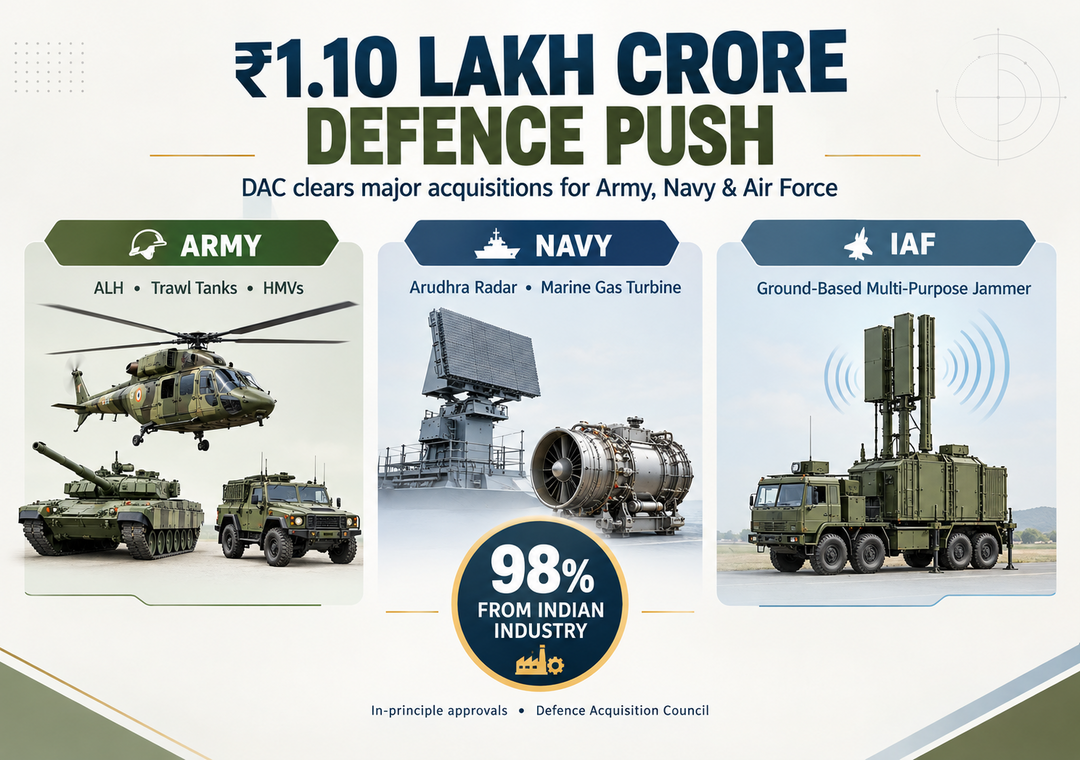
Recently, The Defence Acquisition Council (DAC), chaired by Defence Minister Rajnath Singh, accorded Acceptance of Necessity (AoN), in-principle administrative approval, to defence acquisition proposals worth about ₹1.10 lakh crore for the Army, Navy and Air Force. Around 98% of the approved procurements will be sourced from Indian industry, giving a major boost to defence indigenisation.
Defence Acquisition Council (DAC):
-
-
- The DAC is the highest decision-making body within the Ministry of Defence for major defence procurement and capital-acquisition matters. It was established in 2001 following the recommendations of the Group of Ministers on “Reforming the National Security System” after the Kargil War.
- It is chaired by the Union Defence Minister and covers the procurement requirements of the Armed Forces, including the Army, Navy, Air Force and Indian Coast Guard.
- The DAC is the highest decision-making body within the Ministry of Defence for major defence procurement and capital-acquisition matters. It was established in 2001 following the recommendations of the Group of Ministers on “Reforming the National Security System” after the Kargil War.
-
Core Mandate and Functions:
The DAC seeks to ensure timely procurement of military equipment, balance operational requirements with available resources and promote Atmanirbhar Bharat in defence.
Its key functions include:
-
-
- Acceptance of Necessity (AoN): Provides the mandatory in-principle approval before major procurement proceeds further.
- Procurement route: Determines acquisition categories under the Defence Acquisition Procedure (DAP), including Buy (Indian-IDDM), Buy & Make and Make.
- Long-term planning: Provides approvals and direction for long-term capability-development plans.
- Policy formulation: Recommends changes to procurement procedures to improve transparency, efficiency and indigenisation.
- Acceptance of Necessity (AoN): Provides the mandatory in-principle approval before major procurement proceeds further.
-
Major Acquisitions:
-
-
- Indian Army: Approvals include CBRN reconnaissance vehicles, High Mobility Vehicles, Self-Propelled Mechanical Mine Layers, Advanced Light Helicopters, Trawl Tanks and the Sarvatra Bridge System. These will improve mobility, logistics, CBRN preparedness and battlefield manoeuvrability.
- Indian Navy: The Navy received approval for Arudhra Radars and the design, development and subsequent procurement of Marine Gas Turbines. Indigenous MGTs can reduce dependence on foreign suppliers for critical warship propulsion.
- Indian Air Force: Approvals cover capabilities for fighters, transport aircraft and helicopters, along with Ground-Based Multi-Purpose Jammers (GBMPJs) and the Defence Forces Secure Access Card (DEFSAC) system.
- Indian Army: Approvals include CBRN reconnaissance vehicles, High Mobility Vehicles, Self-Propelled Mechanical Mine Layers, Advanced Light Helicopters, Trawl Tanks and the Sarvatra Bridge System. These will improve mobility, logistics, CBRN preparedness and battlefield manoeuvrability.
-
Significance for Atmanirbhar Bharat:
The approximately 98% Indian sourcing is the most significant aspect of the decision. It can:
-
-
- Reduce dependence on foreign defence suppliers.
- Strengthen domestic defence manufacturing.
- Promote indigenous R&D and critical technologies.
- Generate employment and strengthen MSMEs.
- Enhance India's strategic autonomy.
- Support future defence exports.
- Reduce dependence on foreign defence suppliers.
-
India's defence production has already reached a record ₹1.78 lakh crore in FY 2025–26, while defence exports reached ₹38,424 crore, indicating the expanding domestic defence ecosystem.
Conclusion:
The ₹1.10 lakh crore approvals represent more than military modernisation. With 98% domestic sourcing, they advance India's twin objectives of operational preparedness and strategic self-reliance. Sustained investment in indigenous design, R&D and critical technologies will be essential for transforming India from a major defence importer into a globally competitive defence technology and manufacturing power.



