
Context:
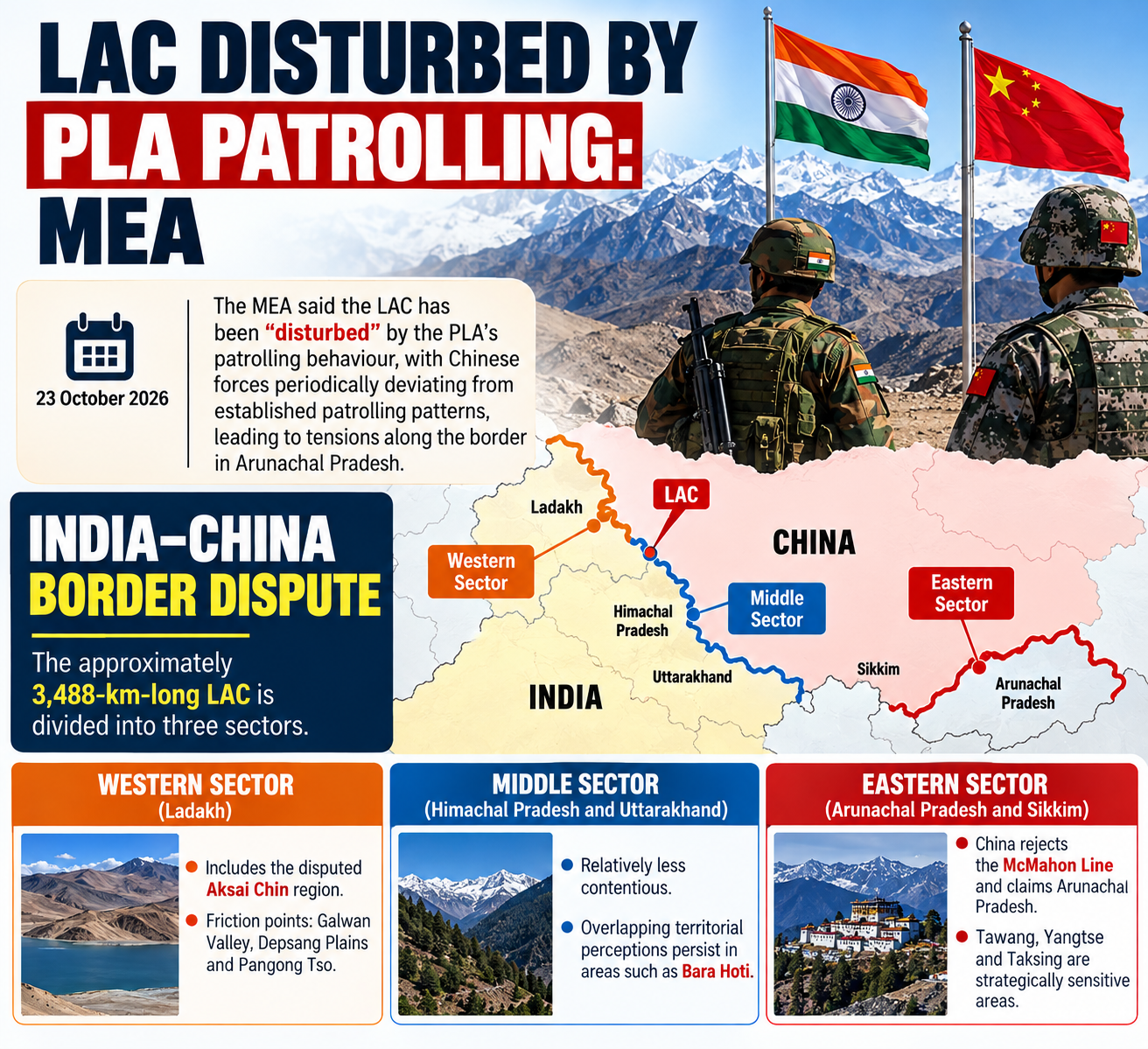
Recently, The Line of Actual Control (LAC) has been “disturbed” by the People’s Liberation Army’s (PLA) patrolling behaviour, the Ministry of External Affairs (MEA) said on 23 October 2026, responding to report on skirmishes along the LAC in Arunachal Pradesh. The MEA stated that Chinese forces periodically deviate from established patrolling patterns, causing tensions along the border.
About India–China Border Dispute:
-
-
- The approximately 3,488-km-long LAC is divided into three sectors:
- Western Sector (Ladakh): Includes the disputed Aksai Chin region and friction points such as Galwan Valley, Depsang Plains and Pangong Tso.
- Middle Sector (Himachal Pradesh and Uttarakhand): Relatively less contentious, although overlapping territorial perceptions persist in areas such as Bara Hoti.
- Eastern Sector (Arunachal Pradesh and Sikkim): China rejects the McMahon Line and claims Arunachal Pradesh. Tawang, Yangtse and Taksing are strategically sensitive areas.
- The approximately 3,488-km-long LAC is divided into three sectors:
-
Why Does the Border Remain Unstable?
-
-
- Lack of demarcation: The LAC is not mutually delineated on maps throughout its length, leading to differing perceptions of territorial control.
- Infrastructure competition: Roads, bridges, airfields and communication networks enable faster troop mobilisation.
- Strategic rivalry: Both countries seek to protect their territorial claims and strengthen their strategic positions.
- Trust deficit: The 2020 Galwan Valley clash intensified mistrust despite subsequent diplomatic efforts and disengagement arrangements.
- Lack of demarcation: The LAC is not mutually delineated on maps throughout its length, leading to differing perceptions of territorial control.
-
India’s Counter-Measures:
-
-
- ITBP modernisation: Shaurya Commandos have been deployed to strengthen responses to close-quarter confrontations.
- Drone surveillance: ITBP has established drone platoons in its border units to improve monitoring.
- Specialised training: The new ‘Strike’ course aims to prepare personnel for Galwan-like confrontations.
- Infrastructure development: Border roads, tunnels, bridges and advanced landing grounds improve logistics and operational readiness.
- ITBP modernisation: Shaurya Commandos have been deployed to strengthen responses to close-quarter confrontations.
-
Implications for India:
-
-
- National security: Persistent face-offs increase the risk of escalation and require sustained military preparedness.
- Diplomatic relations: Border tensions undermine efforts to normalise bilateral ties.
- Economic security: Dependence on Chinese imports and the widening trade deficit raise concerns about supply-chain vulnerabilities.
- Governance: The reported removal of the ITBP chief’s video triggered Opposition allegations of information suppression. However, the reason for its removal has not been established.
- National security: Persistent face-offs increase the risk of escalation and require sustained military preparedness.
-
Institutional Mechanisms:
-
-
- WMCC: Facilitates diplomatic consultation on border affairs.
- Special Representatives mechanism: Addresses the broader boundary question.
- Corps Commander-level talks: Help manage military tensions and disengagement.
- Border Personnel Meetings: Enable communication between local military formations.
- WMCC: Facilitates diplomatic consultation on border affairs.
-
Way Forward:
-
-
- Clarify the LAC: Revive efforts to exchange maps and address differing perceptions of patrol limits.
- Strengthen deterrence: Accelerate strategic infrastructure development, including the proposed Arunachal Frontier Highway.
- Leverage technology: Expand drone surveillance, counter-drone systems and technology-assisted threat detection.
- Sustain dialogue: Use diplomatic and military mechanisms to prevent miscalculations.
- Enhance cooperation: Engage the Quad—India, the US, Japan and Australia—on regional stability while maintaining strategic autonomy.
- Ensure transparency: Communicate verified information without compromising operational security.
- Clarify the LAC: Revive efforts to exchange maps and address differing perceptions of patrol limits.
-
Conclusion:
Recurring face-offs demonstrate that diplomatic engagement alone cannot eliminate border friction. India needs a balanced approach combining military preparedness, modern infrastructure, technological surveillance and sustained dialogue.