
India’s Progress in Reducing Child Mortality: Trends & Data
Context:
The report titled “Levels and Trends in Child Mortality” (2025) was recently released by the United Nations Inter-agency Group for Child Mortality Estimation. The report highlighted both significant global achievements and emerging concerns regarding child survival.
About Child mortality:
Child mortality is the death of children under the age of five, often measured as the rate per 1,000 live births (under-five mortality rate). It serves as a vital indicator of a country's living conditions, healthcare quality, and nutrition.
Key findings:
Globally, an estimated 4.9 million children died before the age of five in 2024, including 2.3 million newborns, although this marks a significant reduction compared to previous decades.
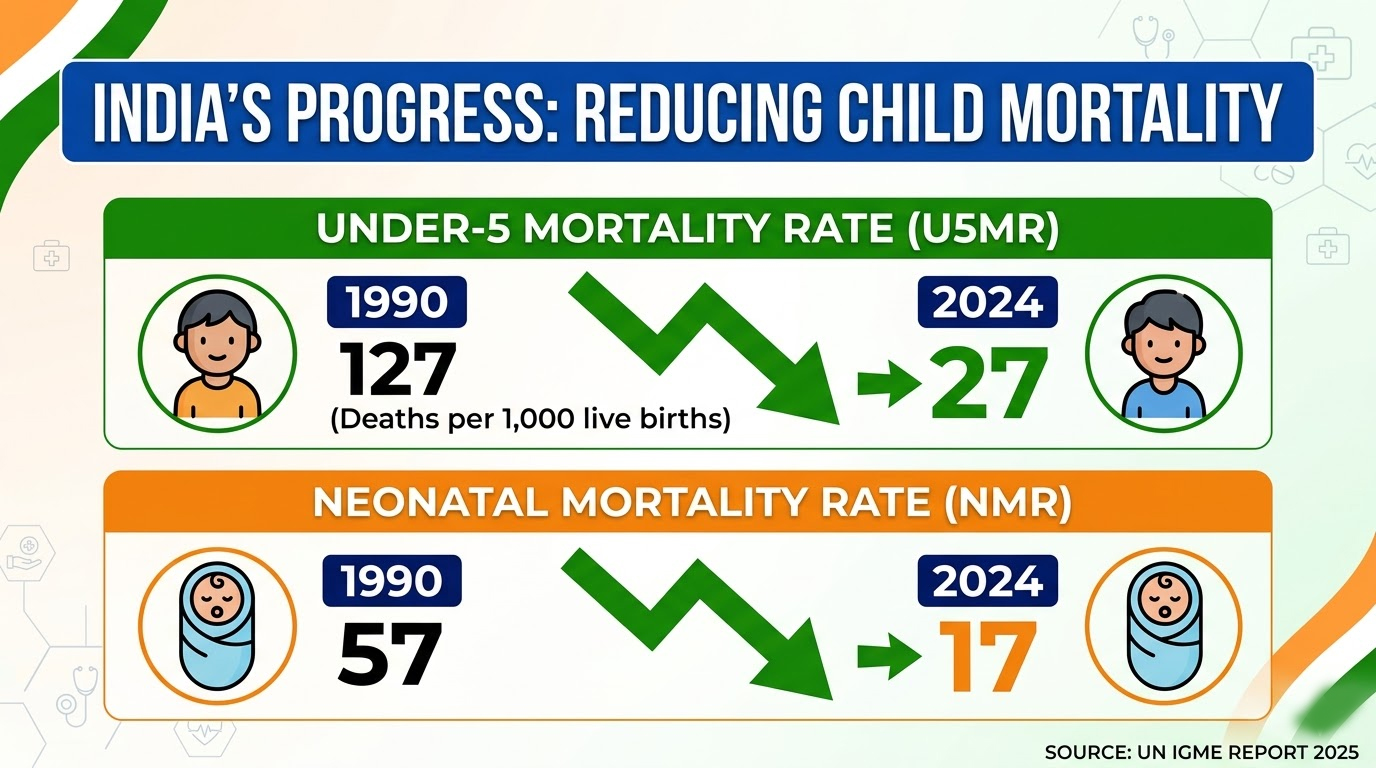
India’s Achievements:
India has made remarkable strides in reducing child mortality over the past three decades. According to the report:
-
- The Under-5 Mortality Rate (U5MR) declined sharply from 127 deaths per 1,000 live births in 1990 to 27 in 2024.
- The Neonatal Mortality Rate (NMR) dropped from 57 per 1,000 live births in 1990 to 17 in 2024.
- The Under-5 Mortality Rate (U5MR) declined sharply from 127 deaths per 1,000 live births in 1990 to 27 in 2024.
This progress reflects systematic and sustained improvements in public health infrastructure and service delivery. India has also played a crucial role in reducing child mortality across the South Asian region, contributing significantly to regional gains.
Several factors have driven this success:
-
- Expansion of institutional deliveries, reducing risks during childbirth
- Increased immunisation coverage, protecting children from preventable diseases
- Strengthening of primary healthcare systems, especially in rural areas
- Focused maternal and child health programmes under the Ministry of Health and Family Welfare
- Expansion of institutional deliveries, reducing risks during childbirth
Initiatives such as Janani Suraksha Yojana, Mission Indradhanush, and improvements in neonatal care have helped address both pre-birth and post-birth risks. These efforts demonstrate how policy continuity and targeted interventions can yield long-term health outcomes.
Global Trends:
Despite global progress, the report highlights a concerning slowdown in reducing child mortality. While under-five deaths have declined by more than half since 2000, the rate of decline has slowed by over 60% since 2015.
Several key challenges persist:
-
- Newborn deaths account for nearly half of all under-five deaths
- Preventable causes remain dominant, including infections and birth complications
- Regional disparities are stark, with Sub-Saharan Africa accounting for 58% of global under-five deaths
- Newborn deaths account for nearly half of all under-five deaths
Conclusion:
India’s progress in reducing child mortality represents a major public health success story, especially in the context of a global slowdown. The sharp decline in under-five and neonatal mortality rates reflects the impact of sustained policy efforts, improved healthcare delivery, and targeted interventions.



