
Context:
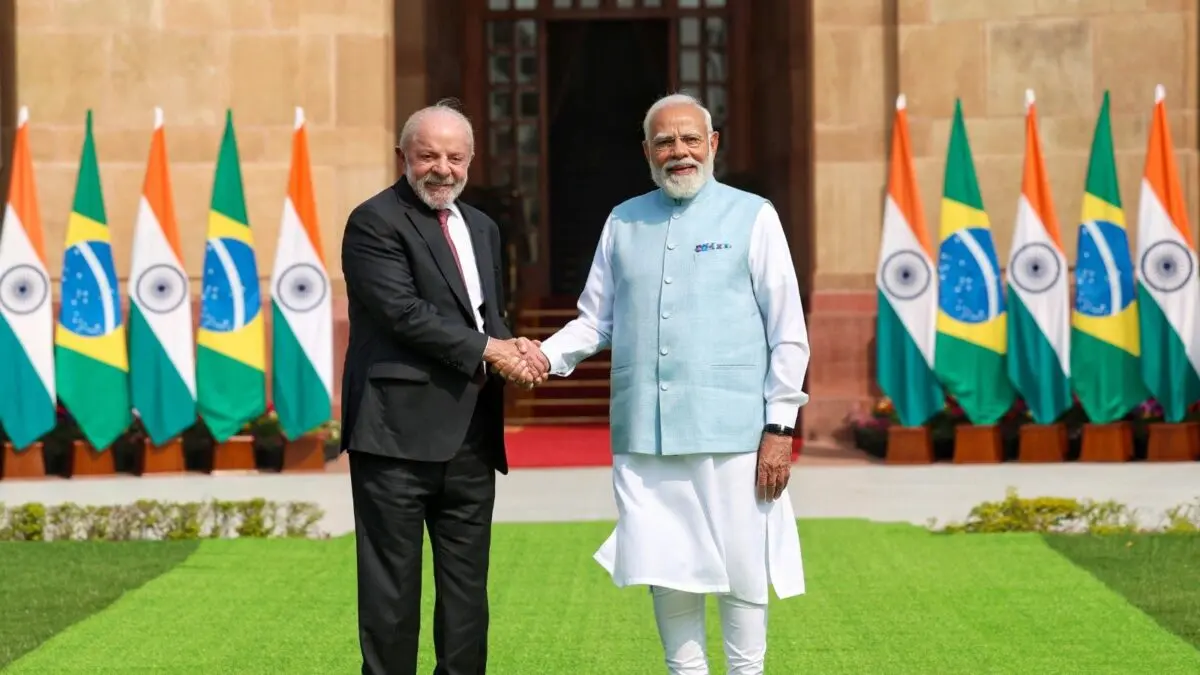
Recently, India and Brazil have set an ambitious target to raise bilateral trade to USD 30 billion by 2030, alongside signing agreements on critical minerals and rare earth cooperation. The development marks a significant step in strengthening ties between two major emerging economies of the Global South. Brazil President Mr. Luiz Inacio Lula da Silva was on a visit to India during the India AI Impact Summit 2026.
Background:
-
-
- India and Brazil established diplomatic relations in 1948, and their partnership has evolved into a Strategic Partnership covering trade, defence, energy, and multilateral cooperation. Brazil is India’s largest trading partner in Latin America, with bilateral trade fluctuating between USD 12–15 billion in recent years.
- The new target seeks to more than double trade by the end of the decade, reflecting growing economic complementarities.
- India and Brazil established diplomatic relations in 1948, and their partnership has evolved into a Strategic Partnership covering trade, defence, energy, and multilateral cooperation. Brazil is India’s largest trading partner in Latin America, with bilateral trade fluctuating between USD 12–15 billion in recent years.
-
About Mineral and Strategic Agreements:
A key outcome of recent engagements is the signing of a Memorandum of Understanding (MoU) on critical and rare earth minerals.
Significance:
-
-
- Diversifies India’s mineral supply chains.
- Reduces overdependence on dominant global suppliers.
- Supports India’s renewable energy, EV, semiconductor and defence manufacturing sectors.
- Strengthens cooperation in exploration, processing and technology transfer.
- Brazil possesses substantial reserves of rare earth elements and strategic minerals essential for clean energy technologies and high-tech industries.
- Diversifies India’s mineral supply chains.
-
Trade and Economic Relations:
-
-
- Brazil is India’s largest trading partner in Latin America, with bilateral trade fluctuating between $12–15 billion in recent years.
- India’s exports to Brazil mainly include organic chemicals, pharmaceuticals, diesel, engineering goods (auto components, electrical and mechanical equipment), iron & steel, textiles, plastics and ceramics.
- India’s imports from Brazil largely comprise crude oil, soya oil, gold, raw sugar and key minerals such as iron ore, manganese and copper ores, along with select agricultural products.
- Brazil is India’s largest trading partner in Latin America, with bilateral trade fluctuating between $12–15 billion in recent years.
-
Multilateral and Strategic Convergence
-
-
- India and Brazil are key members of:
- BRICS
- G20
- IBSA
- BASIC
- BRICS
- Both countries advocate:
- Reform of the United Nations Security Council (UNSC)
- Greater voice for developing nations
- A multipolar global order
- South–South cooperation
- Reform of the United Nations Security Council (UNSC)
- India and Brazil are key members of:
-
Defence, Energy and Climate Cooperation:
The two nations cooperate in defence production, maritime security and technology sharing.
Brazil’s leadership in biofuels complements India’s renewable energy expansion. Both are part of the Global Biofuels Alliance, highlighting clean energy as a pillar of bilateral ties.
Strategic Significance for India:
-
-
- Enhances supply chain resilience.
- Strengthens Global South leadership.
- Expands India’s footprint in Latin America.
- Supports industrial growth under Make in India.
- Enhances supply chain resilience.
-
Conclusion:
The USD 30 billion trade target and mineral cooperation agreements signal a deepening India–Brazil partnership rooted in economic pragmatism and strategic alignment. As two large democracies and emerging powers, their collaboration in trade, minerals, energy and global governance reinforces a broader vision of a balanced, multipolar world order.



