
Context
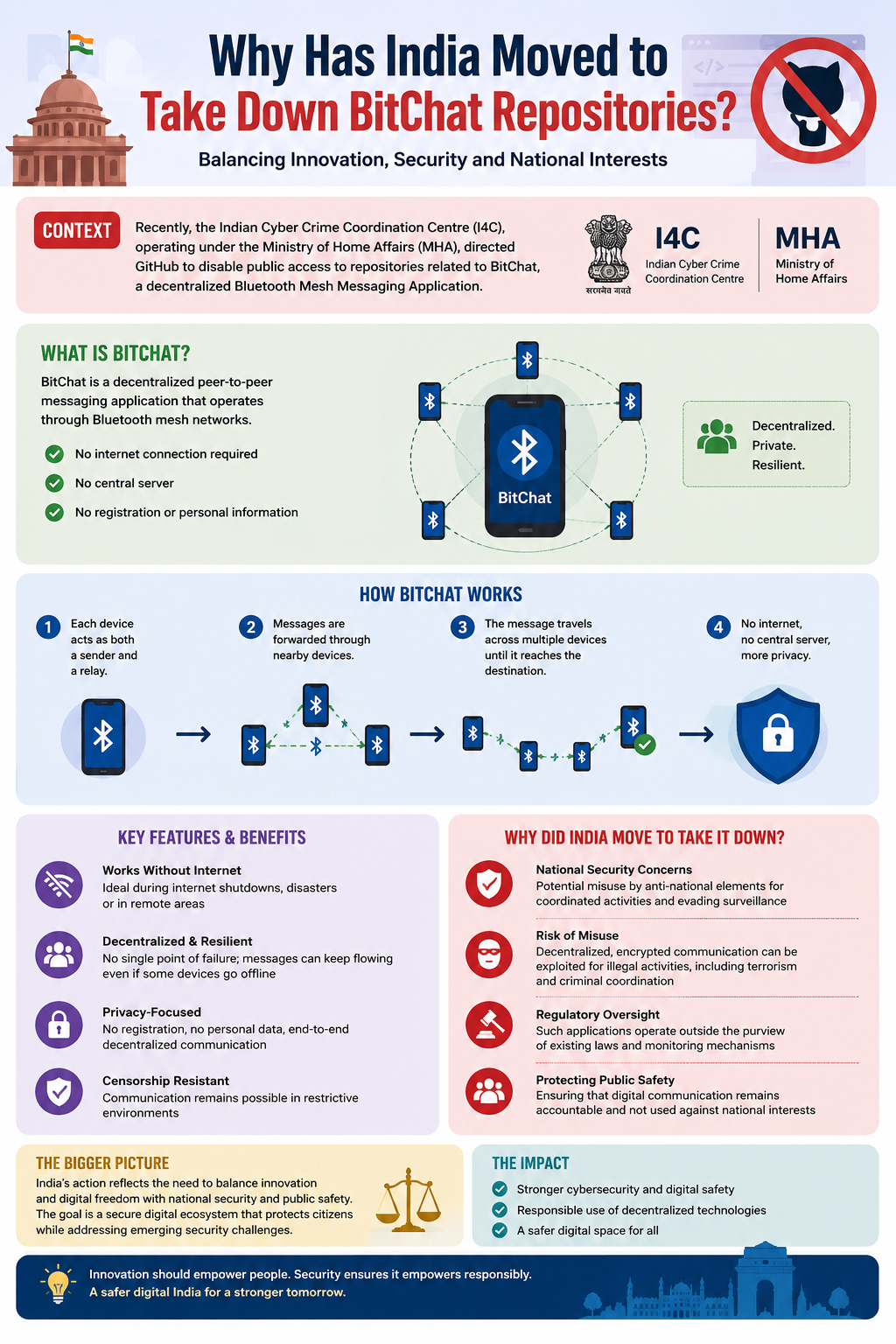
Recently, the Indian Cyber Crime Coordination Centre (I4C), operating under the Ministry of Home Affairs (MHA), directed GitHub to disable public access to repositories related to BitChat, a decentralized Bluetooth Mesh Messaging Application.
What is BitChat?
-
-
- BitChat is a decentralized peer-to-peer messaging application that operates through Bluetooth mesh networks. It does not require an internet connection or a centralized server to function.
- Users are not required to register using a mobile number or any other personal information. In the network, each device functions not only as a sender but also as a relay, forwarding messages to nearby devices. As a result, messages can travel from one location to another through multiple neighboring devices.
- This architecture enables communication even during internet shutdowns, natural disasters, or in remote areas with poor connectivity. It is designed to provide resistance to censorship, protection of user privacy, and independence from centralized communication infrastructure.
- BitChat is a decentralized peer-to-peer messaging application that operates through Bluetooth mesh networks. It does not require an internet connection or a centralized server to function.
-
Why Did the Government Seek Its Removal?
-
-
- According to the Indian Cyber Crime Coordination Centre (I4C), BitChat's anonymous and decentralized architecture makes it extremely difficult for law enforcement agencies to:
- Conduct lawful interception,
- Identify users, and
- Investigate criminal activities.
- Conduct lawful interception,
- The government argues that such platforms could be misused for:
- Organizing unlawful assemblies,
- Coordinating violent protests,
- Facilitating terrorist activities,
- Supporting organized crime,
- Spreading misinformation, and
- Carrying out other activities prejudicial to India's sovereignty, national security, and public order.
- Organizing unlawful assemblies,
- Since messages are exchanged directly between nearby devices without passing through a centralized server, the government fears that users may evade lawful surveillance, particularly during internet shutdowns.
- According to the Indian Cyber Crime Coordination Centre (I4C), BitChat's anonymous and decentralized architecture makes it extremely difficult for law enforcement agencies to:
-
Legal Framework:
-
-
- The directive was issued under Section 79(3)(b) of the Information Technology Act, 2000, read with Rule 3(1)(d) of the Information Technology (Intermediary Guidelines and Digital Media Ethics Code) Rules, 2021.
- Under Section 79, intermediaries such as GitHub enjoy safe harbour protection.
- If an intermediary fails to remove unlawful content after receiving official notice, it may lose this protection.
- However, Section 79 does not itself grant the power to block content.
- The authority to block public access generally flows from Section 69A of the Information Technology Act and the Blocking Rules, 2009. These provisions include procedural safeguards such as recording the reasons for blocking and providing a review mechanism.
- The directive was issued under Section 79(3)(b) of the Information Technology Act, 2000, read with Rule 3(1)(d) of the Information Technology (Intermediary Guidelines and Digital Media Ethics Code) Rules, 2021.
-
Why Is the Order Being Criticized?
-
-
- The Internet Freedom Foundation (IFF) has criticized the order, arguing that the government targeted the entire application based solely on its potential for misuse, without identifying any specific unlawful content hosted in the repositories.
- IFF has also contended that the order does not satisfy the principle of proportionality laid down by the Supreme Court of India in Anuradha Bhasin v. Union of India (2020).
- In this landmark judgment, the Court held that restrictions on internet access and communication must be:
- Necessary,
- Proportionate,
- Limited in scope,
- Temporary, and
- Balanced against citizens' fundamental rights while addressing national security concerns.
- Necessary,
- The Internet Freedom Foundation (IFF) has criticized the order, arguing that the government targeted the entire application based solely on its potential for misuse, without identifying any specific unlawful content hosted in the repositories.
-
Conclusion:
The BitChat controversy highlights the need to strike a careful balance between national security, digital privacy, and freedom of communication. India requires a transparent, accountable, and proportionate regulatory framework that safeguards constitutional rights while effectively preventing the misuse of emerging technologies.



