
Context:
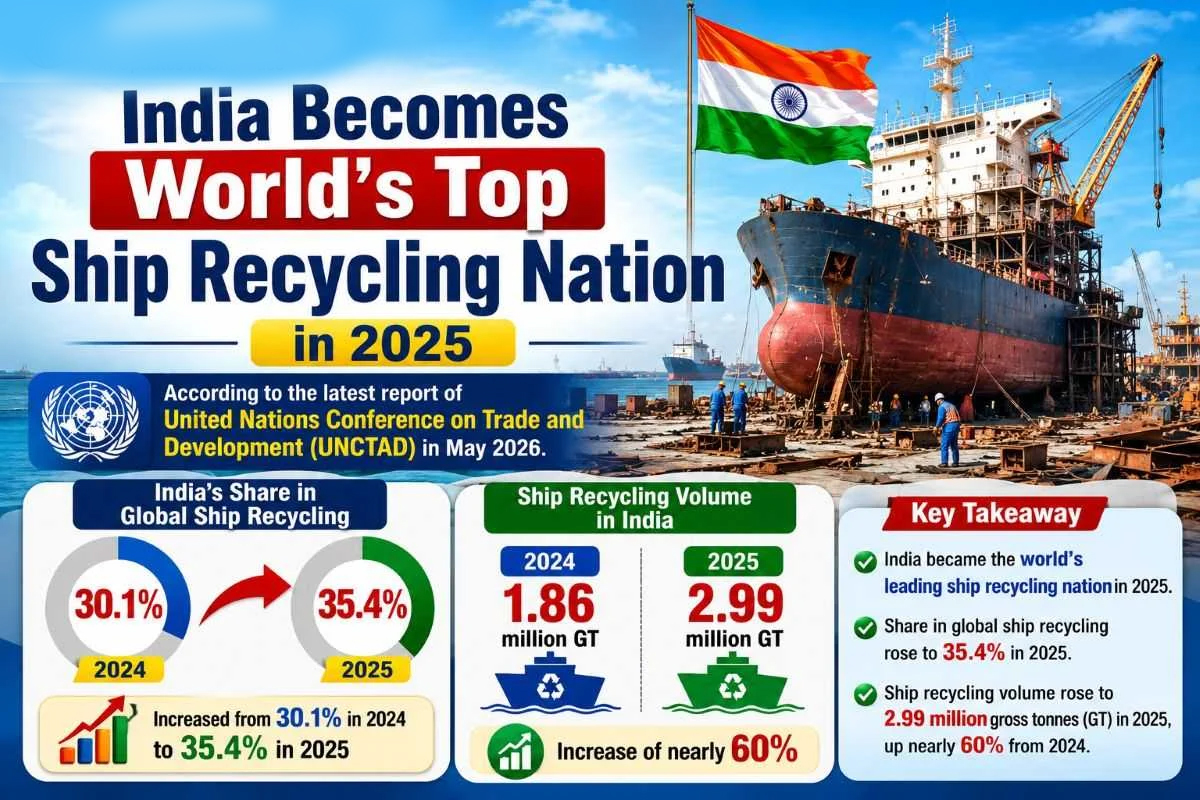
Recently, India has emerged as the world’s largest ship recycling nation in 2025 as per report of the United Nations Conference on Trade and Development (UNCTAD). The achievement is significant as India reached this target five years ahead of the Maritime India Vision 2030 goal.
Background:
-
-
- Ship recycling is highly concentrated in South Asia (India, Bangladesh, Pakistan)
- Around 85% of global ship recycling tonnage occurs in the Indian subcontinent
- India accounts for the largest share at 35.4% in 2025
- Global scrapping is driven by ageing fleets and regulatory pressure for greener dismantling
- Ship recycling is highly concentrated in South Asia (India, Bangladesh, Pakistan)
-
Key Findings of the report:
-
-
- India’s Global Leadership
- India ranked No. 1 in ship recycling globally in 2025
- Share increased to 35.4% (2025) from 30.1% (2024)
- Total recycling volume reached 2.99 million GT
- India ranked No. 1 in ship recycling globally in 2025
- Achievement of MIV 2030 Target Early
- India achieved its Maritime India Vision 2030 target ahead of schedule
- Reflects rapid progress in maritime infrastructure and regulatory reforms
- India achieved its Maritime India Vision 2030 target ahead of schedule
- Strong Growth in Ship Recycling Activity
- Nearly 60% growth in recycling volume year-on-year
- Growth driven by global ageing fleet and scrapping demand
- Nearly 60% growth in recycling volume year-on-year
- India’s Global Leadership
-
Government Initiatives:
-
-
- ₹53.5 crore financial assistance for modernisation of ship recycling yards
- 115 ship recycling facilities upgraded to meet international standards
- Introduction of Ship-breaking Credit Note Scheme, allowing credits from recycling to be used for purchasing new Indian-built ships
- Plan to expand Alang ship recycling capacity to nearly 9 million LDT
- Efforts to include Indian yards in the European Union approved list of recycling facilities
- ₹53.5 crore financial assistance for modernisation of ship recycling yards
-
Role of Policy Reforms:
-
-
- Implementation of Recycling of Ships Act, 2019
- Alignment with Hong Kong International Convention for Safe and Environmentally Sound Recycling of Ships
- India ratified the convention in 2019
- Implementation of Recycling of Ships Act, 2019
-
Infrastructure Strengthening:
-
-
- Dominance of Alang–Sosiya Ship Recycling Yard (Gujarat)
- Largest ship recycling hub in the world
- Continuous upgrades in environmental compliance and safety standards
- Dominance of Alang–Sosiya Ship Recycling Yard (Gujarat)
-
Significance:
-
-
- Economic Significance
- Strengthens India’s blue economy and maritime manufacturing ecosystem
- Ensures steady supply of recycled steel for infrastructure and industry
- Generates large-scale employment in coastal regions
- Strengthens India’s blue economy and maritime manufacturing ecosystem
- Strategic Significance
- Positions India as a global maritime hub
- Enhances role in global shipping lifecycle management
- Supports long-term vision of Maritime India Vision 2030
- Positions India as a global maritime hub
- Environmental Significance
- Promotes circular economy through material recovery
- Reduces dependence on primary steel production
- Encourages green and regulated ship recycling practices
- Promotes circular economy through material recovery
- Economic Significance
-
Challenges:
-
-
- Occupational safety and labour welfare concerns
- Environmental risks in coastal ecosystems
- Competition from Bangladesh and Pakistan due to cost advantages
- Need for scaling up green and mechanised recycling infrastructure
- Waste management and pollution control gaps
- Occupational safety and labour welfare concerns
-
Conclusion:
India’s emergence as the world’s largest ship recycling nation in 2025 marks a key milestone in its maritime growth. It reflects policy reforms, infrastructure upgrades, and alignment with global sustainability standards. Sustaining this position will require balancing economic growth with environmental protection and worker safety for long-term sustainability.



