
Context:
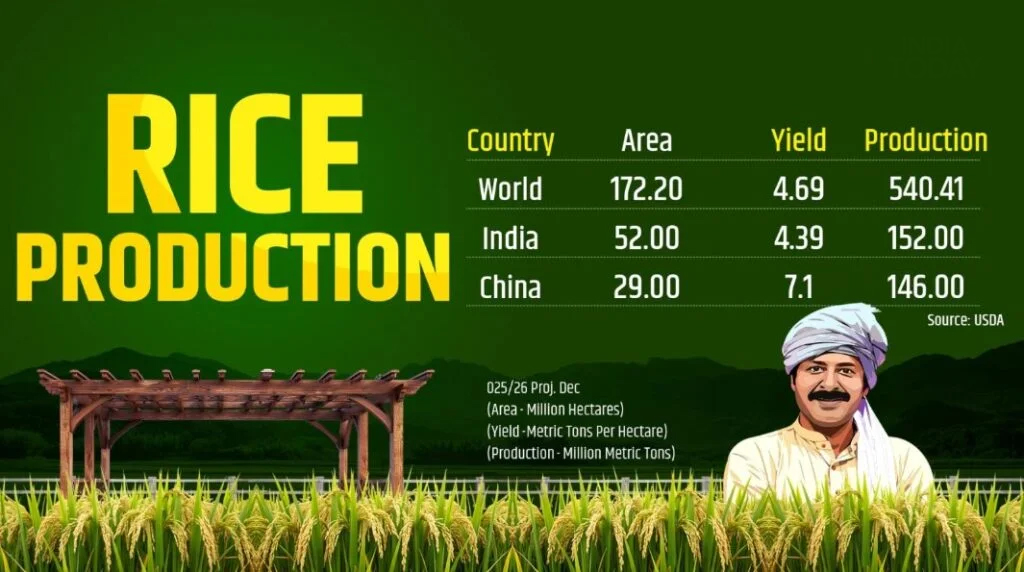
According to official data, India has overtaken China to become the world’s largest rice producer, with output reaching 150.18 million tonnes in 2024–25, compared to China’s 145.28 million tonnes. This milestone reflects sustained policy support, farmer resilience, and technological innovation in Indian agriculture.
Background:
-
-
- Historically, China dominated global rice production due to higher per-hectare yields, advanced mechanisation, and intensive input use. Over time, India steadily narrowed the gap through the expansion of rice-cultivated area, improved irrigation coverage, adoption of high-yielding varieties, and supportive government policies.
- Rice cultivation in India is predominantly undertaken during the Kharif season (sowing in June–July and harvesting in November–December). Major rice-producing states include West Bengal, Uttar Pradesh, Andhra Pradesh, Bihar, Assam, Tamil Nadu, and parts of Northeast India. Rice production plays a critical role in meeting domestic food requirements while supporting export demand.
- Historically, China dominated global rice production due to higher per-hectare yields, advanced mechanisation, and intensive input use. Over time, India steadily narrowed the gap through the expansion of rice-cultivated area, improved irrigation coverage, adoption of high-yielding varieties, and supportive government policies.
-
Climatic Needs and Cultivation Methods:
-
-
- Rice requires warm temperatures (above 25°C), high humidity, and 100–200 cm of rainfall, and is ideally grown on level floodplains with water-retentive soils.
- Farmers increasingly use Direct Seeding of Rice (DSR) to reduce water use and labour costs. Innovations such as genome-edited rice varieties (e.g., Kamla and Pusa DST) have improved yield potential and water-use efficiency. The System of Rice Intensification (SRI), though labour-intensive, significantly reduces seed and water requirements and offers a sustainable alternative, particularly in climate-stressed regions.
- Rice requires warm temperatures (above 25°C), high humidity, and 100–200 cm of rainfall, and is ideally grown on level floodplains with water-retentive soils.
-
Factors behind India’s Rise:
-
- Science-led Agriculture: Research institutions, particularly the Indian Council of Agricultural Research (ICAR), have developed high-yielding, climate-resilient, and short-duration rice varieties. Recently, 184 new crop varieties were released to boost productivity and enhance farmer incomes.
- Policy Support: Government initiatives such as Minimum Support Price (MSP) assurance, expansion of irrigation infrastructure, and efficient seed distribution systems have incentivised farmers to increase rice cultivation.
- Food Security and Exports: Robust domestic production ensures food security while reinforcing India’s position as a leading global rice exporter, contributing to foreign exchange earnings and strengthening its role in international agricultural markets.
- Science-led Agriculture: Research institutions, particularly the Indian Council of Agricultural Research (ICAR), have developed high-yielding, climate-resilient, and short-duration rice varieties. Recently, 184 new crop varieties were released to boost productivity and enhance farmer incomes.
Significance of the Achievement:
-
- Global Food Security: India’s leadership in rice production enhances stability in the global food system, particularly in Asia, where rice is a dietary staple.
- Economic Impact: Higher output stabilises domestic food prices, supports rural livelihoods, and increases India’s participation in global agricultural trade.
- Agricultural Leadership: The achievement underscores India’s growing influence in global agriculture, highlighting the combined impact of policy continuity, technological adoption, and farmer participation.
- Global Food Security: India’s leadership in rice production enhances stability in the global food system, particularly in Asia, where rice is a dietary staple.
Challenges:
Despite this success, India’s average rice yield per hectare remains lower than China’s. Rice cultivation is also water-intensive, raising concerns about groundwater depletion, soil degradation, and environmental sustainability. Addressing these challenges will require a greater focus on precision agriculture, sustainable water management, crop diversification, and mechanisation.
Conclusion:
India’s emergence as the world’s largest rice producer is a testament to scientific innovation, policy consistency, and farmer resilience. While the achievement strengthens global food security and India’s economic standing, the next phase of growth must be guided by sustainable agricultural practices to ensure long-term productivity, environmental protection, and ecological balance.



