
Context:
India has recently become the first country in the world to commercially produce bio‑bitumen for use in road construction. This milestone was announced at a technology transfer event in New Delhi.
About Bio‑Bitumen:
-
-
- Bio‑bitumen is a bio‑binder produced from agricultural or biomass residue, such as paddy straw, using a thermal process called pyrolysis.
- In this process, biomass is heated without oxygen, breaking it into bio‑oil, gases, and char; the bio‑oil fraction is refined and blended with conventional bitumen for use in asphalt.
- Bio‑bitumen can be blended (e.g., 20–30% with petroleum bitumen) and meets performance standards after rigorous testing for durability, rutting, cracking, and moisture resistance.
- Bio‑bitumen is a bio‑binder produced from agricultural or biomass residue, such as paddy straw, using a thermal process called pyrolysis.
-
How India Achieved It?
-
-
- The initiative stems from an indigenous innovation developed jointly by CSIR‑Central Road Research Institute (CRRI) and CSIR‑Indian Institute of Petroleum (IIP), demonstrating that agricultural waste can be transformed into high‑value construction material.
- A 100‑metre trial stretch on the Jorabat–Shillong Expressway (NH‑40) in Meghalaya proved the feasibility of bio‑bitumen for real‑world road building.
- The initiative stems from an indigenous innovation developed jointly by CSIR‑Central Road Research Institute (CRRI) and CSIR‑Indian Institute of Petroleum (IIP), demonstrating that agricultural waste can be transformed into high‑value construction material.
-
Implications of this:
1. Environmental Benefits
-
-
- Reduces air pollution by providing an alternate use for crop residue that otherwise contributes to stubble burning.
- Lowers lifecycle carbon emissions compared to fossil‑based bitumen and supports the transition to clean, green highways.
- Reduces air pollution by providing an alternate use for crop residue that otherwise contributes to stubble burning.
-
2. Economic and Strategic Gains
-
-
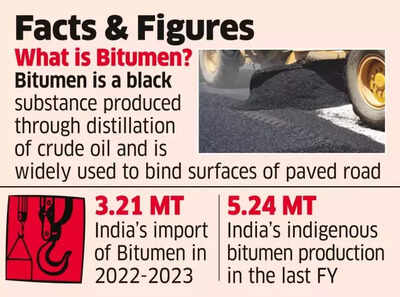
- Reduces dependence on imported bitumen, which India currently imports in large quantities, costing an estimated ₹25,000–₹30,000 crore annually.
- Blending even 15% bio‑bitumen can save foreign exchange and enhance rural livelihoods by converting agricultural waste into valuable inputs.
- Reduces dependence on imported bitumen, which India currently imports in large quantities, costing an estimated ₹25,000–₹30,000 crore annually.
-
Circular Economy and Rural Benefits:
-
-
- Aligns with circular economy principles, creating value from waste and promoting sustainable resource utilisation.
- Opens new income streams for farmers and supports rural employment through biomass collection and processing.
- Aligns with circular economy principles, creating value from waste and promoting sustainable resource utilisation.
-
Policy and Development Linkages:
-
-
- Bio‑bitumen contributes to the Viksit Bharat 2047 vision — a roadmap for developed economy status combining sustainability, self‑reliance, and technological innovation.
- Demonstrates effective science‑government‑industry collaboration, with the Ministry of Road Transport and Highways and Ministry of Science & Technology endorsing deployment.
- Supports Atmanirbhar Bharat goals by reducing fossil fuel imports and bolstering domestic capacity in sustainable materials.
- Bio‑bitumen contributes to the Viksit Bharat 2047 vision — a roadmap for developed economy status combining sustainability, self‑reliance, and technological innovation.
-
Challenges:
-
-
- Scaling production nationally will require policy frameworks that mandate bio‑bitumen blending standards and incentivise use in public infrastructure.
- Ensuring supply chains for biomass feedstock, addressing seasonal variability, and building logistics for pyrolysis facilities are critical for wider adoption.
- Scaling production nationally will require policy frameworks that mandate bio‑bitumen blending standards and incentivise use in public infrastructure.
-
Conclusion:
India’s commercial production of bio‑bitumen represents a landmark in sustainable infrastructure innovation, with environmental, economic, and strategic benefits. While this milestone demonstrates leadership in green technology adoption, the next steps will involve policy mainstreaming, scaling of production, and integration into national highway programmes to achieve meaningful impact on emissions, rural economy, and self‑reliant growth.



