
Why in News?
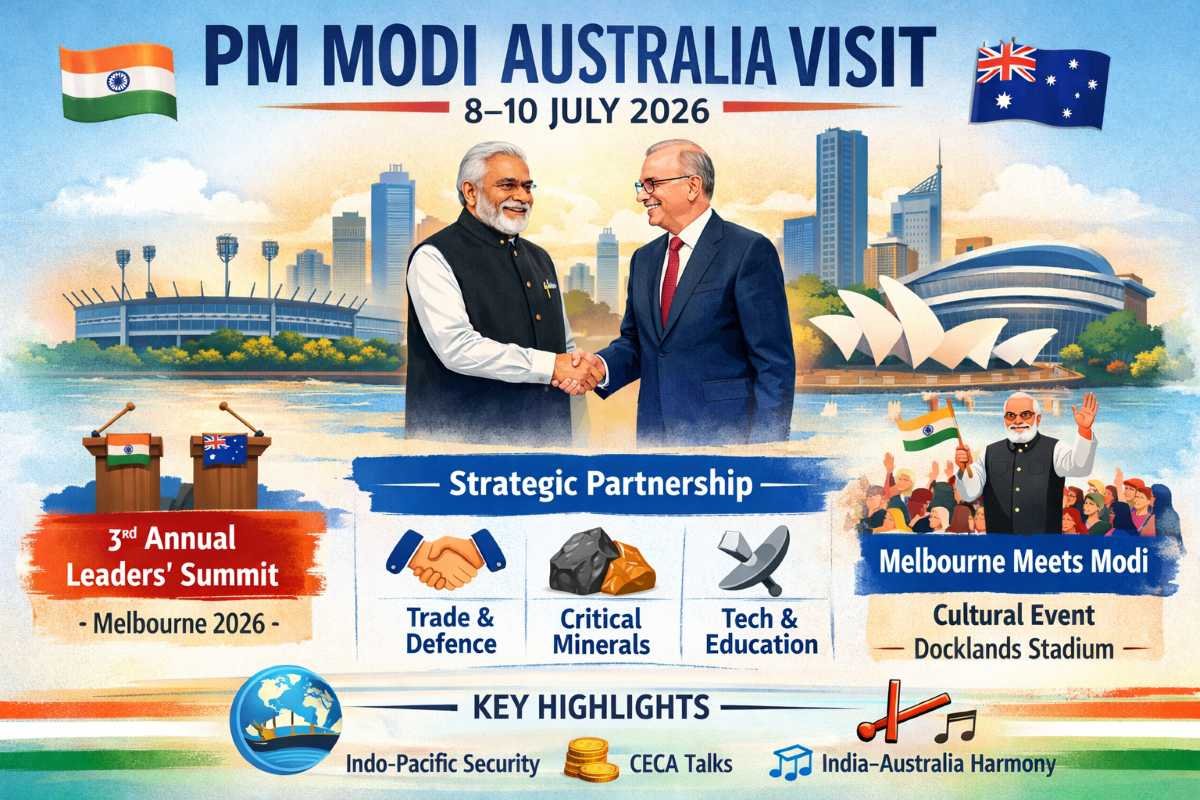
Recently, Prime Minister Narendra Modi and Australian Prime Minister Anthony Albanese held the 3rd Australia–India Annual Leaders' Summit in Melbourne. The summit marked a significant advancement in bilateral ties with agreements on defence, maritime security, clean energy, critical minerals, trade, technology, and education, reinforcing the Comprehensive Strategic Partnership between the two countries.
Key Outcomes of the Summit:
Defence and Security Cooperation:
The two leaders signed a Joint Declaration on Defence and Security Cooperation to strengthen peace and stability in the Indo-Pacific. They also institutionalised an Annual Defence Ministers' Dialogue and launched a Maritime Security Collaboration Roadmap to enhance naval cooperation, maritime domain awareness, and regional security.
Economic and Trade Cooperation:
Building upon the India-Australia Economic Cooperation and Trade Agreement (ECTA), 2022, both countries agreed to accelerate negotiations for a Comprehensive Economic Cooperation Agreement (CECA) and a Bilateral Investment Treaty (BIT). The objective is to expand trade, investment, and market access while creating a balanced and mutually beneficial economic partnership.
Energy Security:
A major outcome was the operationalisation of the Administrative Arrangement under the Australia–India Nuclear Cooperation Agreement, enabling long-term Australian uranium exports to India under international safeguards. Australia possesses nearly one-third of the world's known uranium reserves, and the agreement supports India's target of achieving 100 GW of nuclear power capacity by 2047 as part of its clean energy transition.
Critical Minerals Partnership:
Both countries launched a Dedicated Critical Minerals Corridor to secure resilient supply chains for lithium, cobalt, rare earth elements, and other strategic minerals. The initiative promotes joint investment in mineral processing and refining while reducing dependence on single-source global supply chains for electric vehicles, semiconductors, renewable energy technologies, and defence manufacturing.
Technology, Education and Renewable Energy:
The summit operationalised the Australia–India Partnership on Cyber, Critical Technologies and Supply Chains (AI-PACTS). Both nations also expanded cooperation in renewable energy through the Rooftop Solar Training Academy in Gujarat, focusing on skill development for women and youth. Educational ties were strengthened with the establishment of new Australian university campuses in Bengaluru and Gurugram.
Conclusion:
The summit represents a major step in strengthening the India–Australia Comprehensive Strategic Partnership. It enhances cooperation in defence, clean energy, critical technologies, resilient supply chains, and the Indo-Pacific. The partnership also benefits from a vibrant Indian diaspora and expanding people-to-people, educational, and economic ties, making Australia one of India's most important strategic partners in the region.



