
Context:
Recently, Defence Minister Rajnath Singh has called for deeper defence and security cooperation between India and the Association of Southeast Asian Nations (ASEAN) at the ASEAN–India Defence Think Tank Forum in New Delhi. He highlighted maritime security, defence manufacturing, information sharing and emerging technologies to promote peace and stability in the Indo-Pacific.
Background: India–ASEAN Relations:
-
-
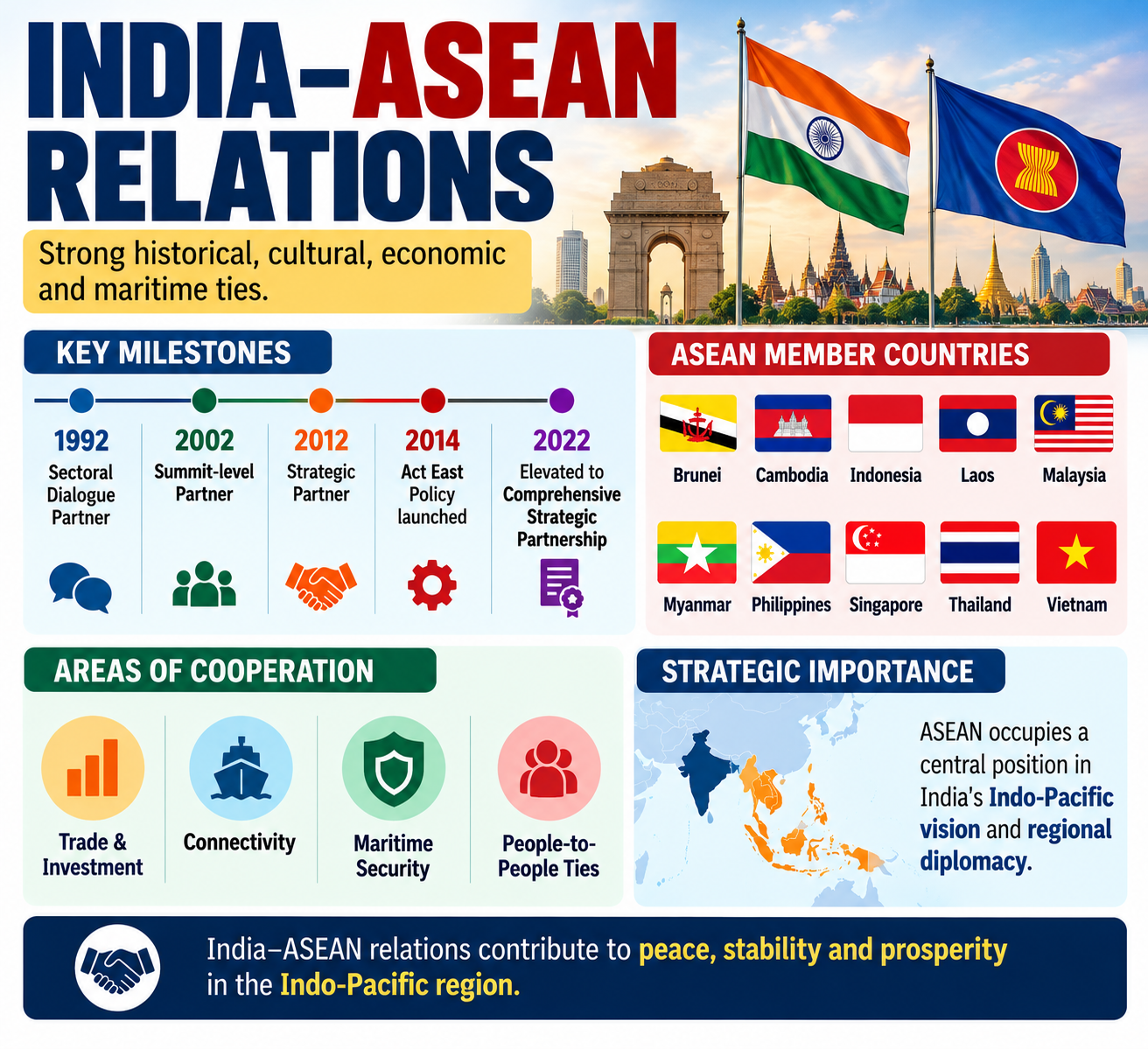
- India and ASEAN share historical, cultural, economic and maritime ties. India became a Sectoral Dialogue Partner in 1992, a Summit-level Partner in 2002 and a Strategic Partner in 2012. In 2014, India launched the Act East Policy to strengthen engagement with Southeast Asia. In 2022, relations were elevated to a Comprehensive Strategic Partnership.
- ASEAN occupies a central position in India's Indo-Pacific vision and regional diplomacy.
- India and ASEAN share historical, cultural, economic and maritime ties. India became a Sectoral Dialogue Partner in 1992, a Summit-level Partner in 2002 and a Strategic Partner in 2012. In 2014, India launched the Act East Policy to strengthen engagement with Southeast Asia. In 2022, relations were elevated to a Comprehensive Strategic Partnership.
-
Key Highlights of the Forum:
-
-
- Maritime Security: Enhanced maritime domain awareness, underwater surveillance, information-sharing and cooperation between navies and coast guards.
- Defence Technology: Collaboration in artificial intelligence, drones, cybersecurity and space-based systems.
- Joint Defence Production: Partnerships in patrol vessels, radars, air-defence systems, helicopters and drones.
- Research and Innovation: India's Innovations for Defence Excellence (iDEX) and Technology Development Fund (TDF) could facilitate collaboration among start-ups, universities and research institutions.
- Capacity Building: Cooperation in training, maintenance, repair and overhaul (MRO), technical assistance and humanitarian assistance and disaster relief (HADR).
- The two-day forum, held on 14–15 October 2026 at the Manohar Parrikar Institute for Defence Studies and Analyses (MP-IDSA), brought together participants from India and all 11 ASEAN member states.
- Maritime Security: Enhanced maritime domain awareness, underwater surveillance, information-sharing and cooperation between navies and coast guards.
-
Significance for India:
Deeper defence ties support India's Act East Policy and its vision of a free, open and inclusive Indo-Pacific. They can strengthen India's maritime presence, diversify defence partnerships, expand markets for indigenous defence products and address transnational threats such as piracy, trafficking and illegal fishing. Cooperation also reinforces ASEAN centrality in regional security.
Key Challenges:
India–ASEAN defence cooperation faces differences in strategic priorities, varying military capabilities and sensitivities concerning major-power competition, particularly in the South China Sea. Limited resources, technological gaps and implementation challenges may also restrict joint projects. ASEAN members have diverse national interests, making consensus essential.
Way Forward:
India should strengthen information-sharing mechanisms, expand joint naval exercises and promote co-development of affordable defence technologies. Greater investment in training, maintenance facilities and disaster-response coordination can build mutual trust. Cooperation should respect national sovereignty, international law and ASEAN's central role in regional institutions.
Conclusion:
Deeper India–ASEAN defence cooperation can contribute to regional stability, secure maritime trade routes and strengthen defence self-reliance. Translating strategic dialogue into practical collaboration, while respecting ASEAN's diversity and autonomy, is essential for a peaceful and prosperous Indo-Pacific.



