
Context:
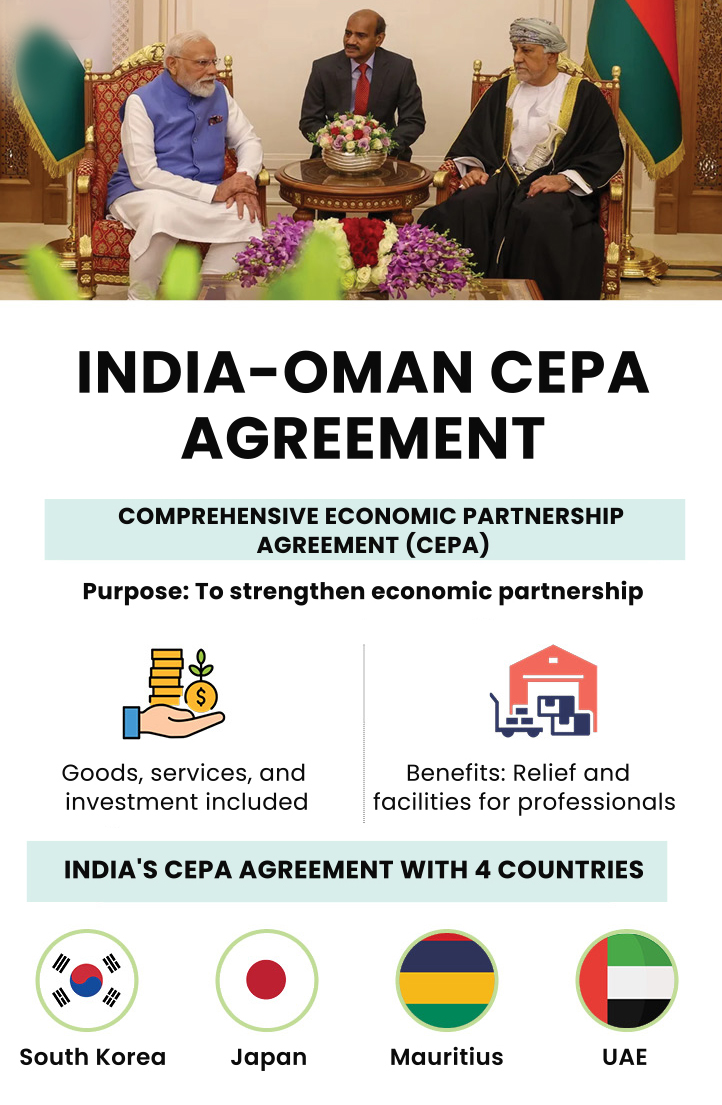
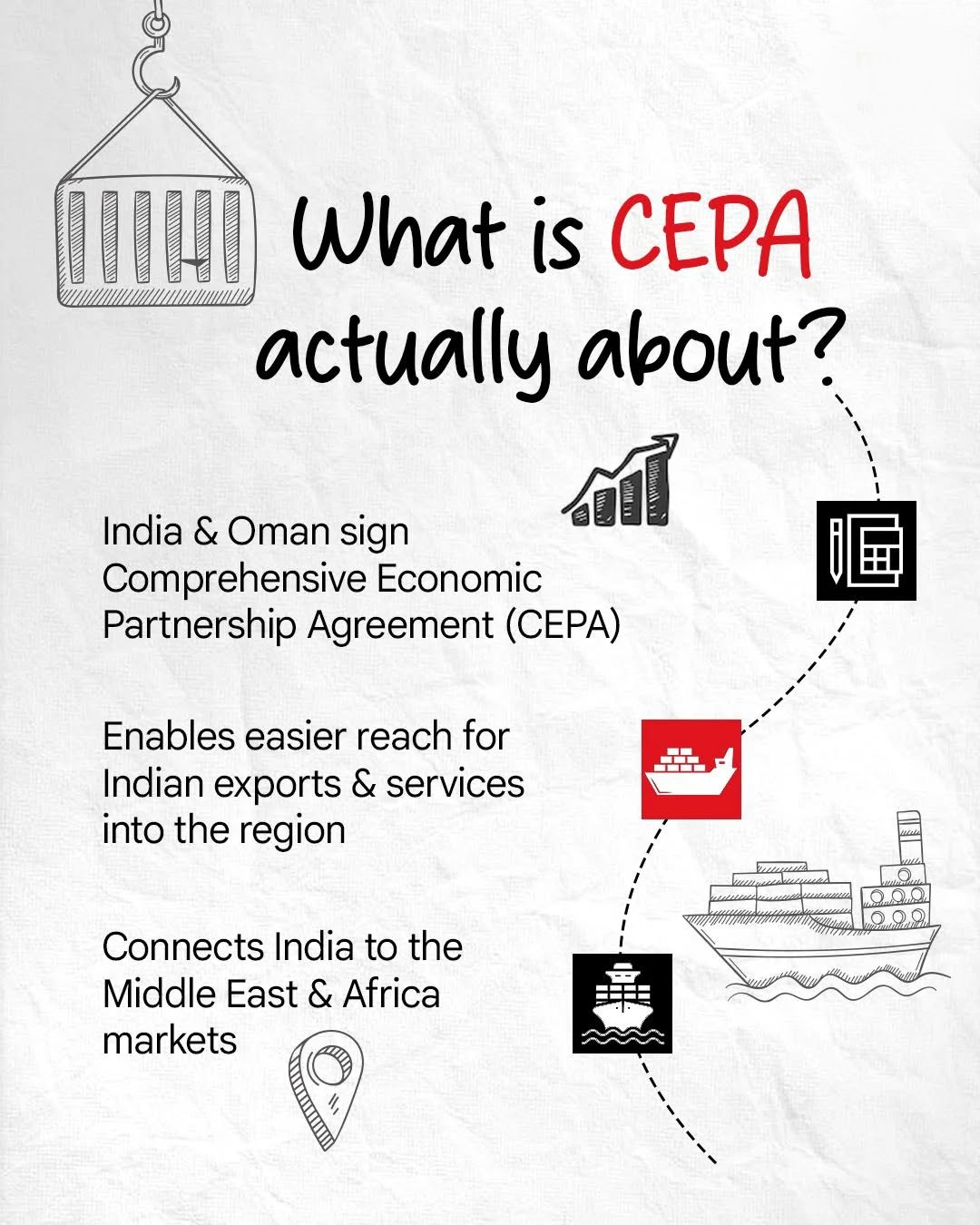
Recently, India and Oman signed a Comprehensive Economic Partnership Agreement (CEPA), a landmark bilateral trade and investment pact aimed at strengthening economic cooperation, boosting trade, and enhancing labour mobility between the two countries.
Key Features of the CEPA:
1. Trade Liberalisation and Duty-Free Access
-
-
-
- Oman will provide India duty-free access to 98.08% of its tariff lines, covering 99.38% of India’s exports to Oman.
- India has offered liberalised tariffs on 77.79% of its tariff lines, covering 94.81% of imports from Oman.
- Full tariff elimination is expected for several labour-intensive and high-value sectors, including:
- Gems and jewellery
- Textiles and leather
- Footwear and sports goods
- Plastics and furniture
- Agricultural products
- Engineering goods
- Pharmaceuticals and medical devices
- Automobiles
- Gems and jewellery
- Oman will provide India duty-free access to 98.08% of its tariff lines, covering 99.38% of India’s exports to Oman.
-
-
2. Sectoral and Services Benefits
-
-
-
- The CEPA includes significant concessions for India’s services sector, with a strong emphasis on professional mobility.
- Certain sensitive products remain excluded from the agreement, including:
- Dairy products
- Tea and coffee
- Rubber and tobacco
- Gold and silver bullion
- Jewellery
- Select footwear and sports goods
- Dairy products
- The CEPA includes significant concessions for India’s services sector, with a strong emphasis on professional mobility.
-
-
3. Enhanced Labour Mobility
-
-
-
- Oman has committed to Mode 4 mobility, facilitating greater access for Indian professionals to Omani markets.
- The quota for Intra-Corporate Transferees (ICTs) has been increased from 20% to 50%.
- Contractual Service Suppliers are permitted a stay of up to two years, extendable by an additional two years.
- Entry and stay conditions for skilled professionals have been liberalised in key sectors such as IT, healthcare, engineering, and professional services.
- Oman has committed to Mode 4 mobility, facilitating greater access for Indian professionals to Omani markets.
-
-
Economic and Strategic Significance:
-
- In 2024–25, India exported merchandise worth $4.06 billion to Oman, while imports from Oman stood at $6.5 billion.
- The CEPA provides India with a strategic gateway to the GCC region, as well as access to Eastern Europe, Central Asia, and Africa, thereby enhancing trade diversification.
- This agreement marks:
- Oman’s first bilateral trade agreement since its FTA with the United States in 2006, and
- India’s second CEPA with a GCC country, following the India–UAE CEPA signed in 2022.
- Oman’s first bilateral trade agreement since its FTA with the United States in 2006, and
- In 2024–25, India exported merchandise worth $4.06 billion to Oman, while imports from Oman stood at $6.5 billion.
Implications of the CEPA:
-
- Trade Growth: Reduced tariffs and expanded market access are expected to significantly boost India’s exports, particularly in labour-intensive and high-value manufacturing sectors, leading to higher bilateral trade volumes.
- Employment and Skills Development: Enhanced labour mobility will generate new employment opportunities for Indian professionals and facilitate skill transfer in sectors such as IT, healthcare, engineering, and technical services.
- Strategic Partnership: Deepening economic ties with Oman strengthens India’s strategic footprint in West Asia, complements its Act West policy, and enhances regional connectivity and energy-security cooperation.
- Youth and Innovation: The CEPA is expected to open new avenues for entrepreneurship, innovation, and start-up collaboration, particularly benefiting the youth in both countries, in alignment with India’s demographic and economic aspirations.
- Trade Growth: Reduced tariffs and expanded market access are expected to significantly boost India’s exports, particularly in labour-intensive and high-value manufacturing sectors, leading to higher bilateral trade volumes.
Conclusion:
The India–Oman CEPA represents a historic step in bilateral economic cooperation by integrating trade liberalisation, services sector access, and labour mobility into a single comprehensive framework. By enabling duty-free market access, liberalised tariffs, and professional mobility, the agreement strengthens economic, strategic, and people-to-people ties. Its effective implementation is expected to boost trade, generate employment, and enhance India’s regional influence, serving as a template for future comprehensive economic partnerships.



