
Context:
Recently, The World Bank’s report, India and Artificial Intelligence: Seizing the Development Opportunity, places India among the top 10 emerging-market performers in AI readiness. India’s strengths include a large technical workforce, a well-established IT sector and digital public infrastructure (DPI). However, gaps in computing infrastructure, finance and AI adoption continue to constrain its potential.
Key Findings of the Report:
-
-
- Rising investment: Private AI investment increased from $1.2 billion in 2024 to $4.1 billion in 2025.
- Growing employment: Professionals employed by Global Capability Centres (GCCs) increased from 1.9 million in 2024 to 2.36 million in 2025.
- AI adoption: Around 23% of Indian firms reported using AI, compared with approximately 43% in the United States.
- Infrastructure gap: India accounted for about 1% of global installed data-centre capacity in 2025.
- Employment exposure: Around 22% of Indian employment is highly exposed to AI, although exposure does not necessarily imply job losses.
- Rising investment: Private AI investment increased from $1.2 billion in 2024 to $4.1 billion in 2025.
-
What Is Artificial Intelligence?
-
-
- Artificial Intelligence (AI) refers to technologies that enable machines to perform tasks associated with human intelligence, including learning, reasoning, language processing and decision-making.
- As a general-purpose technology, AI can improve productivity, expand access to specialised skills and transform sectors such as healthcare, agriculture, education, manufacturing and finance.
- Artificial Intelligence (AI) refers to technologies that enable machines to perform tasks associated with human intelligence, including learning, reasoning, language processing and decision-making.
-
India’s Advantages in AI:
-
-
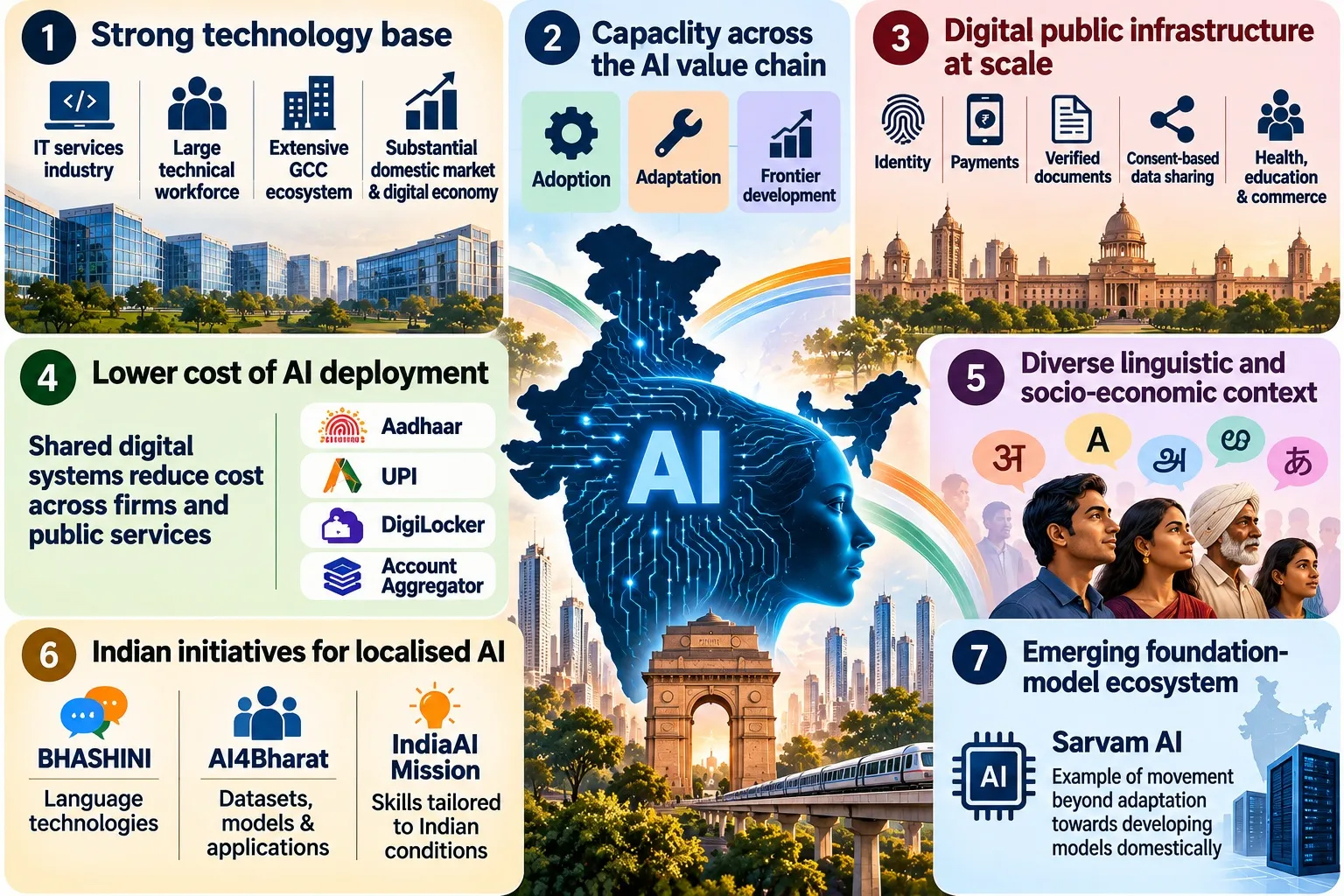
- Digital Public Infrastructure: Aadhaar, UPI, DigiLocker and Account Aggregator provide digital foundations for scalable AI applications.
- Human capital: India’s large engineering workforce and IT-services industry support software development, analytics and AI deployment.
- Domestic market: India’s linguistic and cultural diversity creates opportunities for locally relevant AI solutions.
- Government initiatives: The IndiaAI Mission, BHASHINI and AI4Bharat support AI infrastructure, language technologies, datasets, research and skill development.
- Digital Public Infrastructure: Aadhaar, UPI, DigiLocker and Account Aggregator provide digital foundations for scalable AI applications.
-
Major Challenges:
-
-
- Infrastructure deficit: Limited affordable computing, data-centre capacity and reliable electricity.
- Unequal adoption: Smaller enterprises and informal businesses face financial and technical barriers.
- Skills gap: Shortages of specialised AI researchers and professionals.
- Data limitations: Inadequate high-quality, locally relevant datasets.
- Employment concerns: AI may transform occupations, displace certain tasks and widen skill-based inequalities.
- Ethical risks: Bias, privacy violations, misinformation and lack of accountability.
- Infrastructure deficit: Limited affordable computing, data-centre capacity and reliable electricity.
-
Way Forward:
-
-
- India should expand affordable cloud computing, strengthen broadband and electricity infrastructure, promote AI literacy and provide targeted support to MSMEs.
- Public-sector data should be made more accessible with strong privacy safeguards. Investment should prioritise multilingual AI, healthcare, agriculture and low-cost solutions for underserved communities.
- Risk-based regulation, AI safety evaluations, worker reskilling and stronger institutional capacity are essential for responsible deployment.
- India should expand affordable cloud computing, strengthen broadband and electricity infrastructure, promote AI literacy and provide targeted support to MSMEs.
-
Conclusion:
India has the potential to become a major AI innovator by combining its technical talent, digital infrastructure and domestic market. The priority should be to bridge infrastructure gaps, promote inclusive adoption and develop trustworthy, locally relevant AI systems that support economic growth and social development.



