
Context:
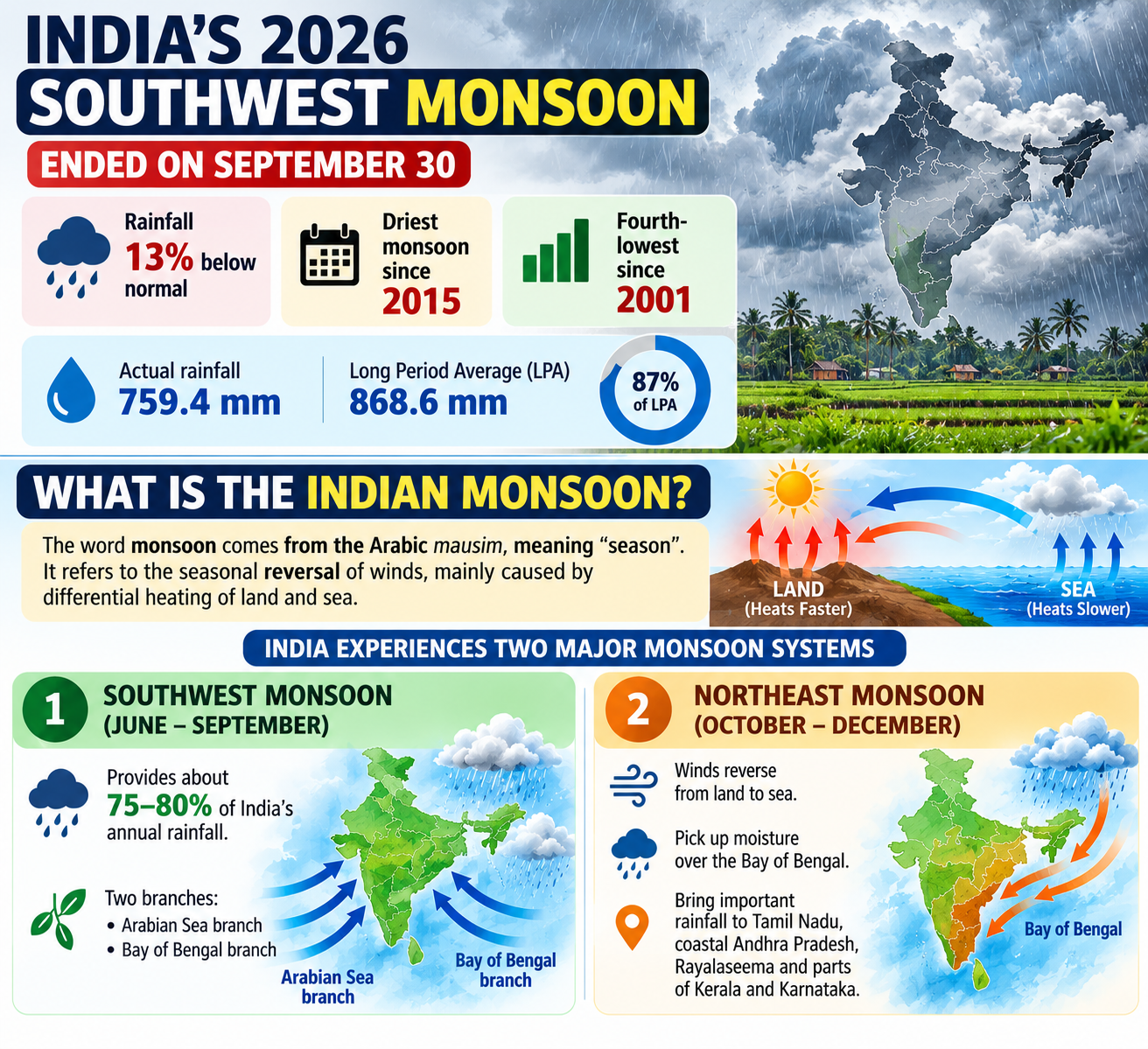
India’s 2026 southwest monsoon ended on September 30 with rainfall about 13% below normal, making it the driest monsoon since 2015 and the fourth-lowest since 2001. India received around 759.4 mm rainfall against the Long Period Average (LPA) of 868.6 mm, or about 87% of LPA.
What is the Indian Monsoon?
-
-
- The word monsoon comes from the Arabic mausim, meaning “season”. It refers to the seasonal reversal of winds, mainly caused by differential heating of land and sea.
- India experiences two major monsoon systems:
- Southwest Monsoon (June–September): Provides roughly 75–80% of India’s annual rainfall and has two branches — Arabian Sea and Bay of Bengal.
- Northeast Monsoon (October–December): Winds reverse from land to sea, pick up moisture over the Bay of Bengal and bring important rainfall to Tamil Nadu, coastal Andhra Pradesh, Rayalaseema and parts of Kerala and Karnataka.
- Southwest Monsoon (June–September): Provides roughly 75–80% of India’s annual rainfall and has two branches — Arabian Sea and Bay of Bengal.
- The word monsoon comes from the Arabic mausim, meaning “season”. It refers to the seasonal reversal of winds, mainly caused by differential heating of land and sea.
-
Major Driving Forces:
The Indian monsoon is influenced by:
-
-
- Differential heating of land and sea
- Inter-Tropical Convergence Zone (ITCZ) shift
- Tibetan Plateau heating
- Withdrawal of the subtropical westerly jet and establishment of the tropical easterly jet
- Mascarene High over the southern Indian Ocean
- ENSO, IOD and Eurasian snow cover
- Differential heating of land and sea
-
Why Was the 2026 Monsoon Deficient?
-
-
- El Niño: The major factor was El Niño, involving abnormal warming of the central and eastern tropical Pacific Ocean. It generally weakens the Indian summer monsoon by altering atmospheric circulation. IMD reported strengthening El Niño conditions during the season.
- Uneven Spatial Distribution: The deficit was not uniform. South Peninsular India received about 76% of its LPA, while the East and Northeast region received about 74%, indicating severe regional variation. At the same time, low-pressure systems over the Bay of Bengal helped bring rainfall to some central and eastern areas and prevented the national deficit from becoming larger.
- El Niño: The major factor was El Niño, involving abnormal warming of the central and eastern tropical Pacific Ocean. It generally weakens the Indian summer monsoon by altering atmospheric circulation. IMD reported strengthening El Niño conditions during the season.
-
Understanding LPA and Rainfall Classification:
The LPA is the average rainfall over a long reference period. For India, the current seasonal LPA is 868.6 mm (about 87 cm), based on 1971–2020.
All-India classification:
-
-
- Excess: >110% of LPA
- Above Normal: 104–110%
- Normal: 96–104%
- Below Normal: 90–95%
- Deficient: <90%
- Excess: >110% of LPA
-
Thus, the 2026 rainfall at about 87% of LPA falls in the deficient category.
Impact on India:
-
-
- Agriculture: Prolonged dry spells can affect paddy, cotton and maize yields, particularly in rain-fed regions.
- Water Security: Lower rainfall can reduce groundwater recharge and reservoir storage.
- Hydropower: Reduced reservoir levels may affect hydroelectric generation.
- Inflation: Crop losses can increase food prices.
- Rural Economy: Lower agricultural income can affect rural demand and employment.
- Ecology: Water-stressed forests, wetlands and ecosystems become more vulnerable to climatic stress.
- Agriculture: Prolonged dry spells can affect paddy, cotton and maize yields, particularly in rain-fed regions.
-
Way Forward:
-
-
- Expand micro-irrigation and rainwater harvesting.
- Promote drought-resistant and short-duration crop varieties.
- Strengthen groundwater recharge and watershed management.
- Improve district-level weather forecasting and early-warning systems.
- Expand crop insurance and climate-resilient agriculture.
- Use programmes such as Mission Mausam to improve observations and numerical weather prediction.
- Expand micro-irrigation and rainwater harvesting.
-
Conclusion:
The 2026 monsoon demonstrates that India’s rainfall challenge is not merely about the quantity of rainfall, but also its timing, duration and spatial distribution. Strengthening climate-resilient agriculture, water management and forecasting capabilities is essential for reducing the socioeconomic impact of increasingly variable monsoon behaviour.



