
Context:
On January 16, 2026, the Union Government of India took a decisive step against unauthorized online betting and gambling by blocking 242 illegal websites and links, taking the total number of such platforms removed to approximately 7,800 since enforcement actions intensified after the passage of the Promotion and Regulation of Online Gaming Act, 2025.
Legal Context:
-
-
-
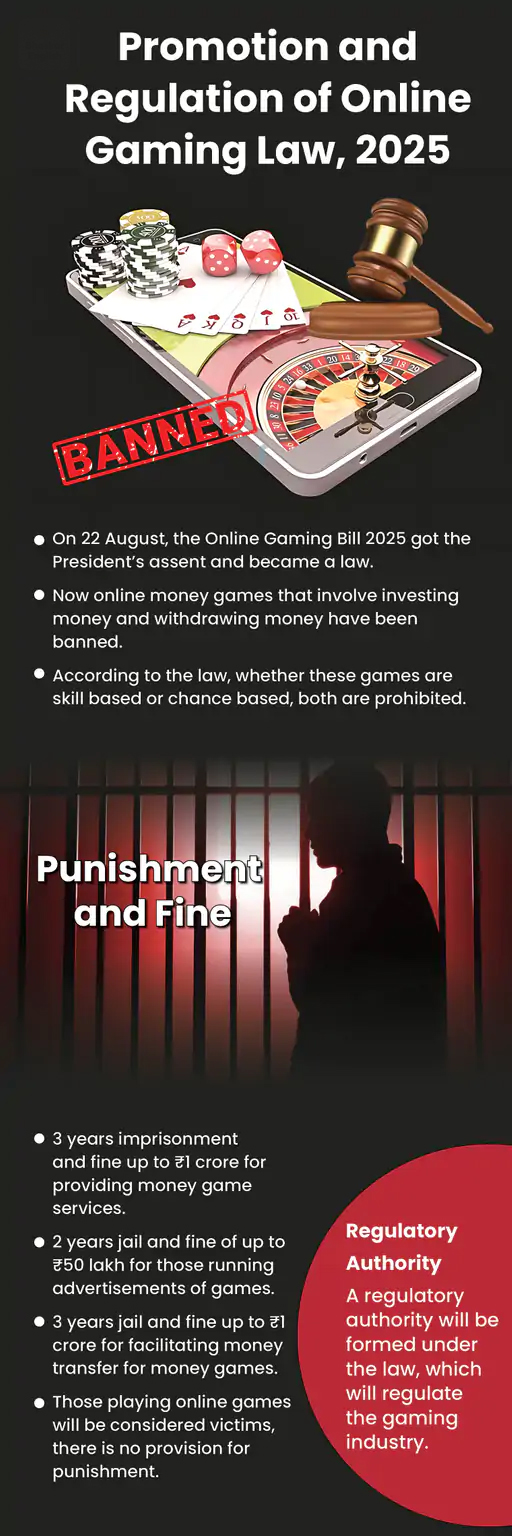
- The crackdown follows the enactment of the Promotion and Regulation of Online Gaming Act, 2025, which came into force after being passed by both houses of Parliament and receiving presidential assent in August 2025.
- Under this law, real‑money gaming — defined as any online game involving monetary stakes regardless of whether the outcome is based on skill, chance, or both — is prohibited in India. The Act also bans associated advertisements and financial transactions linked to such platforms and empowers authorities to take enforcement actions.
- Section 69A of the Information Technology Act, 2000 provides the legal mechanism for blocking access to unlawful online content, including betting and gambling sites, on the directions of the government or authorised agencies.
- The crackdown follows the enactment of the Promotion and Regulation of Online Gaming Act, 2025, which came into force after being passed by both houses of Parliament and receiving presidential assent in August 2025.
-
-
Rationale behind the Crackdown:
The government has justified this policy on multiple grounds:
-
-
- Consumer Protection: Real‑money gaming platforms have been linked to financial losses, addiction, and social harm, particularly among young users and vulnerable groups.
- Public Health and Safety: Reports and official statements have highlighted instances of addiction and distress caused by uncontrolled gaming experiences.
- Regulatory Gaps: Many illegal platforms are offshore or unregistered, escaping GST compliance and Indian legal oversight. Their operations pose challenges related to money laundering, illicit fund transfers, and lack of consumer recourse.
- Protecting Households and Savings: Stakeholders, including policymakers, have cited concerns about families losing savings and financial instability due to risky online betting platforms.
- Consumer Protection: Real‑money gaming platforms have been linked to financial losses, addiction, and social harm, particularly among young users and vulnerable groups.
-
Challenges in Regulation:
Despite these actions, combating illegal betting and gambling online faces structural and technical hurdles:
-
-
- URL Switching and Evasion: Illegal operators frequently shift domain names and hosting locations to evade detection and blocking, making enforcement iterative and complex.
- Offshore Jurisdictions: A significant number of platforms are based outside Indian jurisdiction, complicating legal enforcement and digital policing.
- Financial Flows: Using intermediary “mule” accounts and digital wallets, funds can be swiftly moved out of reach of Indian authorities, raising issues of money laundering and financial regulation.
- URL Switching and Evasion: Illegal operators frequently shift domain names and hosting locations to evade detection and blocking, making enforcement iterative and complex.
-
Conclusion:
The recent blocking of 242 illegal online betting and gambling sites is a landmark enforcement action under India’s Online Gaming Act, 2025, reflecting the government’s broader strategy to curb financial harm, addiction, and social damage associated with real‑money gaming. Yet, the persistence of illegal operators and offshore platforms highlights the ongoing challenges in digital governance, requiring sustained enforcement, cross‑sector cooperation, and innovative regulatory mechanisms to balance consumer protection with technological evolution.



