
Context:
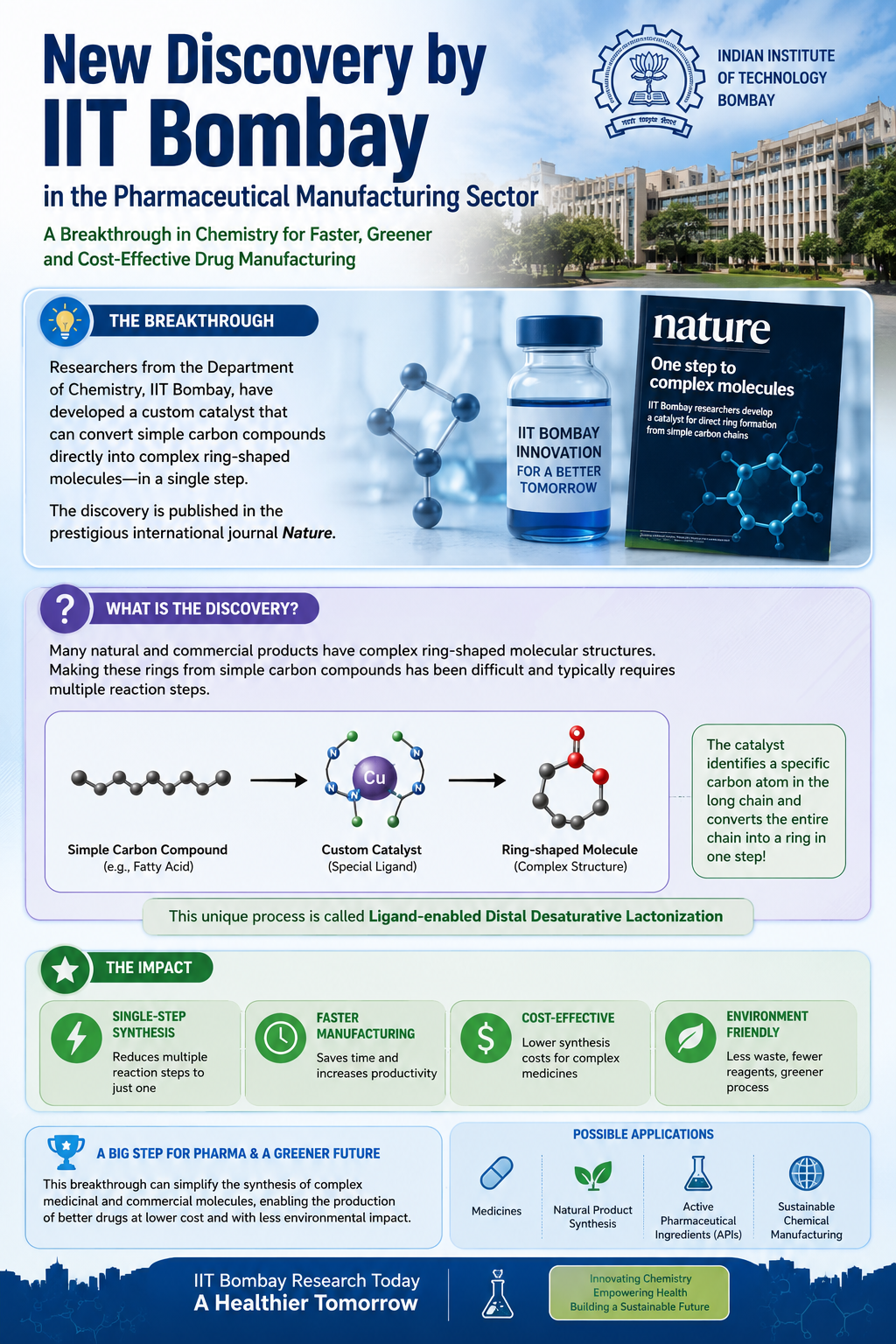
Recently, researchers from the Department of Chemistry at the Indian Institute of Technology (IIT) Bombay have made a significant breakthrough in pharmaceutical science that could make drug manufacturing faster, more cost-effective, and environmentally sustainable in the future. The research has been published in the prestigious international journal Nature.
About the Discovery:
-
-
- Many naturally occurring medicinal and commercial products possess complex ring-shaped molecular structures. Until now, converting simple carbon compounds (such as fatty acids) directly into these complex ring structures has been a difficult, time-consuming, and multi-step process.
- The IIT Bombay research team has developed a custom chemical entity (special catalyst) that can identify a specific carbon atom within a long carbon chain and transform the entire chain into a ring-shaped molecule. This chemical process is technically known as Ligand-enabled Distal Desaturative Lactonization. The technology enables the synthesis of complex molecules in a single-step process, significantly simplifying chemical manufacturing.
- Many naturally occurring medicinal and commercial products possess complex ring-shaped molecular structures. Until now, converting simple carbon compounds (such as fatty acids) directly into these complex ring structures has been a difficult, time-consuming, and multi-step process.
-
Industrial Applications:
This breakthrough extends far beyond laboratory research and has wide-ranging commercial and industrial applications:
-
-
- Pharmaceutical Industry: Complex anticancer compounds (such as Muricatacin) and other life-saving drugs can now be synthesized more quickly and at significantly lower costs.
- Perfumery and Fragrance Industry: Many natural fragrance compounds possess ring-shaped molecular structures. This technology will facilitate the artificial production of expensive fragrance ingredients.
- Agrochemicals: It can support the development of environmentally friendly and targeted pesticides and fertilizers.
- Green Chemistry: By reducing the number of reaction steps, the technology significantly lowers industrial waste generation and the emission of harmful by-products.
- Pharmaceutical Industry: Complex anticancer compounds (such as Muricatacin) and other life-saving drugs can now be synthesized more quickly and at significantly lower costs.
-
Significance of the Discovery:
-
-
- Self-Reliance in the Pharmaceutical Sector: This indigenous technology developed by IIT Bombay could become a milestone in reducing India's dependence on China for Active Pharmaceutical Ingredients (APIs) and strengthening self-reliance in pharmaceutical manufacturing.
- Modernization of Traditional Medicine (Ayurveda): India possesses a rich heritage of traditional medicinal knowledge. This technology can help synthesize complex bioactive molecules present in Ayurvedic herbs and natural products, facilitating their development into modern pharmaceutical drugs.
- Affordable Healthcare: Lower manufacturing costs will make life-saving medicines more affordable and accessible to the general public, contributing significantly to the achievement of Sustainable Development Goal (SDG)-3: Good Health and Well-being.
- Self-Reliance in the Pharmaceutical Sector: This indigenous technology developed by IIT Bombay could become a milestone in reducing India's dependence on China for Active Pharmaceutical Ingredients (APIs) and strengthening self-reliance in pharmaceutical manufacturing.
-
Existing Challenges in India's Pharmaceutical Sector:
Although India is known as the "Pharmacy of the World," the pharmaceutical industry continues to face several structural challenges:
-
-
- Dependence on Imported APIs: India is the world's largest producer of generic medicines, yet it still depends on China for nearly 70–80% of its Active Pharmaceutical Ingredients (APIs).
- Low Investment in Research and Development (R&D): Compared to global pharmaceutical giants, Indian companies focus primarily on generic medicines rather than new drug discovery, as pharmaceutical R&D requires substantial investment and involves high risk.
- Quality and Regulatory Challenges: Global regulatory agencies such as the U.S. Food and Drug Administration (USFDA) frequently adopt a stringent approach toward quality compliance issues at Indian pharmaceutical manufacturing facilities.
- Drug Price Control Policies: Government regulation of essential medicine prices under the Drug Price Control Order (DPCO) reduces profit margins, limiting pharmaceutical companies' ability to invest in research and innovation.
- Dependence on Imported APIs: India is the world's largest producer of generic medicines, yet it still depends on China for nearly 70–80% of its Active Pharmaceutical Ingredients (APIs).
-



