
New Particle Discovery at the Large Hadron Collider
Context:
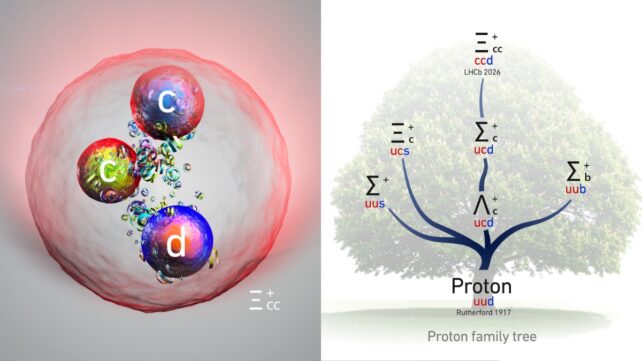
The CERN’s Large Hadron Collider has recently discovered a new subatomic particle named Xi-cc-plus (Ξcc⁺), marking the 80th particle identified at the world’s most powerful particle accelerator. This discovery has been made by the LHCb (Large Hadron Collider beauty) experiment after recent upgrades to the detector.
Understanding the Science behind the particle:
-
-
- All matter is composed of atoms, whose nuclei contain protons and neutrons. These, in turn, are made of smaller particles called quarks, which are the fundamental constituents of matter. Quarks exist in six types or “flavours”: up, down, charm, strange, top, and bottom.
- Particles made of three quarks are called baryons. Protons and neutrons are the most familiar baryons, composed of combinations of up and down quarks.
- The newly discovered Xi-cc-plus particle is unusual because:
- It contains two charm quarks and one down quark
- It is about four times heavier than a proton
- It is highly unstable and exists only for a very short duration
- It contains two charm quarks and one down quark
- Such particles are extremely difficult to detect because they decay almost instantly after being created in high-energy collisions.
- The particle is significant because it is a “doubly charmed baryon”, containing two heavy “charm” quarks and one lighter quark. Scientists believe that studying this particle will deepen our understanding of quantum mechanics and the strong nuclear force, which binds matter together.
- All matter is composed of atoms, whose nuclei contain protons and neutrons. These, in turn, are made of smaller particles called quarks, which are the fundamental constituents of matter. Quarks exist in six types or “flavours”: up, down, charm, strange, top, and bottom.
-
About Large Hadron Collider:
-
-
- The Large Hadron Collider is the world’s largest and most powerful particle accelerator, consisting of a 27-kilometre underground ring located beneath the France–Switzerland border.
- It works by accelerating particles, usually protons to near the speed of light and then colliding them. These collisions recreate conditions similar to those just after the Big Bang, allowing scientists to observe rare and exotic particles.
- Key features of the LHC’s functioning include:
- High-energy collisions that produce short-lived particles
- Detection of decay products to reconstruct original particles
- Advanced detectors like LHCb, designed to study rare particles and interactions
- High-energy collisions that produce short-lived particles
- The Large Hadron Collider is the world’s largest and most powerful particle accelerator, consisting of a 27-kilometre underground ring located beneath the France–Switzerland border.
-
Conclusion:
The discovery of the Xi-cc-plus particle at the Large Hadron Collider marks a significant milestone in humanity’s quest to understand the fundamental nature of matter. It highlights how even a small variation in particle composition such as replacing one quark, can lead to profound differences in behavior, revealing the complexity of the quantum world.



