
Hypersonic Missile Technology
Context:
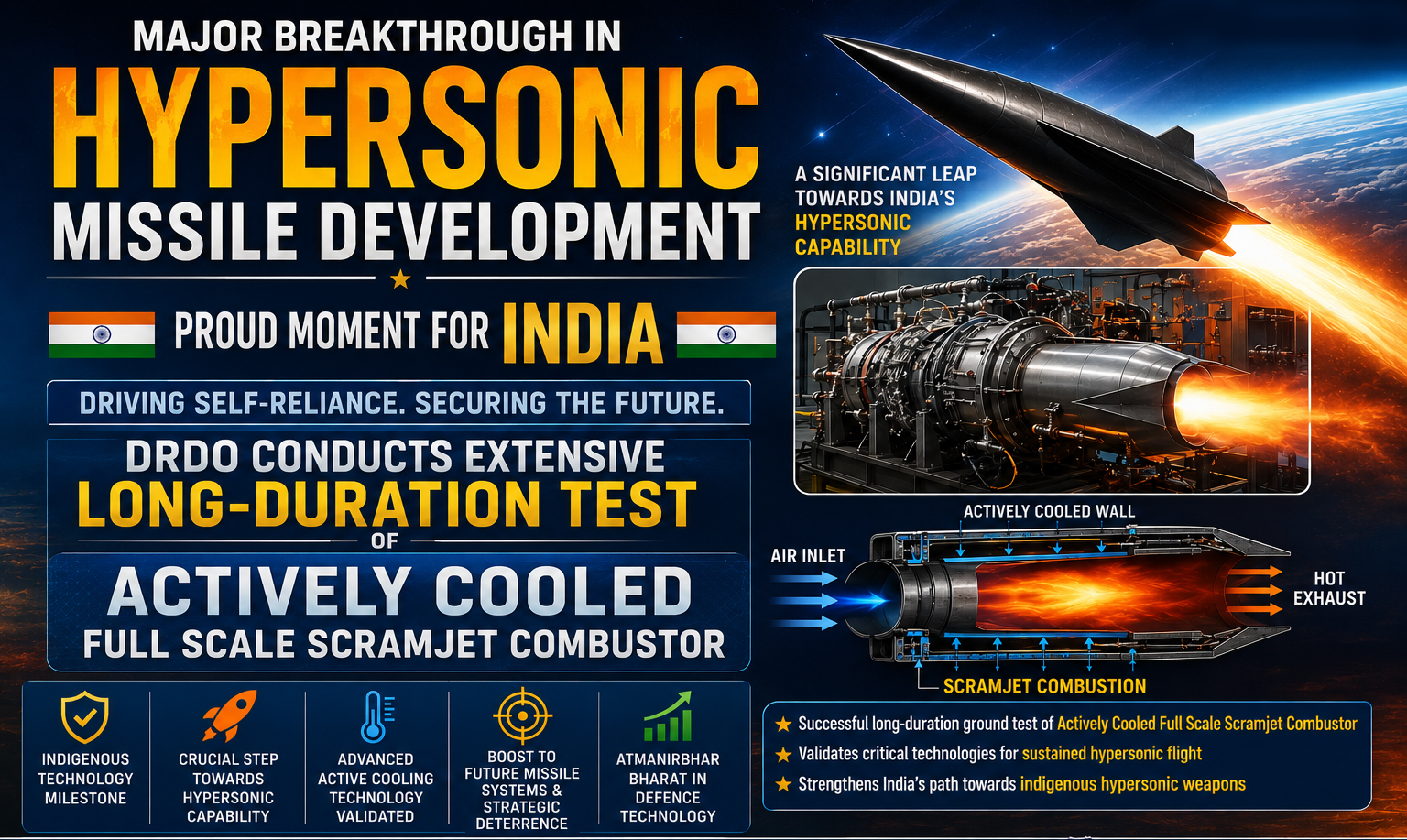
Recently, The Defence Research and Development Organisation’s Defence Research & Development Laboratory (DRDL) successfully conducted a long-duration test of an actively cooled full-scale scramjet combustor at Hyderabad. The combustor operated for over 1,200 seconds, surpassing the earlier 700-second test conducted in January 2026.
About Hypersonic Missiles:
-
-
- Hypersonic missiles are advanced weapons capable of traveling at speeds greater than Mach 5, nearly five times the speed of sound. These missiles are difficult to intercept because they combine extreme speed with maneuverability.
- Unlike conventional ballistic missiles that follow predictable paths, hypersonic missiles can change direction and fly at lower altitudes, making them harder to detect through radar and missile defence systems. Their development is rapidly transforming modern warfare and global strategic deterrence.
- Hypersonic missiles are advanced weapons capable of traveling at speeds greater than Mach 5, nearly five times the speed of sound. These missiles are difficult to intercept because they combine extreme speed with maneuverability.
-
Types of Hypersonic missiles:
-
-
- Hypersonic missiles are mainly classified into two categories: Hypersonic Glide Vehicles (HGVs) and Scramjet-powered Hypersonic Cruise Missiles.
- HGVs are launched using rockets and then glide toward targets at high speed while maneuvering unpredictably. In contrast, hypersonic cruise missiles are powered continuously by scramjet engines using atmospheric oxygen for combustion, enabling sustained hypersonic flight and greater fuel efficiency for long-range operations.
- Hypersonic missiles are mainly classified into two categories: Hypersonic Glide Vehicles (HGVs) and Scramjet-powered Hypersonic Cruise Missiles.
-
About Scramjet Engine:
A Scramjet, or Supersonic Combustion Ramjet, is an advanced air-breathing engine in which combustion occurs while airflow remains supersonic. Unlike conventional rockets, scramjets use atmospheric oxygen instead of carrying oxidizers, making them lighter and more efficient at very high speeds. However, maintaining stable combustion under such conditions is technologically challenging. The successful DRDL test demonstrates India’s progress in mastering this sophisticated propulsion technology.
Significance and Strategic Importance:
The successful 1,200-second test is a major breakthrough for India’s hypersonic programme. It validated the design of the actively cooled combustor and showcased indigenous technologies such as liquid hydrocarbon fuel and thermal barrier coatings. Hypersonic technology strengthens India’s strategic deterrence by improving long-range precision strike capability and reducing dependence on foreign defence systems under the vision of Atmanirbhar Bharat.
Conclusion:
Despite challenges such as extreme heat, guidance complexity, and high development costs, the DRDL scramjet test marks a historic achievement. It positions India among leading nations like the United States, Russia, and China in the global hypersonic race and enhances India’s future defence preparedness.



