
Context:
In recent times, Reservoir levels at India's major hydroelectric power plants have fallen to their lowest levels for the April–July period since 2023, primarily due to erratic weather conditions associated with El Niño. According to the Ministry of Power, reduced water availability has adversely affected hydropower generation, raising concerns over electricity supply, especially during peak demand.
Background:
Hydropower is a crucial component of India's energy mix, providing clean, renewable, and flexible electricity. It plays a vital role in meeting peak evening demand, particularly when solar power generation declines after sunset. However, deficient monsoon rainfall and uneven precipitation patterns have significantly reduced reservoir storage across the country.
Key Highlights:
-
-
- Out of 30 major hydropower reservoirs, 23 recorded lower water levels during April 1–July 30, 2026, compared to the same period last year.
- Electricity generation from large hydropower plants declined by 10.75%, falling from 60,522.95 Million Units (MU) to 54,019.42 MU.
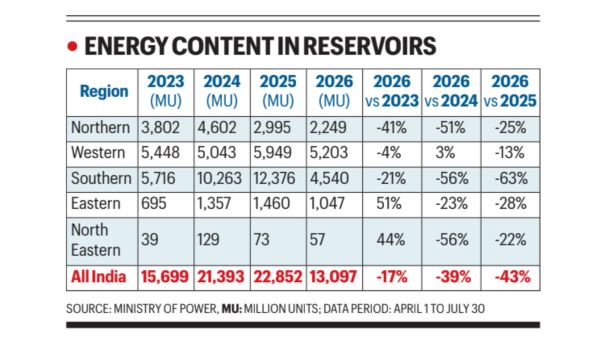
- The energy content of reservoirs, which indicates the electricity generation potential stored in water, declined by 43% year-on-year, 39% compared to 2024, and 17% compared to 2023.
- The southern region experienced the sharpest decline, with reservoir energy content falling by 63%, followed by eastern (28%), northern (25%), north-eastern (22%), and western (13%) regions.
- Out of 30 major hydropower reservoirs, 23 recorded lower water levels during April 1–July 30, 2026, compared to the same period last year.
-
Role of El Niño:
El Niño is the abnormal warming of sea surface temperatures in the central and eastern equatorial Pacific Ocean, which disrupts global atmospheric circulation. In India, El Niño is generally associated with weaker southwest monsoon rainfall, resulting in reduced inflows into reservoirs, lower hydropower generation, increased irrigation demand, and higher electricity consumption for cooling purposes.
Implications:
Lower hydropower generation has increased India's dependence on coal-based thermal power. Coal-fired electricity generation rose by 9.49% during April–July 2026 and by over 13% during July alone to compensate for the shortfall in hydroelectric output. Greater reliance on coal increases greenhouse gas emissions, raises fuel costs, and challenges India's commitments towards clean energy transition and climate goals. Reduced reservoir storage also affects irrigation, drinking water availability, and overall water security.
Way Forward:
India should strengthen integrated water resource management and improve reservoir operations through advanced forecasting and efficient water management systems.
Additionally, the country should:
-
-
- Diversify renewable energy sources by integrating energy storage systems.
- Expand Pumped Storage Hydropower Projects (PSPs) to enhance grid stability and energy security.
- Promote energy efficiency to reduce peak electricity demand.
- Strengthen coordination among water resource, power, and meteorological agencies for better planning and decision-making.
- Develop climate-resilient infrastructure to improve the resilience of the energy sector against climate-induced risks.
- Diversify renewable energy sources by integrating energy storage systems.
-
Conclusion:
The sharp decline in hydropower reservoir levels highlights the growing vulnerability of India's energy sector to climate variability. Building a resilient power system through diversified energy sources, efficient water management, and climate-adaptive planning will be critical for ensuring reliable electricity supply while advancing India's clean energy transition.



