
Context:
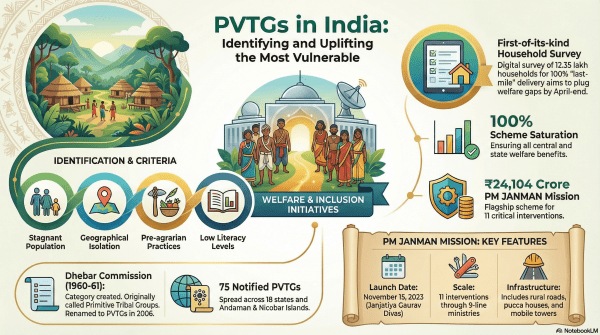
Recently, the Centre has directed states to complete the first-of-its-kind household survey of Particularly Vulnerable Tribal Groups (PVTGs) by April-end 2026. The survey aims to capture last-mile data on welfare scheme delivery, issue entitlement cards, and create a digital database for 12.35 lakh PVTG households through a dedicated app. The move also aligns with the potential inclusion of PVTGs in the upcoming national Census.
About PVTGs:
-
-
- PVTGs are a sub-category of Scheduled Tribes (STs) considered more vulnerable than other ST communities. Originally identified as “Primitive Tribal Groups” by the Dhebar Commission in 1960–61, they were renamed PVTGs in 2006.
- The criteria for PVTG classification include:
- declining or stagnant population,
- geographical isolation,
- pre-agrarian subsistence practices such as hunting and gathering,
- economic backwardness, and
- low literacy levels.
- declining or stagnant population,
- Currently, 75 PVTGs exist across 18 states and the Union Territory of Andaman and Nicobar Islands, including communities such as the Chenchu, Dongaria Khond, Bondo, Maria Gond, Jarawa, and Onge. These communities face marginalisation, limited access to basic services, low political representation, and high vulnerability to displacement.
- PVTGs are a sub-category of Scheduled Tribes (STs) considered more vulnerable than other ST communities. Originally identified as “Primitive Tribal Groups” by the Dhebar Commission in 1960–61, they were renamed PVTGs in 2006.
-
Key Government Initiatives:
-
-
- PM JANMAN Scheme:
- The Pradhan Mantri Janjati Adivasi Nyaya Maha Abhiyan (PM JANMAN), launched in November 2023 at Khunti, Jharkhand, targets all 75 PVTG communities with an outlay of ₹24,104 crore. Coordinated across nine ministries, it implements eleven key interventions, including rural roads, piped water supply, last-mile electrification, pucca housing, and mobile connectivity.
- A nationwide Information, Education, and Communication (IEC) campaign was also conducted to ensure the saturation of government schemes in PVTG-majority areas.
- The Pradhan Mantri Janjati Adivasi Nyaya Maha Abhiyan (PM JANMAN), launched in November 2023 at Khunti, Jharkhand, targets all 75 PVTG communities with an outlay of ₹24,104 crore. Coordinated across nine ministries, it implements eleven key interventions, including rural roads, piped water supply, last-mile electrification, pucca housing, and mobile connectivity.
- Other Welfare Schemes:
- The PVTG Development Plan focuses on education, healthcare, livelihoods, and the preservation of traditional knowledge.
- The Pradhan Mantri Janjatiya Vikas Mission (PMJVM) facilitates market linkages and the procurement of Minor Forest Produce at Minimum Support Prices.
- Additional programmes include:
- Pradhan Mantri Adi Adarsh Gram Yojana
- Integrated Tribal Development Project (ITDP)
- Tribal Sub-Plan (TSP)
- Eklavya Model Residential Schools
- Forest Rights Act, 2006
- SC/ST (Prevention of Atrocities) Act, 1989
- Panchayats (Extension to Scheduled Areas) Act, 1996
- Pradhan Mantri Adi Adarsh Gram Yojana
- The PVTG Development Plan focuses on education, healthcare, livelihoods, and the preservation of traditional knowledge.
- PM JANMAN Scheme:
-

Significance and Challenges:
-
-
- The survey and associated welfare initiatives represent a data-driven and targeted approach to tribal development. They address issues of marginalisation, poor access to services, and vulnerability to displacement, while promoting socio-economic inclusion.
- However, PVTGs continue to face challenges due to geographical isolation, limited literacy, and weak political representation, making effective implementation and monitoring crucial.
- The survey and associated welfare initiatives represent a data-driven and targeted approach to tribal development. They address issues of marginalisation, poor access to services, and vulnerability to displacement, while promoting socio-economic inclusion.
-
Conclusion:
The PVTG household survey and initiatives such as PM JANMAN highlight India’s efforts to ensure inclusive development for the most marginalised tribal communities. Strengthening last-mile delivery of entitlements remains critical for the sustainable and equitable growth of PVTGs.



