
Context:
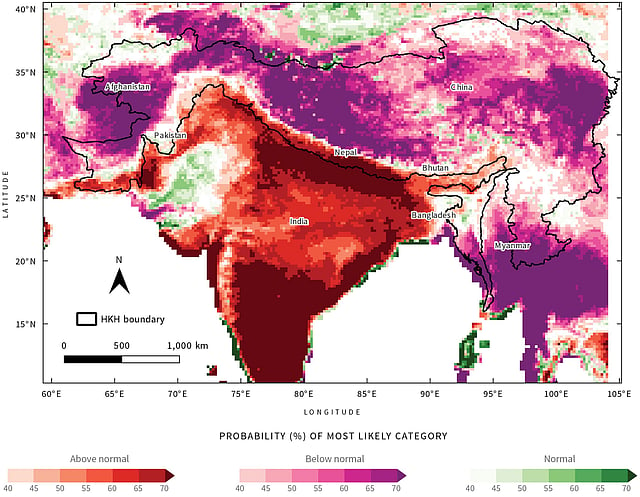
Recently, the “HKH Monsoon Outlook 2026” report jointly released by the International Centre for Integrated Mountain Development and Institute of Atmospheric Physics has predicts a weak or drier monsoon in the Hindu Kush Himalaya (HKH) region.
Key Findings of the Analysis:
-
-
- The HKH Monsoon Outlook 2026 indicates that likely El Niño conditions may weaken the South Asian monsoon, leading to reduced rainfall. Above-normal temperatures are expected to increase heat stress and water loss.
- Low winter snow persistence further reduces seasonal water storage, increasing dependence on monsoon rainfall and groundwater. Despite overall drier conditions, short-duration extreme rainfall events may still trigger floods and landslides in the region.
- The HKH Monsoon Outlook 2026 indicates that likely El Niño conditions may weaken the South Asian monsoon, leading to reduced rainfall. Above-normal temperatures are expected to increase heat stress and water loss.
-
About the Hindu Kush Himalaya (HKH) Region:
-
-
- The HKH region spans 3,500 km across eight countries—Afghanistan, Bangladesh, Bhutan, China, India, Myanmar, Nepal, and Pakistan.
- Known as the “Water Tower of Asia,” it contains the largest ice and snow reserves outside the polar regions and feeds major rivers like the Ganga, Brahmaputra, and Indus, supporting nearly 1.9 billion people.
- The HKH region spans 3,500 km across eight countries—Afghanistan, Bangladesh, Bhutan, China, India, Myanmar, Nepal, and Pakistan.
-
Causes behind the Drier Monsoon:
-
-
- El Niño conditions, marked by warm Pacific Ocean waters, are the main factor weakening the monsoon. Below-normal Northern Hemisphere snow cover also contributes to reduced rainfall. Although a possible positive Indian Ocean Dipole (IOD) may partly offset these effects, uncertainty remains.
- El Niño conditions, marked by warm Pacific Ocean waters, are the main factor weakening the monsoon. Below-normal Northern Hemisphere snow cover also contributes to reduced rainfall. Although a possible positive Indian Ocean Dipole (IOD) may partly offset these effects, uncertainty remains.
-
What is Ecological Concerns?
The HKH region is warming almost twice as fast as the global average, accelerating glacier melt and increasing risks of Glacial Lake Outburst Floods (GLOFs). Long-term glacier loss threatens water security, even though short-term river flows may increase. The region is also highly biodiverse and ecologically fragile.
What is significance for India?
India depends heavily on HKH-origin rivers for agriculture, hydropower, and drinking water. Changes in monsoon patterns and glacier melt directly impact water availability and disaster risk, making climate adaptation and water management critical.
Conclusion:
A drier monsoon in the HKH region does not reduce climate risks. Rising temperatures, glacier retreat, and extreme rainfall events continue to threaten water security and livelihoods, requiring stronger resilience and cooperation.
Frequently Asked Question (FAQ)-
What is the HKH Monsoon Outlook 2026?
It is a report by International Centre for Integrated Mountain Development and the Institute of Atmospheric Physics predicting a weak/drier monsoon in the Hindu Kush Himalaya region.
Why is the 2026 monsoon expected to be weaker?
Main reasons include likely El Niño conditions, below-normal snow cover, and changes in ocean–atmosphere interactions like the Indian Ocean Dipole.
Why is the HKH region important for Asia?
It spans 3,500 km across 8 countries and is called the “Water Tower of Asia,” feeding major rivers like the Ganga, Brahmaputra, and Indus, supporting nearly 1.9 billion people.
Can a drier monsoon still cause disasters?
Yes. Even with lower rainfall, short intense rainfall events can trigger floods, landslides, and Glacial Lake Outburst Floods (GLOFs).
What is the significance for India?
India depends heavily on HKH river systems for agriculture, drinking water, and hydropower, so changes in monsoon and glacier melt directly affect water security and disaster risk.
Consider the following rivers originating from the Hindu Kush Himalaya (HKH) region:
1. Ganga
2. Brahmaputra
3. Indus
4. Mekong
How many of the rivers mentioned above are fed by the HKH region's ice and snow reserves?
A) One only
B) Two only
C) Three only
D) All four
Correct Answer: D
Explanation:
The Hindu Kush Himalaya (HKH) is known as the "Water Tower of Asia" and possesses the largest ice and snow reserves outside the polar regions. It is the origin point of ten major Asian river systems that support the water and food security of nearly two billion people. These include the Ganga, Brahmaputra, Indus, Mekong, Yangtze, and Irrawaddy, among others.



