
Context:
Recently, the Himalayan Monal, the state bird of Uttarakhand, has drawn scientific attention. Two five-year studies conducted by researchers at Hemvati Nandan Bahuguna Garhwal University (HBGU) have highlighted the emerging impacts of anthropogenic noise and climate change on its behaviour and habitat suitability.
About the Himalayan Monal:
-
-
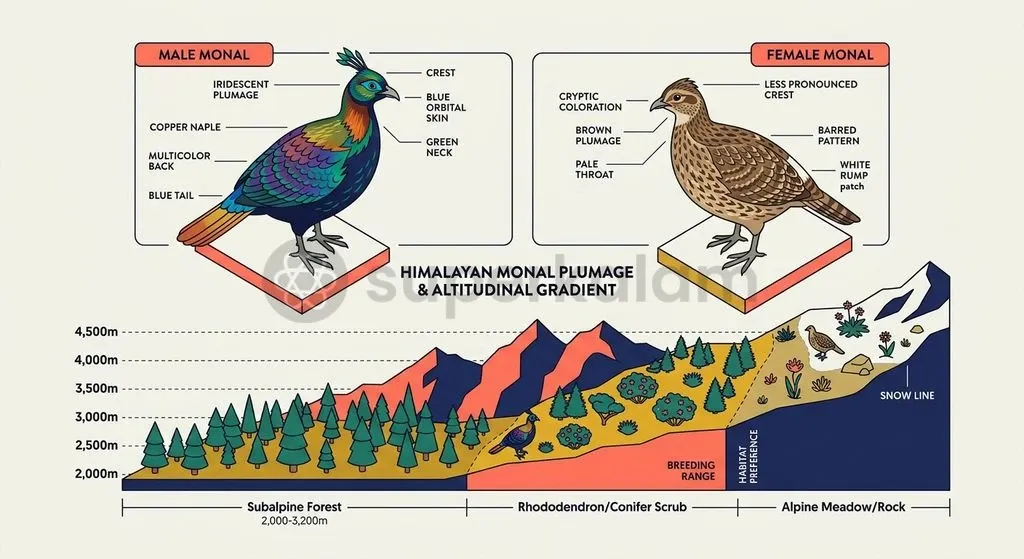
- The Himalayan Monal (Lophophorus impejanus) is a striking Himalayan pheasant and ground-dwelling bird found across the Himalayan region. Its distribution includes Jammu and Kashmir, Himachal Pradesh, Uttarakhand and Sikkim, among other Himalayan areas.
- It is generally found in sub-alpine and alpine areas, oak-mixed forests, coniferous forests, rhododendron scrub and mountain grasslands. According to research, it can occur at elevations of approximately 2,400–4,500 metres and changes its altitude seasonally.
- State Bird: Uttarakhand
- IUCN Status: Least Concern
- Habitat: Himalayan forests, alpine grasslands and high-altitude ecosystems
- Distribution: Himalayan region
- State Bird: Uttarakhand
-
Impact of Anthropogenic Noise:
-
-
- Researchers compared Himalayan Monal populations in two areas of the Kedarnath Musk Deer Sanctuary:
- Madmaheshwar Valley: A relatively quiet area with limited human disturbance and no roads.
- Chopta Valley: An area with greater tourism, pilgrimage, traffic and human activities.
- Madmaheshwar Valley: A relatively quiet area with limited human disturbance and no roads.
- Using Passive Acoustic Monitoring, researchers recorded hundreds of Monal calls across different seasons. They found that Monals in the noisier Chopta Valley used calls with higher frequency and greater amplitude compared to birds living in relatively quieter habitats.
- This indicates that the Monal has the capacity to adjust or modify its vocalisations in response to noisy environments.
- Researchers compared Himalayan Monal populations in two areas of the Kedarnath Musk Deer Sanctuary:
-
Why is this Important?
-
-
- Monal calls are important for communication, social behaviour and reproduction. The reproductive calls of male Monals play an important role in attracting females. Increasing anthropogenic noise can potentially cause acoustic masking, making communication between birds more difficult.
- However, researchers have not yet established that these changes in vocalisations are directly resulting in a decline in reproductive success.
- Monal calls are important for communication, social behaviour and reproduction. The reproductive calls of male Monals play an important role in attracting females. Increasing anthropogenic noise can potentially cause acoustic masking, making communication between birds more difficult.
-
Conclusion:
The Himalayan Monal case demonstrates that conservation should not be limited to preventing a decline in the population of a species. Noise pollution, climate-driven habitat changes and habitat fragmentation can affect animal behaviour and ecological interactions even before a species becomes endangered. Therefore, for the long-term conservation of Himalayan biodiversity, it will be important to properly manage tourism activities while maintaining natural habitats and connectivity between them (Habitat Connectivity).



