
Context:
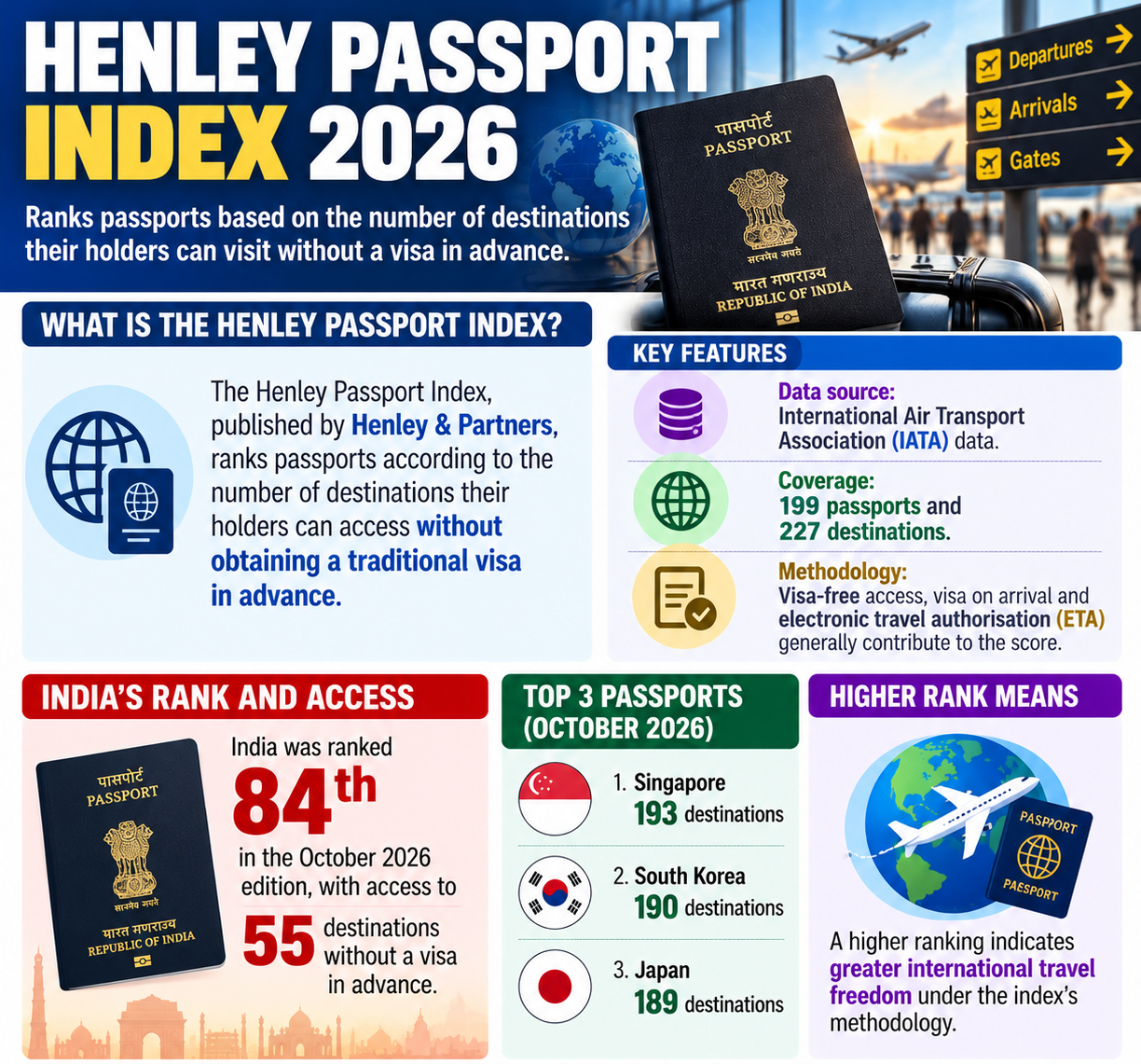
Recently, The Henley Passport Index released its October 2026 edition. The index ranks passports according to the number of destinations their holders can access without obtaining a visa in advance. India was reported at 84th position in the October edition, with access to 55 destinations.
What Is the Henley Passport Index?
The Henley Passport Index, published by Henley & Partners, ranks passports according to the number of destinations their holders can access without obtaining a traditional visa in advance.
-
-
- Data source: International Air Transport Association (IATA) data.
- Coverage: 199 passports and 227 destinations.
- Methodology: Visa-free access, visa on arrival and electronic travel authorisation (ETA) generally contribute to the score.
- Data source: International Air Transport Association (IATA) data.
-
A higher ranking indicates greater international travel freedom under the index's methodology.
Key Findings of the 2026 Edition:
-
-
- India: Reported 84th, with access to 55 destinations.
- Singapore: Ranked first, with access to 193 destinations.
- Japan, South Korea and the UAE: Jointly ranked second, with access to 188 destinations each.
- Sweden: Ranked third, with access to 187 destinations.
- India: Reported 84th, with access to 55 destinations.
-
India's Performance:
-
-
- India improved from 85th position in October 2025 to 84th in October 2026. However, the number of destinations accessible without obtaining a traditional visa beforehand declined from 57 to 55.
- This demonstrates that a country's relative ranking may improve even when its absolute score declines, depending on changes in the scores of other countries.
- India improved from 85th position in October 2025 to 84th in October 2026. However, the number of destinations accessible without obtaining a traditional visa beforehand declined from 57 to 55.
-
Significance for India:
-
-
- Diplomatic relations: Visa liberalisation agreements can strengthen bilateral cooperation.
- Economic growth: Easier travel supports tourism, business visits, trade and professional exchanges.
- People-to-people ties: Mobility facilitates education, cultural interaction and family connections.
- Global integration: Passport mobility provides an indicator of India's international connectivity, though it does not measure overall national power.
- Diplomatic relations: Visa liberalisation agreements can strengthen bilateral cooperation.
-
Conclusion:
The Henley Passport Index highlights the growing importance of international mobility in an interconnected world. India can improve travel access through sustained diplomatic engagement and mutually beneficial agreements.



