
Context:
A recent study published in Clean Air found a sharp rise in ground-level (surface) ozone pollution due to severe heatwaves in India. In 2024 alone, the study estimates over 830 deaths in India linked to heatwave-driven ozone pollution.
What is Ground-Level Ozone?
Ozone (O₃) exists in two forms:
-
- Stratospheric ozone (15–50 km above Earth)
- Forms the ozone layer
- Protects Earth from harmful ultraviolet (UV) radiation
- Acts as a natural “sunshield”
- Forms the ozone layer
- Ground-level (tropospheric) ozone
- A harmful air pollutant
- Not directly emitted, but formed through photochemical reactions involving:
- Nitrogen oxides (NOₓ)
- Volatile organic compounds (VOCs)
- Sunlight and high temperature
- Nitrogen oxides (NOₓ)
- A harmful air pollutant
- Stratospheric ozone (15–50 km above Earth)
Thus, unlike protective ozone aloft, ground-level ozone is a secondary pollutant with toxic impacts on human health and ecosystems.
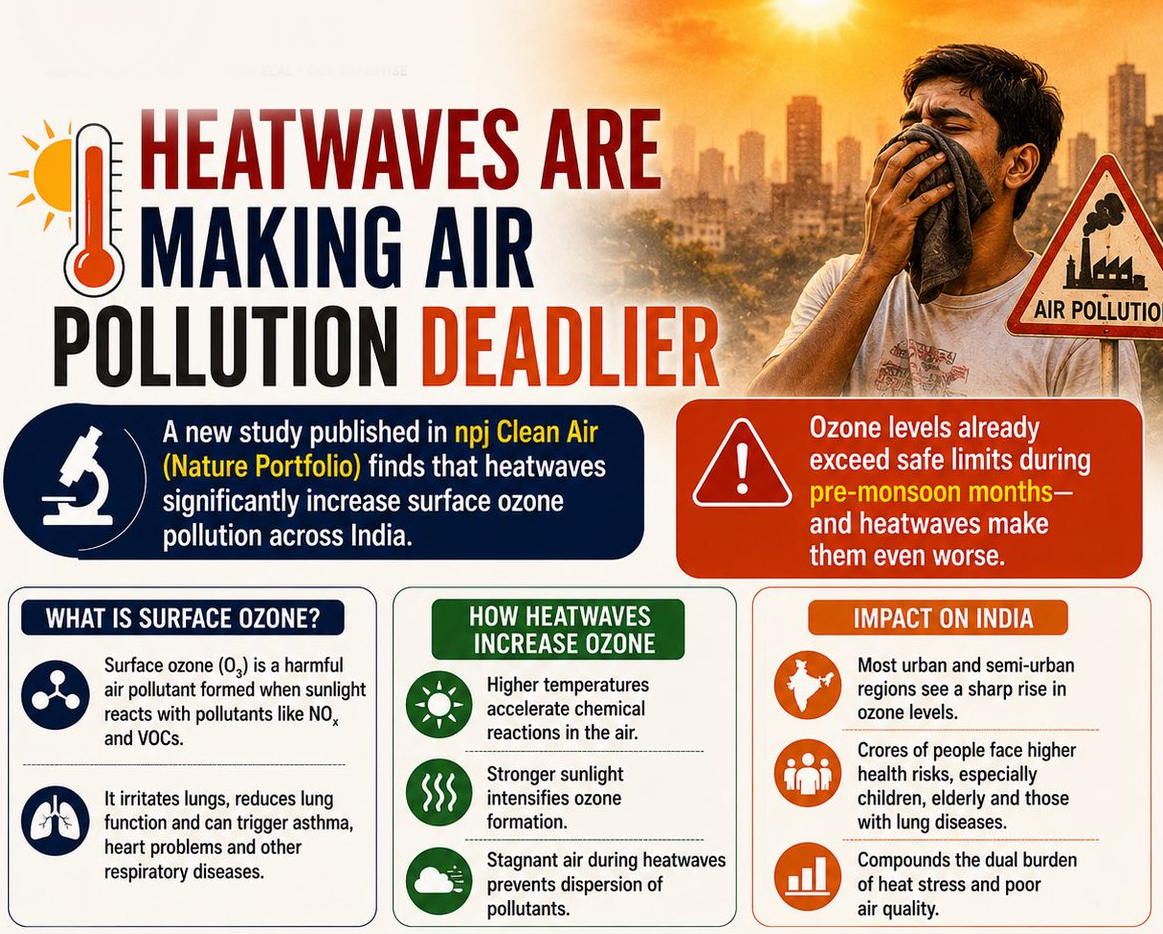
Key Findings of the Study:
Heatwaves significantly increase ozone levels
-
-
- Heat accelerates chemical reactions producing ozone
- Ozone concentrations rise sharply during heatwave days
- Levels often exceed safe limits across Indian regions
- Heat accelerates chemical reactions producing ozone
-
Unsafe baseline pollution in India
-
-
- Safe level: ~30 parts per billion (ppb) (~60 µg/m³)
- India’s background levels: ~50–55 ppb already high
- During heatwaves, levels increase further, often exceeding WHO guidelines
- Safe level: ~30 parts per billion (ppb) (~60 µg/m³)
-
Regional hotspots
-
-
- Northwest India and Indo-Gangetic Plain (IGP) show the highest ozone concentrations
- These regions combine:
- High pollution load
- Dense population
- Strong heatwave intensity
- High pollution load
- Northwest India and Indo-Gangetic Plain (IGP) show the highest ozone concentrations
-
Why Heatwaves Increase Ozone Concentration:
Heatwaves act as a chemical amplifier of pollution due to:
-
- Faster photochemical reactions under high temperature
- Strong sunlight intensity increasing ozone formation
- Atmospheric stagnation, reducing pollutant dispersion
- Urban emissions of NOₓ and VOCs acting as precursors
- Climate change-induced frequency of heat extremes
- Faster photochemical reactions under high temperature
Broader Implications:
-
-
- Climate–Air Pollution Nexus: Heatwaves and ozone pollution reinforce each other, creating a compound hazard that increases mortality risk.
- Agricultural damage: Ground-level ozone reduces crop yield by damaging plant tissues and lowering photosynthesis.
- Urban vulnerability: Highly polluted urban clusters in northern India face dual stress of heat and toxic air.
- Climate–Air Pollution Nexus: Heatwaves and ozone pollution reinforce each other, creating a compound hazard that increases mortality risk.
-
Policy Suggestions:
To address this emerging threat, the study highlights the need for:
-
- Real-time ozone monitoring during heatwaves
- Inclusion of ozone in heatwave health alerts (IMD & CPCB)
- Reduction of NOₓ and VOC emissions from transport and industries
- Expansion of urban green cover to reduce heat intensity
- Development of integrated heat–air pollution early warning systems
- Real-time ozone monitoring during heatwaves
Conclusion:
The study clearly establishes that heatwaves are not only thermal hazards but also drivers of toxic air pollution episodes, particularly ground-level ozone formation. With climate change increasing both heatwave frequency and intensity, India may face a growing burden of combined heat and air pollution stress unless mitigation measures are urgently strengthened.



