
Context:
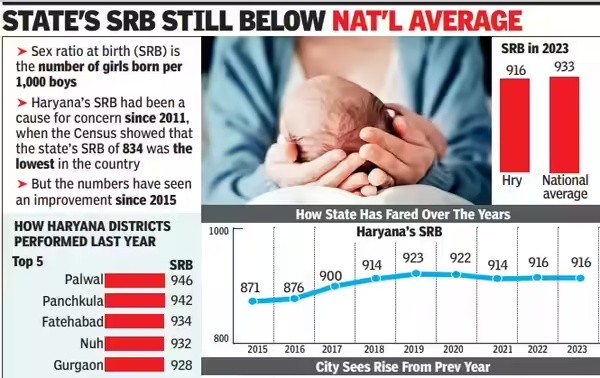
Haryana, once among India’s worst performers in terms of sex ratio at birth (SRB), has witnessed a remarkable improvement over the last decade. From 834 girls per 1,000 boys in 2011, the state’s SRB rose to 923 in 2025, approaching the national average of 933. This turnaround reflects a combination of legal enforcement, administrative monitoring, community engagement, and innovative policy interventions.
Key Measures Undertaken:
1. Strict Enforcement of PNDT and MTP Acts
-
-
- Haryana registered 1,375 FIRs between 2015 and 2025 against medical practitioners and owners of ultrasound centres.
- District-wise action targeted urban centres such as Faridabad (126 FIRs), Sonipat (115), and Gurugram (112), along with Tier II districts including Ambala, Hisar, and Kurukshetra.
- Haryana registered 1,375 FIRs between 2015 and 2025 against medical practitioners and owners of ultrasound centres.
-
2. Inter-State Raids
-
-
- To prevent residents from seeking illegal sex-determination tests outside the state, 218 raids were conducted in Uttar Pradesh, 89 in Delhi, 83 in Punjab, and 26 in Rajasthan in 2025.
- Coordination with neighbouring states proved crucial in overcoming logistical and intelligence-related challenges.
- To prevent residents from seeking illegal sex-determination tests outside the state, 218 raids were conducted in Uttar Pradesh, 89 in Delhi, 83 in Punjab, and 26 in Rajasthan in 2025.
-
3. Technological and Administrative Innovations
-
-
- RCHID (Reproductive and Child Health ID): A 12-digit unique ID for every pregnant woman improved registration rates by 37 percentage points.
- Monitoring programmes: Initiatives such as Saheli, involving ASHA and anganwadi workers, specifically monitored pregnant women with daughters, reducing trimester-wise abortion rates by 57 percentage points within one year.
- Regular inspections, WhatsApp-based communication with ultrasound centres, and quarterly review meetings ensured accountability.
- RCHID (Reproductive and Child Health ID): A 12-digit unique ID for every pregnant woman improved registration rates by 37 percentage points.
-
4. Incentives and Community Participation
-
-
- Informers reporting illegal practices were rewarded, with total payouts amounting to approximately ₹5 crore over 10 years.
- Police decoys, often women with a personal stake in gender equity, were deployed to detect illegal operations.
- Informers reporting illegal practices were rewarded, with total payouts amounting to approximately ₹5 crore over 10 years.
-
5. Legal and Penal Action
-
-
- Violations resulted in cancellation of licences, seizure of equipment, and prosecution of medical personnel.
- Special task forces tracked the illegal sale of MTP kits and portable ultrasound machines in the black market.
- Violations resulted in cancellation of licences, seizure of equipment, and prosecution of medical personnel.
-
About Sex Ratio at Birth (SRB):
-
-
- The sex ratio at birth (SRB) is defined as the number of male births per 100 female births, with the natural biological norm being around 105 males per 100 females (approximately 105:100). Deviations from this ratio, particularly lower female births, often indicate sex-selective practices such as prenatal sex determination and selective abortion.
- The sex ratio at birth (SRB) is defined as the number of male births per 100 female births, with the natural biological norm being around 105 males per 100 females (approximately 105:100). Deviations from this ratio, particularly lower female births, often indicate sex-selective practices such as prenatal sex determination and selective abortion.
-
Scheme to Improve Sex Ratio at Birth (SRB):
Beti Bachao Beti Padhao (BBBP)
-
-
- Launched in 2015 to improve SRB and promote the survival, protection, and education of the girl child.
- Follows a multi-sectoral approach integrating awareness generation, health interventions, education, and legal enforcement.
- Works in convergence with schemes such as Poshan Abhiyaan and the Pradhan Mantri Matru Vandana Yojana.
- Launched in 2015 to improve SRB and promote the survival, protection, and education of the girl child.
-
Conclusion:
Haryana’s experience provides a blueprint for states grappling with skewed sex ratios. Sustained political will, strong inter-departmental coordination, technology-driven monitoring, and active community participation can effectively counter gender-based discrimination and promote the welfare of the girl child. Continuous vigilance and innovation remain essential to consolidate gains and extend progress to lagging districts.



