
Growing Culture of Freebies: Fiscal Impact & Social Equity
Context:
The Supreme Court of India recently raised a serious alarm over the increasing trend of state governments offering freebies to citizens, particularly in the lead-up to elections. The apex court warned that such practices could endanger fiscal discipline, undermine economic growth, distort markets, and even erode the work ethic of citizens. The bench questioned whether these handouts, often distributed without targeting the genuinely needy, amounted to a form of political appeasement. These observations have reignited a national debate on the line between welfare and populism.
Understanding Freebies:
-
-
- Although widely discussed in political discourse, there is no precise legal definition of freebies. According to the Reserve Bank of India, freebies are: “A public welfare measure that is provided free of charge.”
- Typically, freebies are announced by political parties during election campaigns, promising short-term benefits such as free electricity, water, laptops, cycles, or even debt waivers. Over the years, such measures have become an integral part of Indian electoral politics, with the distinction between welfare and giveaways often blurred.
- Although widely discussed in political discourse, there is no precise legal definition of freebies. According to the Reserve Bank of India, freebies are: “A public welfare measure that is provided free of charge.”
-
Welfarism vs. Freebies:
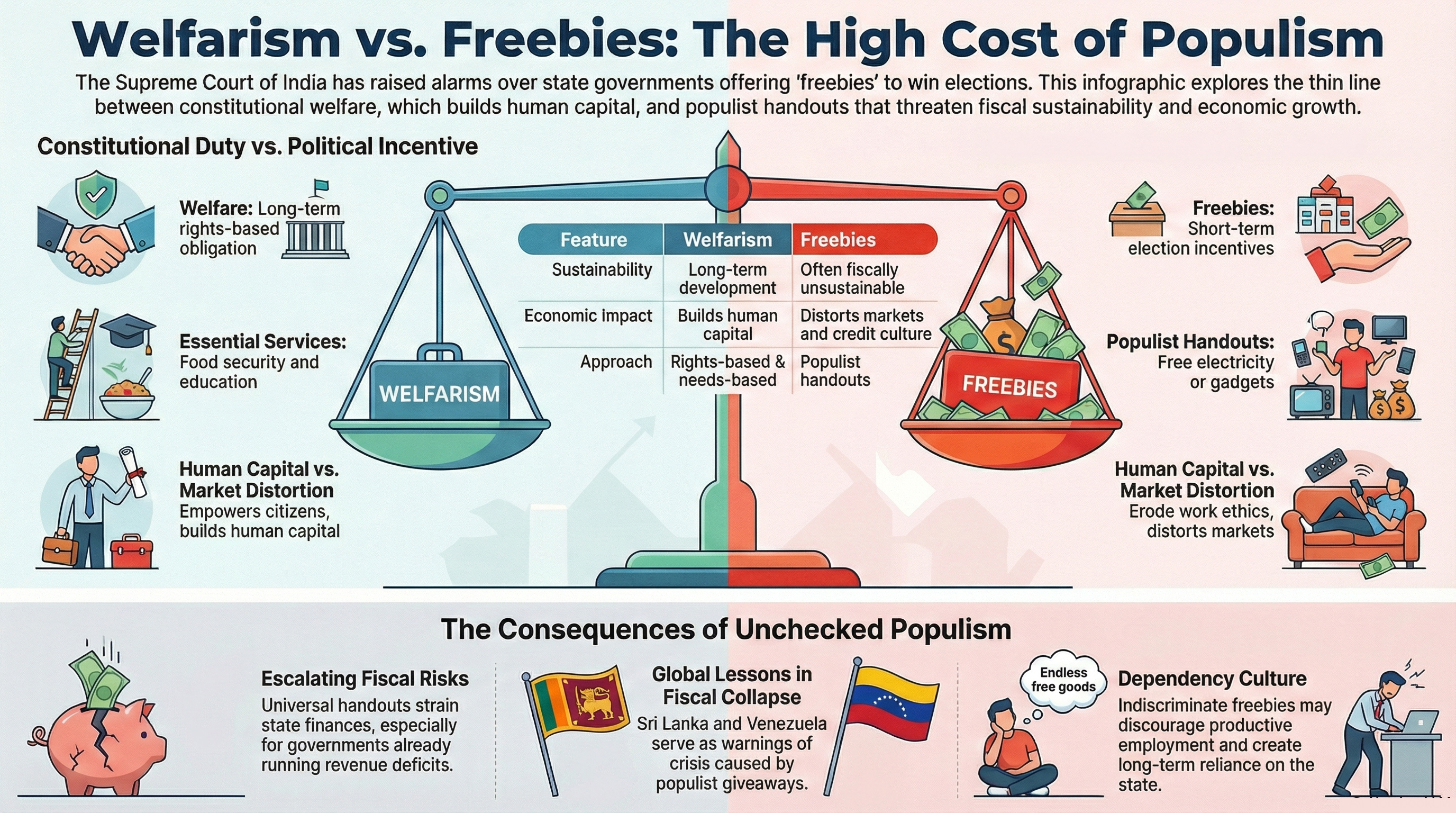
It is critical to differentiate welfare programs from political freebies. While welfare initiatives aim for sustainable social development, freebies are often transient measures designed to secure votes.
|
Aspect |
Welfarism |
Freebies |
|
Root |
Constitutional duty |
Short-term political incentive |
|
Examples |
Food security (PDS), jobs (MGNREGA), education/health support |
Free electricity, water, debt waivers |
|
Sustainability |
Long-term |
Often unsustainable |
|
Economic Impact |
Builds human capital |
Distorts markets, erodes credit culture, discourages work |
|
Approach |
Rights-based, needs-based, or charity-based |
Populist handouts |
Approaches to Welfarism:
-
-
- Charity Approach: Focuses on inputs rather than outcomes, recognizes moral responsibility of the rich, and views individuals as victims.
- Needs-Based Approach: Addresses inputs and outcomes to meet identified needs, seeing individuals as objects of development interventions.
- Rights-Based Approach: Emphasizes process and outcome, where citizens are empowered to claim their rights, and structural causes of problems are addressed.
- Charity Approach: Focuses on inputs rather than outcomes, recognizes moral responsibility of the rich, and views individuals as victims.
-
Supreme Court Observations on Freebies:
-
-
- The apex court, in hearings involving petitions challenging the distribution of freebies by Tamil Nadu Power Distribution Corporation Ltd, observed that universal handouts, such as free electricity without income distinction—raise questions of financial prudence and political motivation.
- Key observations from the bench included:
- Freebies without targeting the needy could strain state finances, especially for states running revenue deficits.
- Political giveaways may undermine work culture, as citizens may become reliant on free provisions rather than engage in productive employment.
- Welfare should focus on long-term development, employment generation, and sustainable social support rather than transient handouts aimed at garnering votes.
- The apex court, in hearings involving petitions challenging the distribution of freebies by Tamil Nadu Power Distribution Corporation Ltd, observed that universal handouts, such as free electricity without income distinction—raise questions of financial prudence and political motivation.
-
Constitutional and Legal Perspectives:
-
-
-
- The Supreme Court has consistently framed the debate around freebies within constitutional provisions and the Directive Principles of State Policy (DPSP):
- Articles 38, 39, 41 of the Constitution stress the state’s responsibility to:
- Promote social welfare and economic justice.
- Ensure adequate means of livelihood for citizens.
- Prevent excessive concentration of wealth.
- Provide rights to work, education, and public assistance in specified cases.
- Promote social welfare and economic justice.
- The Supreme Court has consistently framed the debate around freebies within constitutional provisions and the Directive Principles of State Policy (DPSP):
-
-
Key Judicial Interventions:
-
-
- Subramaniyam Balaji Case (2013): A two-judge bench ruled that distributing goods like laptops and color TVs to eligible citizens aligns with DPSPs and does not warrant judicial interference.
- Ashwini Kumar Upadhyay v Union of India: Challenges the legality of offering and distributing freebies during election campaigns.
- Subramaniyam Balaji Case (2013): A two-judge bench ruled that distributing goods like laptops and color TVs to eligible citizens aligns with DPSPs and does not warrant judicial interference.
-
Election Commission Guidelines:
The Election Commission of India has emphasized transparency in electoral promises, urging political parties to disclose funding mechanisms for freebies. This measure aims to curb excessive populism and ensure electoral accountability.
Impacts of Freebies:
Freebies, while sometimes beneficial in alleviating immediate hardship, carry significant economic and social risks.
|
Positive (Welfarism) |
Negative (Freebies) |
|
Fulfillment of basic needs (food, health, education) |
Financial burden on government, fiscal deficits |
|
Addresses social and gender disparities |
Dependency culture, reduced motivation/productivity |
|
Promotes inclusivity and social mobility |
Undermines sustainable growth, affects intergenerational equity |
|
Political participation and voter engagement |
Used as populist tools to secure votes |
|
Mitigates market failure by addressing underemployment |
Diverts resources from investments, undermines market competitiveness |
Experts note that in recent times, the distinction between welfare programs and freebies has often vanished, with the two being used almost interchangeably in political discourse.
Policy Reforms and Recommendations:
-
-
- To ensure welfare remains sustainable and political freebies do not compromise economic and social development, several steps are proposed:
- Fiscal Prudence and Debt Management: Prioritize sustainable welfare schemes with sunset clauses while maintaining fiscal discipline.
- Prevent Leakages and Corruption: Ensure subsidies reach intended beneficiaries without diversion or fraud.
- Expand Insurance Coverage: Protect vulnerable populations against shocks such as pandemics or natural disasters.
- Political Consensus: Central and state governments should coordinate to prevent misuse of welfare schemes for vote-bank politics.
- Election Commission Oversight: Enforce transparency in manifestos and funding of freebies to avoid competitive populism.
- Skill Development and Self-Reliance: Empower individuals to reduce long-term dependency on freebies.
- Voter Awareness Programs: Educate citizens about the long-term costs and consequences of freebies to encourage informed voting.
- Judicial Oversight and Expert Committees: Bodies comprising members of NITI Aayog, RBI, and Finance Commission can evaluate the socioeconomic impacts of freebies.
- Fiscal Prudence and Debt Management: Prioritize sustainable welfare schemes with sunset clauses while maintaining fiscal discipline.
- To ensure welfare remains sustainable and political freebies do not compromise economic and social development, several steps are proposed:
-
Global Lessons:
-
-
- Sri Lanka (2019): Election-promise tax cuts and giveaways led to a severe fiscal crisis.
- Venezuela: Populist freebies and debt waivers contributed to prolonged economic collapse.
- Sri Lanka (2019): Election-promise tax cuts and giveaways led to a severe fiscal crisis.
-
Welfare vs Populism:
-
-
- The Supreme Court’s observations are a reminder of the delicate balance between fulfilling the constitutional mandate of welfare and avoiding unsustainable populist handouts. Welfare programs aim to build human capital, alleviate poverty, and empower citizens, whereas unchecked freebies risk eroding fiscal discipline, distorting markets, and creating dependency culture.
- While welfare is legally and morally necessary, indiscriminate giveaways, especially during elections, can compromise long-term development and economic stability. The judiciary’s warnings underscore the need for targeted, sustainable, and transparent policies that prioritize human development and social equity over short-term political gains.
- The Supreme Court’s observations are a reminder of the delicate balance between fulfilling the constitutional mandate of welfare and avoiding unsustainable populist handouts. Welfare programs aim to build human capital, alleviate poverty, and empower citizens, whereas unchecked freebies risk eroding fiscal discipline, distorting markets, and creating dependency culture.
-
Conclusion:
India’s democracy and constitutional framework emphasize the state’s duty to ensure social welfare, but the line between welfare and political freebies has blurred. The Supreme Court’s intervention serves as a critical reminder that public resources should be used prudently, sustainably, and equitably.
| UPSC/PCS Mains Practice Question: How might the growing trend of freebies affect the Indian economy and social structure? Critically analyse. |



