
Context:
Recently, astronomers have identified a star with an unusual yellowish-green glow, challenging what scientists know about the colours of stars. The white dwarf, WD J1330+6435, exhibits this unusual colour due to the interaction of sodium with helium under the extreme density conditions of its atmosphere. The discovery highlights how atomic physics and spectroscopy help explain unusual astronomical phenomena and improve our understanding of stellar evolution.
What Is a White Dwarf?
-
-
- A white dwarf is the extremely dense, hot stellar remnant left behind after a low- or intermediate-mass star, such as the Sun, exhausts its nuclear fuel and sheds its outer layers. It forms when the star evolves into a red giant and expels its outer material, often creating a planetary nebula.
- A white dwarf typically has a mass comparable to the Sun but a size similar to Earth, making it one of the densest objects in the universe. It no longer produces energy through nuclear fusion and is supported against gravitational collapse by electron degeneracy pressure, a consequence of the Pauli Exclusion Principle.
- The Chandrasekhar limit, approximately 1.4 times the Sun’s mass, represents the maximum mass a white dwarf can stably support. Beyond this limit, it may trigger a Type Ia supernova under suitable conditions. Over billions of years, a white dwarf gradually cools and may theoretically become a black dwarf. However, the universe is not yet old enough for any black dwarfs to have formed.
- A white dwarf is the extremely dense, hot stellar remnant left behind after a low- or intermediate-mass star, such as the Sun, exhausts its nuclear fuel and sheds its outer layers. It forms when the star evolves into a red giant and expels its outer material, often creating a planetary nebula.
-
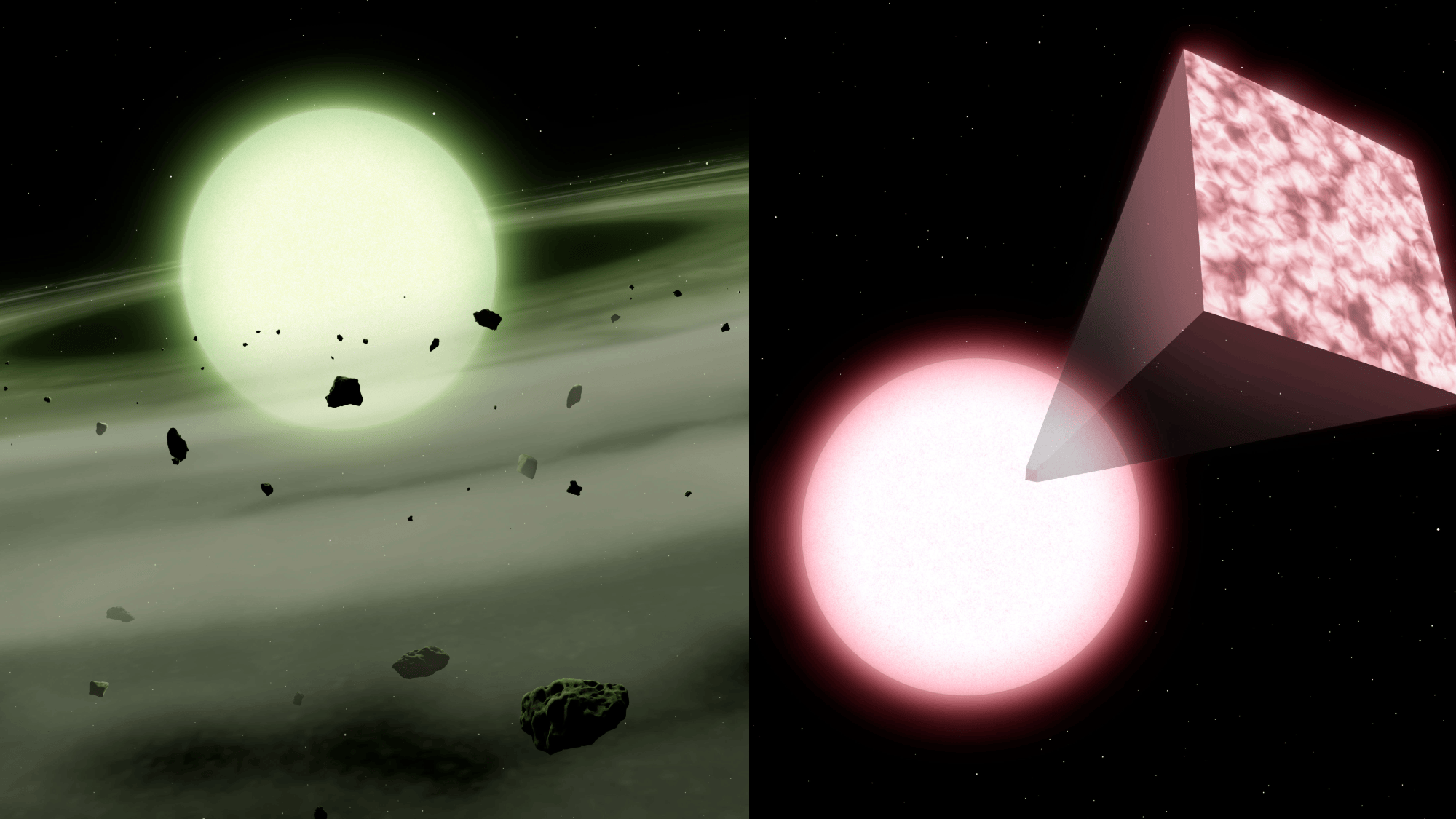
Why Does the Star Look Green?
Under extreme atmospheric density, interactions between sodium and helium alter sodium's light-absorption spectrum. Greater absorption of certain yellow, orange and red wavelengths produces a yellowish-green appearance. Spectroscopy helps scientists identify atmospheric elements and understand stellar evolution.
Other Stellar Remnants:
-
-
- Neutron Star: Formed when the core of a sufficiently massive star collapses, usually during a supernova. Protons and electrons combine to form neutrons. A neutron star may contain more than the Sun's mass within a sphere roughly 20 kilometres across. Pulsars emit regular beams of radiation, while magnetars possess exceptionally powerful magnetic fields.
- Black Hole: Forms when a stellar core collapses beyond the mass that neutron-star matter can support. Within its event horizon, the escape velocity exceeds the speed of light. The Schwarzschild radius describes the event-horizon radius of a non-rotating, uncharged black hole.
- Neutron Star: Formed when the core of a sufficiently massive star collapses, usually during a supernova. Protons and electrons combine to form neutrons. A neutron star may contain more than the Sun's mass within a sphere roughly 20 kilometres across. Pulsars emit regular beams of radiation, while magnetars possess exceptionally powerful magnetic fields.
-
Comparison:
|
Feature |
White Dwarf |
Neutron Star |
Black Hole |
|
Supporting force |
Electron degeneracy pressure |
Neutron-star matter pressure |
No known pressure halts collapse in the classical model |
|
Approximate size |
Earth-sized |
City-sized |
Defined by event horizon |
|
Key concept |
Chandrasekhar limit |
TOV limit |
Event horizon |
Conclusion:
The greenish white dwarf demonstrates how established physical laws can produce unexpected cosmic phenomena, expanding our understanding of the life cycles of stars.