
Context:
In the area designated for the proposed mega infrastructure project on Great Nicobar Island, several remarkable new species linked to the region’s biodiversity have recently been discovered. Since 2021, about 40 new species have been identified here, nearly half of them reported in 2025 alone.
Key Discoveries:
-
- Among the most notable discoveries is a new wolf snake, Lycodon irwini, named after the famous Australian conservationist Steve Irwin. Only four records of this species exist so far. Given its highly restricted range and potential threats, researchers have recommended that it be classified as “Endangered” under the IUCN Red List.
- From the same region, a potentially new bird species, the Great Nicobar Crake (Rallina sp), has also been reported. It has been photographed only three times in the past decade. Researchers note that its distinctive morphological traits suggest it could be a new species.
- Among the most notable discoveries is a new wolf snake, Lycodon irwini, named after the famous Australian conservationist Steve Irwin. Only four records of this species exist so far. Given its highly restricted range and potential threats, researchers have recommended that it be classified as “Endangered” under the IUCN Red List.
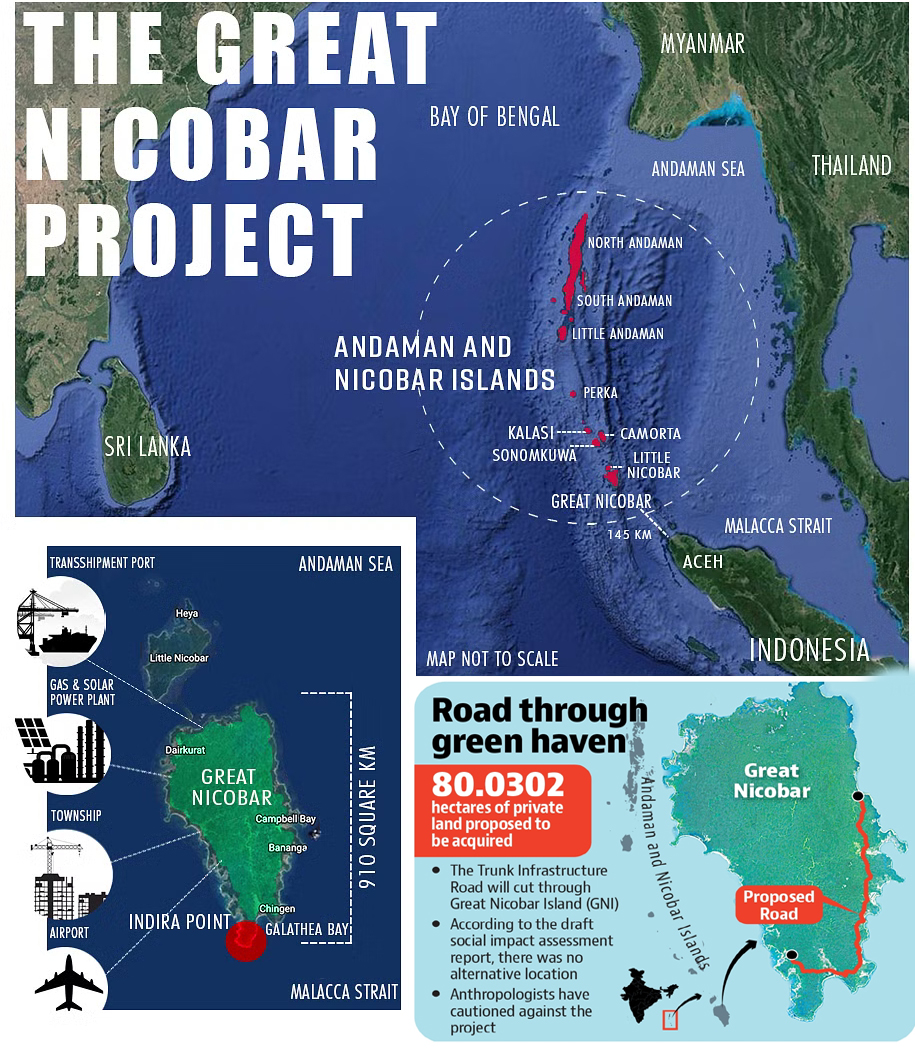
About the Project
-
- The Great Nicobar Island Project, conceptualised by NITI Aayog and launched in 2021, aims to develop:
- An International Container Transshipment Terminal (ICTT)
- A greenfield international airport
- A modern township
- A gas–solar power plant
- An International Container Transshipment Terminal (ICTT)
- Implementing agency: Andaman and Nicobar Islands Integrated Development Corporation (ANIIDCO)
- It aligns with Maritime Vision 2030 and is a core initiative under the Amrit Kaal Vision 2047.
- The Great Nicobar Island Project, conceptualised by NITI Aayog and launched in 2021, aims to develop:
Strategic Significance
1. Transshipment and Trade
-
-
-
- ICTT will reduce India’s dependence on foreign hubs like Singapore and Colombo.
- Enhances India’s integration into global supply chains.
- ICTT will reduce India’s dependence on foreign hubs like Singapore and Colombo.
-
-
2. Dual-Use Greenfield Airport
-
-
-
- Boosts civilian connectivity, tourism, and enhances defence preparedness.
- Boosts civilian connectivity, tourism, and enhances defence preparedness.
-
-
3. Strategic Location Advantages
-
-
-
- Great Nicobar lies near key global shipping arteries—the Malacca, Sunda, and Lombok Straits.
- Offers monitoring capability over crucial trade and energy routes.
- Provides proximity to strategic locations such as:
- Sabang (Indonesia)
- Coco Island (Myanmar)
- Proposed Kra Canal (Thailand)
- Sabang (Indonesia)
- Lies nearly equidistant from Colombo, Port Klang, and Singapore, positioning India at the heart of Indo-Pacific sea trade.
- Great Nicobar lies near key global shipping arteries—the Malacca, Sunda, and Lombok Straits.
-
-
4. Maritime Security
-
-
-
- Andaman & Nicobar Islands form India’s first line of maritime defence.
- Share maritime boundaries with Myanmar, Thailand, Indonesia, and Bangladesh.
- Enable India to exercise rights over a vast Exclusive Economic Zone (EEZ) under UNCLOS (1982).
- Strengthens naval reach against:
- Piracy
- Trafficking
- Terrorism
- Great-power competition (especially Chinese naval presence)
- Piracy
- Andaman & Nicobar Islands form India’s first line of maritime defence.
-
-
About Great Nicobar Island:
-
- Part of the 836-island Andaman & Nicobar chain, separated by the Ten Degree Channel.
- Largest Nicobar island (910 sq km), dominated by dense rainforest.
- Contains Indira Point, India’s southernmost point, 90 nautical miles from Sumatra.
- Home to:
- Shompen and Nicobarese tribes
- Two national parks
- A designated biosphere reserve
- Shompen and Nicobarese tribes
- The Great Nicobar Biosphere Reserve was added to the UNESCO Man and Biosphere (MAB) list in 2013.
- Part of the 836-island Andaman & Nicobar chain, separated by the Ten Degree Channel.
Conclusion:
Great Nicobar hosts about 650 plant species and over 1,800 species of fauna, with nearly 24% endemism. These ongoing discoveries highlight the island’s rich biodiversity and reinforce the need for its conservation.



