
Great Nicobar Mega Infrastructure Project
Context:
The Great Nicobar mega-infrastructure project has recently become a focal point of political and strategic debate after Leader of Opposition in Lok Sabha raised concerns over its environmental and tribal impact. Defence experts have strongly supported the project, describing it as crucial for India’s maritime security, economic growth, and strategic presence near the Strait of Malacca in the Indian Ocean Region.
About the Project:
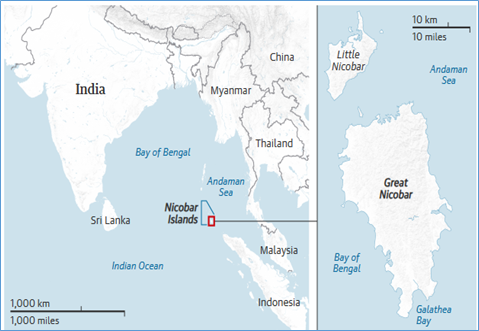
The ₹92,000-crore Great Nicobar Island development project is proposed at Campbell Bay in the Andaman and Nicobar Islands. It includes a transhipment terminal, greenfield international airport, township development, and power infrastructure. The National Green Tribunal has already cleared the project, subject to strict compliance with environmental conditions.
Strategic Significance of the project:
-
-
- Defence experts argue that the project has high strategic value due to its proximity to critical global sea lanes. It is located close to the Strait of Malacca, one of the world’s most important maritime chokepoints. Nearly 80% of China’s oil imports and a significant share of its trade pass through this route.
- From a security perspective, the project strengthens India’s ability to monitor maritime traffic in the eastern Indian Ocean. Experts highlight that enhanced infrastructure at Great Nicobar will significantly improve India’s domain awareness across air and maritime zones and enable better surveillance of regional naval movements.
- The location also provides India a stronger strategic position vis-à-vis China’s expanding maritime presence and its “String of Pearls” strategy, which includes ports such as Gwadar Port in Pakistan, Hambantota Port in Sri Lanka, and Kyaukpyu Port in Myanmar.
- Defence experts argue that the project has high strategic value due to its proximity to critical global sea lanes. It is located close to the Strait of Malacca, one of the world’s most important maritime chokepoints. Nearly 80% of China’s oil imports and a significant share of its trade pass through this route.
-
Concerns and Criticism:
Opposition leaders, have criticized the project, calling it a potential threat to ecological balance and indigenous communities of the Nicobar region. Concerns focus on deforestation, biodiversity loss, and risks to tribal heritage. Environmental groups also argue that large-scale infrastructure may disrupt fragile island ecosystems.
Conclusion:
The Great Nicobar project represents a complex intersection of environmental concerns, indigenous rights, and national security priorities. For India, it is not merely an infrastructure initiative but a strategic investment in maritime dominance and regional influence. Its success will depend on balancing ecological safeguards with strategic imperatives, ensuring that development is both sustainable and security-oriented in line with India’s long-term Indo-Pacific vision.



