
Context:
Recently, Two captive-bred male Great Indian Bustards (GIBs) were released into the wild at the Desert National Park in Jaisalmer, Rajasthan, marking the beginning of the rewilding phase under Project Great Indian Bustard.
About the Great Indian Bustard:
-
-
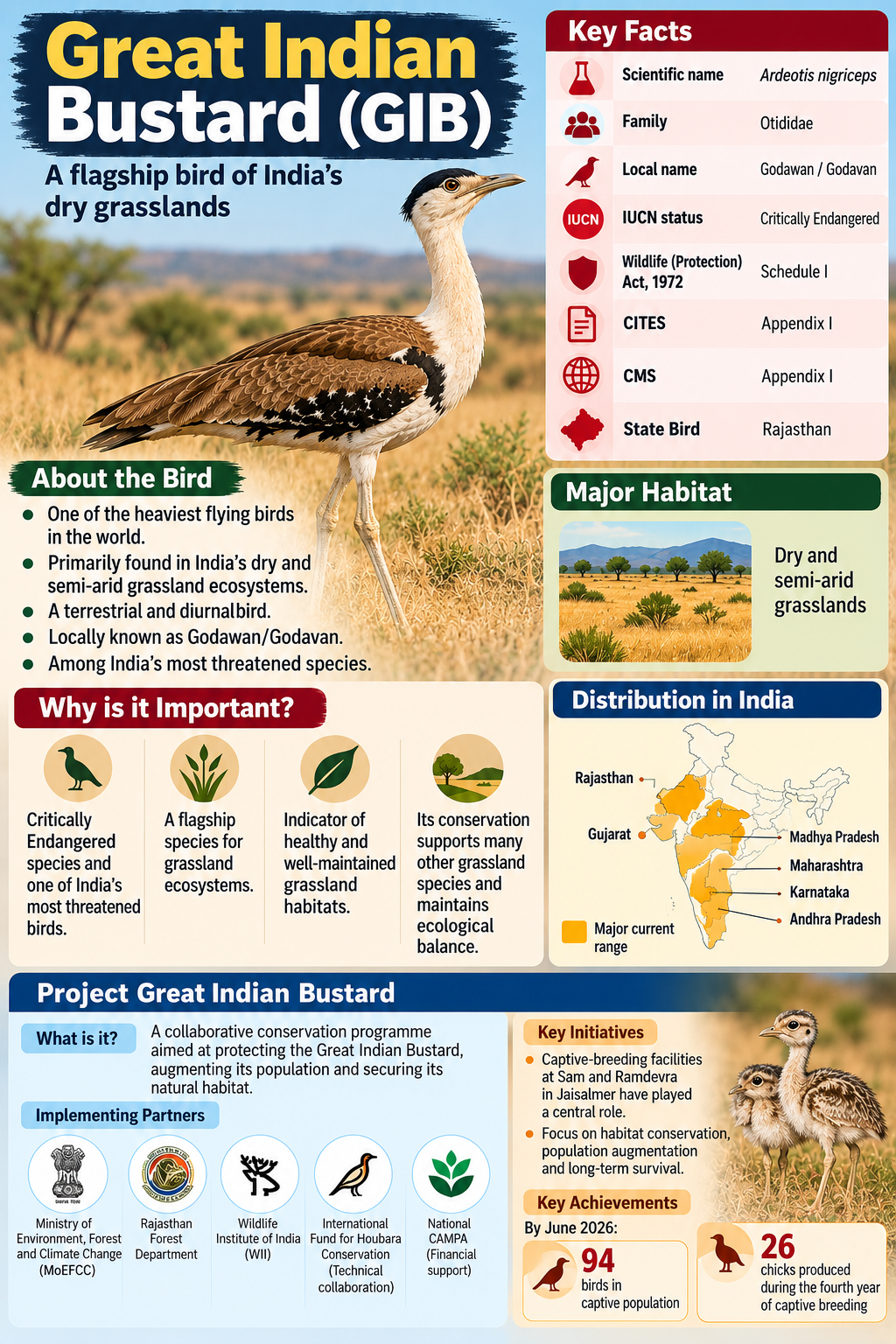
- The Great Indian Bustard (GIB) is one of the heaviest flying birds in the world and is primarily associated with India's dry and semi-arid grassland ecosystems. It is a terrestrial and diurnal bird and is locally known as Godawan/Godavan.
- Rajasthan's Thar Desert supports the largest remaining population, particularly around Jaisalmer and Barmer. Smaller and fragmented populations are found in Gujarat, Maharashtra, Karnataka, Andhra Pradesh and Madhya Pradesh.
- The GIB is a flagship and indicator species for grassland ecosystems. Its conservation is therefore important not only for the species but also for protecting India's fragile grassland biodiversity.
- The Great Indian Bustard (GIB) is one of the heaviest flying birds in the world and is primarily associated with India's dry and semi-arid grassland ecosystems. It is a terrestrial and diurnal bird and is locally known as Godawan/Godavan.
-
Key prelims Facts:
-
-
- Scientific name: Ardeotis nigriceps
- Family: Otididae
- Local name: Godawan/Godavan
- IUCN: Critically Endangered
- Wildlife (Protection) Act, 1972: Schedule I
- CITES: Appendix I
- CMS: Appendix I
- State Bird: Rajasthan
- Major habitat: Dry and semi-arid grasslands
- Scientific name: Ardeotis nigriceps
-
Why is it important?
-
-
- The Great Indian Bustard (Ardeotis nigriceps) is a Critically Endangered bird and is among India's most threatened species. Its wild population is estimated to be only around 110–150 birds, with Rajasthan's Thar landscape being its most important remaining stronghold. A 2026 assessment estimated about 130 GIBs in Rajasthan, while noting that the species now occupies only a small fraction of its former habitat.
- The latest release is significant because it is the first pilot release of captive-bred GIBs into their natural habitat under India's conservation-breeding programme. Scientists will monitor the birds to assess their survival, behaviour, habitat use and eventually their ability to reproduce in the wild. The lessons learned will help refine future releases.
- The Great Indian Bustard (Ardeotis nigriceps) is a Critically Endangered bird and is among India's most threatened species. Its wild population is estimated to be only around 110–150 birds, with Rajasthan's Thar landscape being its most important remaining stronghold. A 2026 assessment estimated about 130 GIBs in Rajasthan, while noting that the species now occupies only a small fraction of its former habitat.
-
About Project Great Indian Bustard:
-
-
- The conservation programme is a collaborative effort involving the Ministry of Environment, Forest and Climate Change, Rajasthan Forest Department and Wildlife Institute of India (WII), with technical collaboration from the International Fund for Houbara Conservation and financial support from National CAMPA.
- Captive-breeding facilities at Sam and Ramdevra in Jaisalmer have played a central role. By June 2026, the captive population had reached 94 birds, with 26 chicks produced during the fourth year of captive breeding.
- The conservation programme is a collaborative effort involving the Ministry of Environment, Forest and Climate Change, Rajasthan Forest Department and Wildlife Institute of India (WII), with technical collaboration from the International Fund for Houbara Conservation and financial support from National CAMPA.
-
Major threats to the Great Indian Bustard:
The species faces several serious threats:
-
-
- Loss and fragmentation of grassland habitat
- Collision with overhead power transmission lines
- Expansion of solar and wind-energy infrastructure
- Predation of eggs and chicks
- Human disturbance and infrastructure development
- Power-line collisions are particularly dangerous because GIBs have poor frontal vision and may fail to detect overhead transmission wires while flying.
- Loss and fragmentation of grassland habitat
-
Conclusion:
The release of two captive-bred Great Indian Bustards is a significant milestone in India's wildlife conservation efforts. It represents a shift from preserving the species in captivity to restoring viable populations in the wild. For long-term success, India must combine scientific rewilding with grassland protection, power-line mitigation and landscape-level conservation.



