
Context:
In a written reply to Parliament, the Government confirmed that several major Indian airports - including Chennai International Airport and Kempegowda International Airport (Bengaluru) - have reported incidents of GPS spoofing or GNSS interference.
About GPS Spoofing:
-
-
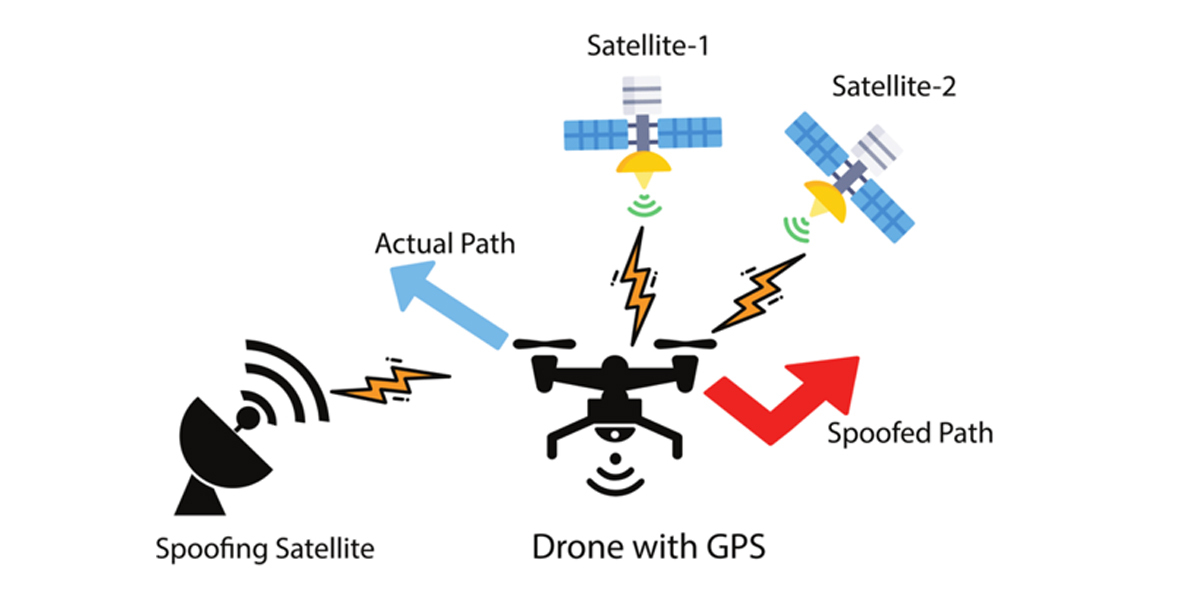
- GPS spoofing involves transmitting fake satellite signals to deceive GPS receivers into miscalculating position, speed, or timing. Unlike jamming, which blocks signals entirely, spoofing manipulates data without alerting the receiver.
- In aviation, spoofed signals can mislead pilots or autopilot systems during navigation, approaches, and landings.
- GPS is not only essential for aircraft navigation but also supports air traffic control, logistics, and surveillance systems, making spoofing a multi-layered threat.
- GPS spoofing involves transmitting fake satellite signals to deceive GPS receivers into miscalculating position, speed, or timing. Unlike jamming, which blocks signals entirely, spoofing manipulates data without alerting the receiver.
-
Incidents and Impact:
-
-
- Flights at Chennai, Bengaluru, Delhi, Mumbai, Kolkata, Hyderabad, and Amritsar experienced temporary GPS anomalies.
- Pilots had to revert to ground-based navigation aids for safe approaches and landings.
- No accidents or flight disruptions beyond minor rerouting were reported, indicating existing redundancies were effective.
- Flights at Chennai, Bengaluru, Delhi, Mumbai, Kolkata, Hyderabad, and Amritsar experienced temporary GPS anomalies.
-
Risks and Vulnerabilities:
-
-
- Spoofing poses a direct threat to flight safety by misleading aircraft on altitude, position, or trajectory.
- It can affect multiple systems simultaneously, including cargo tracking, air traffic control, and digital communication.
- Repeated incidents hint at potential malicious attempts to compromise civil aviation or conduct cyber-intimidation.
- Spoofing poses a direct threat to flight safety by misleading aircraft on altitude, position, or trajectory.
-
Government Response:
-
-
- The Wireless Monitoring Organisation (WMO) and DGCA have been directed to identify sources of interference.
- Standard Operating Procedures (SOPs) for reporting GNSS anomalies have been issued.
- Redundant ground-based navigation systems are actively used as fail-safes.
- Coordination with cybersecurity agencies like CERT-In and NCIIPC has been intensified to strengthen aviation infrastructure against cyber threats.
- The Wireless Monitoring Organisation (WMO) and DGCA have been directed to identify sources of interference.
-
Implications for Policy and Security:
-
-
- There is an urgent need for a robust GNSS security architecture and real-time spoofing detection systems.
- Regulatory oversight must be enhanced through audits, contingency planning, and inter-agency coordination.
- These events underscore the link between civil aviation safety and national security, especially in India’s strategic Indo-Pacific airspace.
- There is an urgent need for a robust GNSS security architecture and real-time spoofing detection systems.
-
Conclusion:
The GPS spoofing incidents at Chennai and Bengaluru airports underscore the vulnerability of India’s aviation infrastructure to cyber threats. While redundancies prevented immediate disasters, these events highlight the need for a multi-layered defence: secure GNSS systems, real-time monitoring, regulatory enforcement, and cyber-resilience planning. Balancing technological modernization with national security will be essential to maintain safe, reliable, and globally trusted air travel in India.



