
Context:
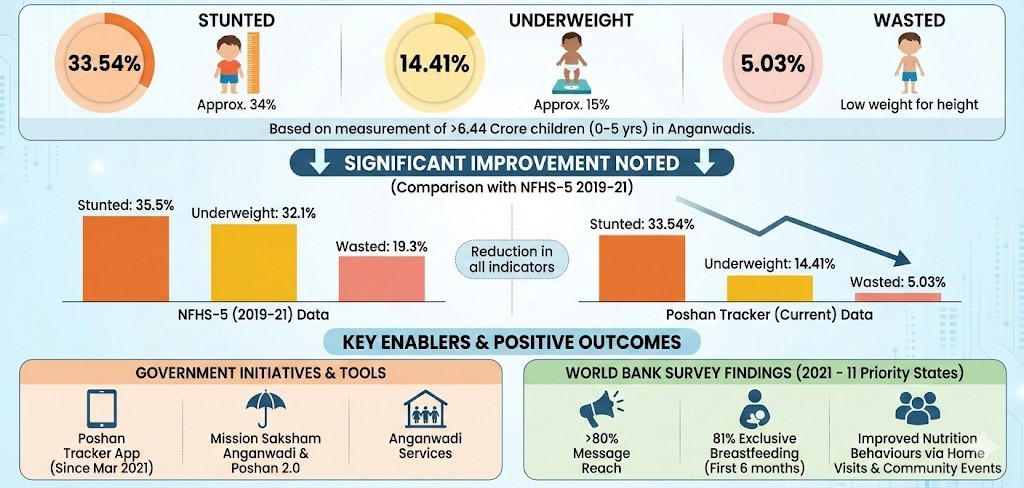
The Government of India recently informed Parliament that about 34% of children under five years are stunted, while 15% are underweight, according to data from the Poshan Tracker. The statistics reflect ongoing challenges in child nutrition, despite notable improvements in recent years.
Key Findings from the Poshan Tracker:
-
- The Poshan Tracker, a digital application launched in March 2021, monitors children enrolled in Anganwadi Centres (AWCs) across the country.
- As of October 2025, over 6.44 crore children aged 0–5 years were measured for height and weight.
- Data indicates:
- 33.54% children are stunted (low height-for-age)
- 14.41% children are underweight (low weight-for-age)
- 5.03% children are wasted (low weight-for-height)
- 33.54% children are stunted (low height-for-age)
- The Poshan Tracker, a digital application launched in March 2021, monitors children enrolled in Anganwadi Centres (AWCs) across the country.
Comparison with NFHS-5:
-
- According to the National Family Health Survey-5 (2019–21):
- Stunting: 35.5%
- Underweight: 32.1%
- Wasting: 19.3%
- Stunting: 35.5%
- The data suggests a gradual improvement in malnutrition indicators, but the prevalence remains high.
- According to the National Family Health Survey-5 (2019–21):
Key Nutrition Schemes to Counter Malnutrition in India:
|
Scheme / Initiative |
Key Features / Components |
Target Group |
Objective |
|
1. Mission Poshan 2.0 (Saksham Anganwadi & POSHAN Abhiyaan) |
• Integrates Anganwadi Services & Poshan Abhiyaan |
Children (0–6 yrs), Pregnant Women, Lactating Mothers, Adolescent Girls |
Reduce stunting, wasting, anaemia; improve service delivery & nutrition behaviour |
|
2. Integrated Child Development Services (ICDS) |
• Supplementary nutrition |
Children (0–6 yrs), P&L women, Adolescent girls |
Provide integrated early childhood care & nutrition |
|
3. PM POSHAN (Mid-Day Meal) |
• Cooked meals for school children |
School children (Class 1–8) |
Improve school nutrition & reduce classroom hunger |
|
4. Pradhan Mantri Matru Vandana Yojana (PMMVY) |
• Cash transfers during pregnancy & lactation |
Pregnant & lactating mothers |
Improve maternal nutrition & reduce IMR, MMR |
|
5. Scheme for Adolescent Girls (SAG) |
• Nutrition supplementation |
Adolescent girls (11–18 years) |
Improve nutritional & health status, empower adolescent girls |
National Strategy & Convergence (NITI Aayog & Ministries):
|
Component |
Key Features |
Objective |
|
National Nutrition Strategy (NITI Aayog) |
• Target to reduce all forms of malnutrition by 2030 (aligned with SDG-2) |
Achieve a malnutrition-free India |
|
Convergence Across Ministries |
Ministries involved: |
Ensure coordinated action across first 1,000 days, school age, and adolescence |
|
Poshan Maah (Nutrition Month) |
• Annual national campaign |
Mass awareness for nutrition & behaviour change |
Conclusion:
While India has made progress in reducing malnutrition among children under five, the data indicates that a third of children are still stunted and one-sixth underweight. Programs like Poshan Tracker and Mission Poshan 2.0 are crucial tools for targeted intervention, but sustained focus on maternal and child health, nutrition awareness, and poverty alleviation is essential to achieve long-term improvements.



