
Context:
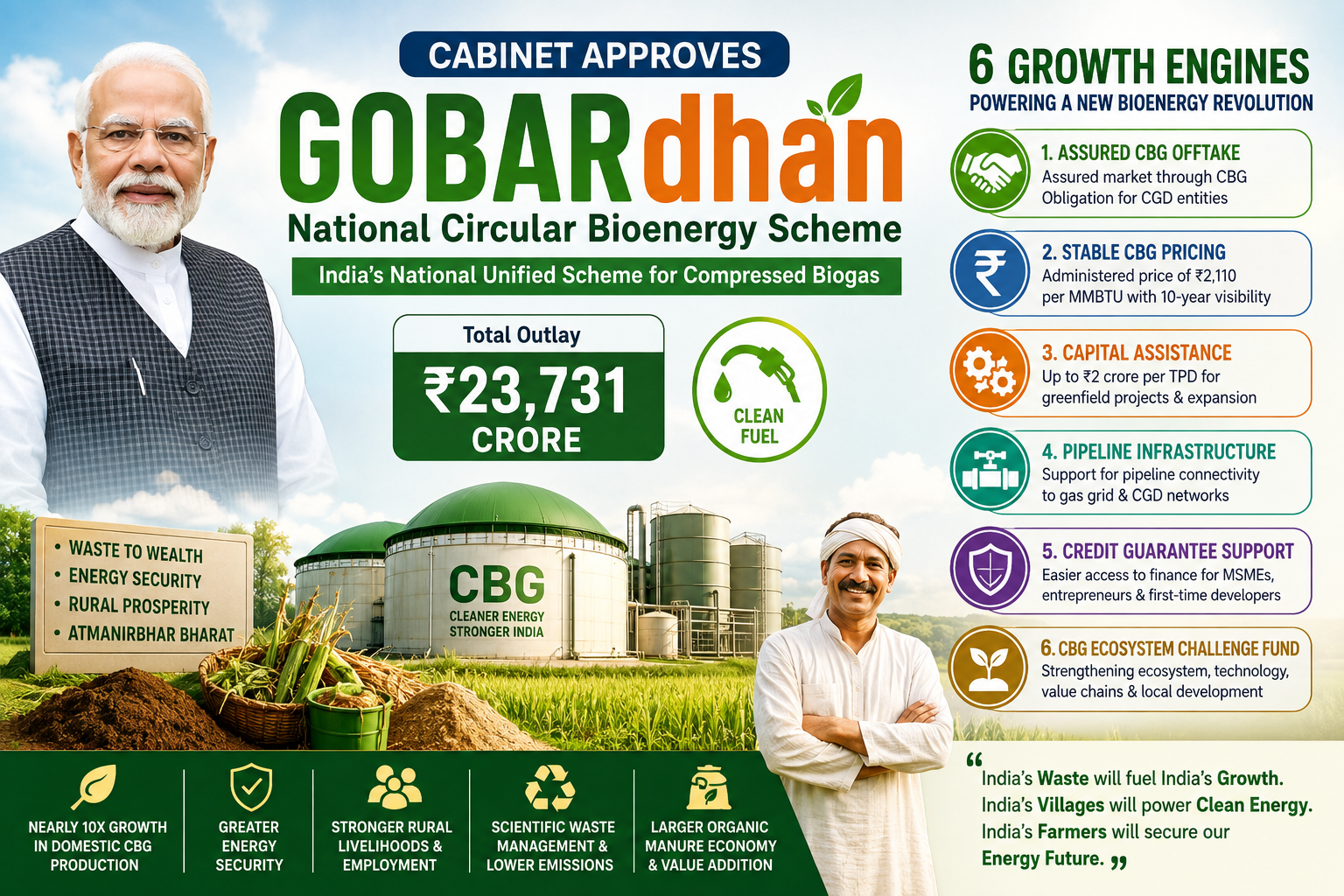
Recently, The Union Cabinet, chaired by Prime Minister Narendra Modi, has approved GOBARdhan (Galvanizing Organic Bio-Agro Resources Dhan) as the National Circular Bioenergy Scheme with an outlay of ₹23,731 crore. The scheme will be implemented from FY 2026-27 to FY 2035-36 and aims to establish Compressed Biogas (CBG) as a key component of India’s clean energy transition.
About GOBARdhan scheme:
Launched in 2018 under the Swachh Bharat Mission (Grameen), GOBARdhan promotes the conversion of cattle dung, crop residue, municipal organic waste, press mud, and other biomass into Compressed Biogas (CBG) and organic manure. Building on initiatives such as SATAT, Market Development Assistance (MDA), Biomass Aggregation Machinery (BAM), and the National Bioenergy Programme, the revamped scheme seeks to create an integrated circular bioeconomy.
Key Features of National Circular Bioenergy Scheme:
-
-
- Integrated CBG Value Chain: Administered by the Ministry of Petroleum and Natural Gas (MoPNG), the scheme provides a unified framework covering feedstock collection, production, storage, transportation, and marketing of CBG.
- Assured Offtake: City Gas Distribution (CGD) entities will procure CBG to meet the mandatory CBG Obligation (CBGO) of 3% (2026-27), 4% (2027-28), and 5% from 2028-29 onwards.
- Stable Pricing: A government-backed administered price of ₹2,110 per MMBTU with a minimum 10-year pricing horizon ensures revenue certainty for producers.
- Capital and Credit Support: Greenfield projects will receive capital assistance of up to ₹2 crore per Ton Per Day (TPD) of installed capacity. MSMEs will benefit from a dedicated Credit Guarantee Mechanism to improve access to finance.
- Pipeline Infrastructure: The scheme supports pipeline connectivity between CBG plants and City Gas Distribution networks to facilitate efficient evacuation and distribution.
- CBG Ecosystem Challenge Fund: It will support feedstock mapping, technology adoption, district-level planning, organic manure value addition, and capacity building.
- Integrated CBG Value Chain: Administered by the Ministry of Petroleum and Natural Gas (MoPNG), the scheme provides a unified framework covering feedstock collection, production, storage, transportation, and marketing of CBG.
-
Significance:
-
-
- The scheme aims to increase domestic CBG production nearly ten-fold, reduce dependence on imported fossil fuels, strengthen India’s energy security, and accelerate the transition towards a circular economy.
- It is expected to generate rural employment, provide additional income to farmers through biomass supply, improve scientific waste management, reduce greenhouse gas emissions, and promote the production of organic manure. The initiative also supports the objectives of Net Zero, Atmanirbhar Bharat, Waste-to-Wealth, and Sustainable Development Goals (SDGs).
- The scheme aims to increase domestic CBG production nearly ten-fold, reduce dependence on imported fossil fuels, strengthen India’s energy security, and accelerate the transition towards a circular economy.
-
Challenges:
Efficient feedstock aggregation, high initial investment, pipeline connectivity, technology adoption, and coordination among multiple stakeholders remain key implementation challenges. Ensuring financial viability and sustained private sector participation will be critical.
Conclusion:
The National Circular Bioenergy Scheme marks a significant step in India's clean energy journey by transforming agricultural and organic waste into a sustainable source of energy and income. By strengthening the CBG ecosystem, the scheme has the potential to enhance energy security, empower rural communities, and promote environmentally sustainable development.



