
Context:
A recent report by the United Nations University’s Institute for Water, Environment and Health has sounded an alarm on the onset of a new era of “global water bankruptcy,” in which freshwater resources are being depleted to the point of irreversible scarcity. The report underscores the urgent need for sustainable water management in the context of climate change and rapidly rising demand.
What Is Global Water Bankruptcy?
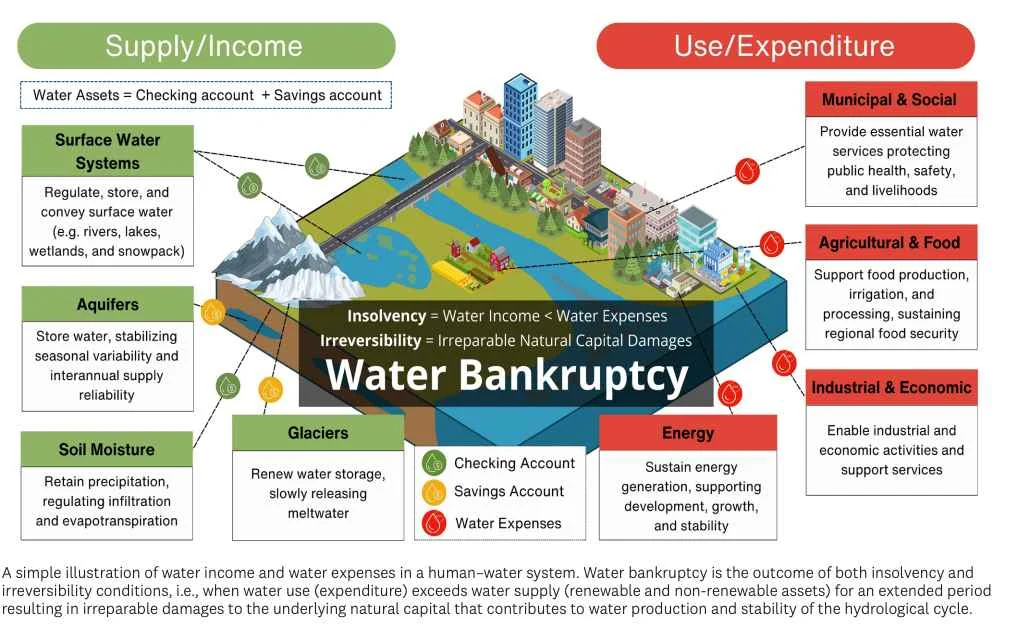
Unlike earlier concepts such as water stress or water crisis, water bankruptcy refers to the irreversible depletion of freshwater resources caused by excessive withdrawals from rivers, aquifers, and glaciers that far exceed natural recharge rates. It highlights that the crisis is not merely one of water availability, but of fundamentally unsustainable water management practices.
Key Global Findings:
-
- 6.1 billion people live in water-insecure or critically water-insecure regions.
- 4 billion people experience severe water scarcity for at least one month each year.
- The increasing occurrence of “Day Zero” events in cities signals the near-collapse of municipal water systems.
- Climate change intensifies droughts, evaporation, wildfires, and soil salinisation, while human activities—such as groundwater over-extraction and wetland destruction—further exacerbate the crisis.
- 6.1 billion people live in water-insecure or critically water-insecure regions.
Policy Recommendations:
-
- Recognise water bankruptcy explicitly in global and national policy debates.
- Establish a global monitoring framework for freshwater resources.
- Restrict development projects that further degrade local water supplies.
- Promote sustainable land and water management practices, including ecosystem restoration, efficient irrigation, and urban water conservation.
- Integrate water planning into broader climate resilience and adaptation strategies.
- Recognise water bankruptcy explicitly in global and national policy debates.
India and the Risk of Water Bankruptcy:
Sustainable water management has emerged as a critical national priority for India.
-
- Nearly 600 million Indians face high-to-extreme water stress.
- India supports 18% of the global population but possesses only 4% of the world’s freshwater resources.
- By 2030, water demand is projected to exceed supply by 70%, posing serious risks to food security, urban stability, and economic growth.
- Nearly 600 million Indians face high-to-extreme water stress.
Key Government Frameworks and Schemes:
The Ministry of Jal Shakti (established in 2019) anchors India’s water governance through several initiatives:
-
- Jal Jeevan Mission (extended to 2028): Nearly 80% of rural households now have functional tap water connections.
- Atal Bhujal Yojana: Promotes community-led groundwater management across seven states.
- Jal Shakti Abhiyan – Catch the Rain: Focuses on rainwater harvesting and the rejuvenation of water bodies.
- Pradhan Mantri Krishi Sinchayee Yojana (PMKSY): Encourages micro-irrigation under the “Per Drop More Crop” approach.
- National Water Policy (under revision): Emphasises climate resilience and integrated water governance.
- Jal Jeevan Mission (extended to 2028): Nearly 80% of rural households now have functional tap water connections.
Sustainable Water Management Strategies:
-
- Circular Water Management: Mandating cities to recycle at least 20% of consumed water.
- Nature-Based Solutions: Revival of traditional water systems such as johads, stepwells, tanks, and wetlands.
- Agricultural Reforms: Crop diversification toward less water-intensive crops like millets and pulses.
- Smart Technologies: Use of IoT sensors, AI-based leak detection, and GIS mapping for efficient water management.
- Circular Water Management: Mandating cities to recycle at least 20% of consumed water.
Key Challenges:
-
- Groundwater Depletion: India is the world’s largest user of groundwater, with irrigation accounting for 80–90% of extraction.
- Water Pollution: Nearly 70% of surface water sources are contaminated.
- Climate Change: Erratic monsoons and retreating Himalayan glaciers intensify water insecurity.
- Fragmented Governance: Weak coordination across institutions hampers effective water management.
- Groundwater Depletion: India is the world’s largest user of groundwater, with irrigation accounting for 80–90% of extraction.
Conclusion:
The UN report makes it clear that water scarcity is no longer merely a condition of stress or crisis—it is becoming irreversible in many regions. Sustainable management practices, integrated policymaking, and enhanced global cooperation are essential to avert widespread human suffering and ecological collapse.



