
Context:
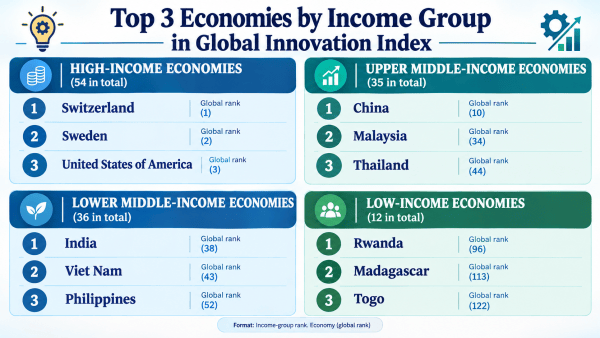
Recently, World Intellectual Property Organization (WIPO) released Global Innovation Index (GII) 2026 in which, India ranks 38th among 139 economies. India ranks first among lower-middle-income economies and in Central and Southern Asia. This achievement reflects India’s capacity in digital services, entrepreneurship, and technological development. However, there remains a need to strengthen investment in research and development and institutional capabilities.
What is the Global Innovation Index?
-
-
- The Global Innovation Index is a major index that assesses the performance of various countries in the field of innovation. It was launched in 2007. The year 2026 marks its 19th edition.
- The index evaluates countries based on approximately 80 indicators. It has two major sub-indices:
- Innovation Inputs: Institutions, human capital and research, infrastructure, market sophistication, and business sophistication.
- Innovation Outputs: Knowledge and technology outputs and creative outputs.
- Equal weight is given to both sub-indices. Thus, the index measures not only the resources available for innovation but also the actual outcomes obtained from them.
- The Global Innovation Index is a major index that assesses the performance of various countries in the field of innovation. It was launched in 2007. The year 2026 marks its 19th edition.
-
Key Findings of GII 2026:
-
-
- Globally, Switzerland ranks first, Sweden second, and the United States third. South Korea ranks fourth, while Singapore ranks fifth. China remains in tenth place.
- India’s position is particularly noteworthy because it is performing better in innovation outputs despite limited resources. In 2026, India ranks 49th in innovation inputs and 25th in innovation outputs. This indicates that India has the capacity to convert available resources into economic and technological achievements.
- Globally, Switzerland ranks first, Sweden second, and the United States third. South Korea ranks fourth, while Singapore ranks fifth. China remains in tenth place.
-
Major Achievements of India:
-
-
- Digital Services: India ranks first globally in ICT services exports. This has strengthened India’s role in the global digital economy.
- Startups and Investment: India ranks fourth in late-stage venture capital deals, reflecting the growth potential of innovation-based enterprises.
- Regional Leadership: India ranks first in Central and Southern Asia and also holds the top position among 36 lower-middle-income economies.
- Innovation-Based Development: India’s capabilities in digital services, software, entrepreneurship, and technology are strengthening its innovation outputs.
- Digital Services: India ranks first globally in ICT services exports. This has strengthened India’s role in the global digital economy.
-
Major Challenges Before India:
-
-
- Investment in Research and Development: Adequate financial resources are required for scientific research and the development of new technologies.
- Coordination Between Education and Industry: It is necessary to increase cooperation among universities, research institutions, and private companies.
- Commercialisation of Innovation: The process of converting technologies developed in laboratories into useful products and large-scale industries must be simplified.
- Lack of Infrastructure: It is essential to ensure equal access to advanced research facilities, technological equipment, and innovation centres.
- Regional Inequality: Instead of limiting innovation activities to a few major cities, they must be extended to smaller cities and rural areas.
- Investment in Research and Development: Adequate financial resources are required for scientific research and the development of new technologies.
-
Way Forward:
To transform India into an innovation-driven economy, the following steps should be taken:
-
-
- Public and private investment in research and development should be increased.
- Research and skill development aligned with industry requirements should be encouraged in universities.
- Startups should be provided with financial assistance, technical guidance, and facilities for the protection of intellectual property rights.
- Indigenous technologies should be developed in emerging fields such as artificial intelligence, semiconductors, biotechnology, and clean energy.
- Innovation centres, incubation hubs, and research institutions should be developed in Tier-2 and Tier-3 cities.
- Initiatives such as the National Education Policy, Startup India, and the Atal Innovation Mission should be better aligned with research and commercial requirements.
- Public and private investment in research and development should be increased.
-
Conclusion:
India’s position in the Global Innovation Index 2026 reflects its technological capabilities and progress in entrepreneurship. However, it is necessary to reduce the gap between innovation outputs and investment. India should not limit itself to becoming a major exporter of digital services; rather, it should also develop leadership in fundamental research, indigenous technology, and high-value-added manufacturing. This will help achieve the goals of Atmanirbhar Bharat, Viksit Bharat @2047, and inclusive economic development.



