
Context:
Recently, The United Nations, through reports by the World Health Organization (WHO) and UNICEF, has warned that the global immunisation system is showing signs of weakness due to declining financial support, conflicts, misinformation, and gaps in healthcare delivery.
About Global Immunisation System:
-
-
- The global immunisation system is a collaborative network of international organisations, governments, and health alliances working to ensure universal access to life-saving vaccines. It provides guidelines, technical support, and resources to prevent more than 14 major diseases, including measles, polio, and HPV.
- The system is led by organisations such as:
- World Health Organization (WHO)
- UNICEF
- Gavi, the Vaccine Alliance
- World Health Organization (WHO)
- The global immunisation system is a collaborative network of international organisations, governments, and health alliances working to ensure universal access to life-saving vaccines. It provides guidelines, technical support, and resources to prevent more than 14 major diseases, including measles, polio, and HPV.
-
Key Frameworks:
-
-
- Immunisation Agenda 2030 (IA2030): It is the global strategy aimed at ensuring equitable vaccine access, recovering from vaccination disruptions, and saving more than 50 million lives during this decade.
- Expanded Programme on Immunization (EPI): Focused on childhood diseases, EPI has expanded to provide recommendations for vaccination against 13 core diseases across different age groups, including adolescents and adults.
- Immunisation Agenda 2030 (IA2030): It is the global strategy aimed at ensuring equitable vaccine access, recovering from vaccination disruptions, and saving more than 50 million lives during this decade.
-
Key Findings of the Report:
-
-
- 90% of infants globally (nearly 116 million children) received at least one dose of the DTP vaccine in 2025, while 85% completed all three doses.
- Global vaccination coverage improved slightly but remains below the 2019 pre-COVID level.
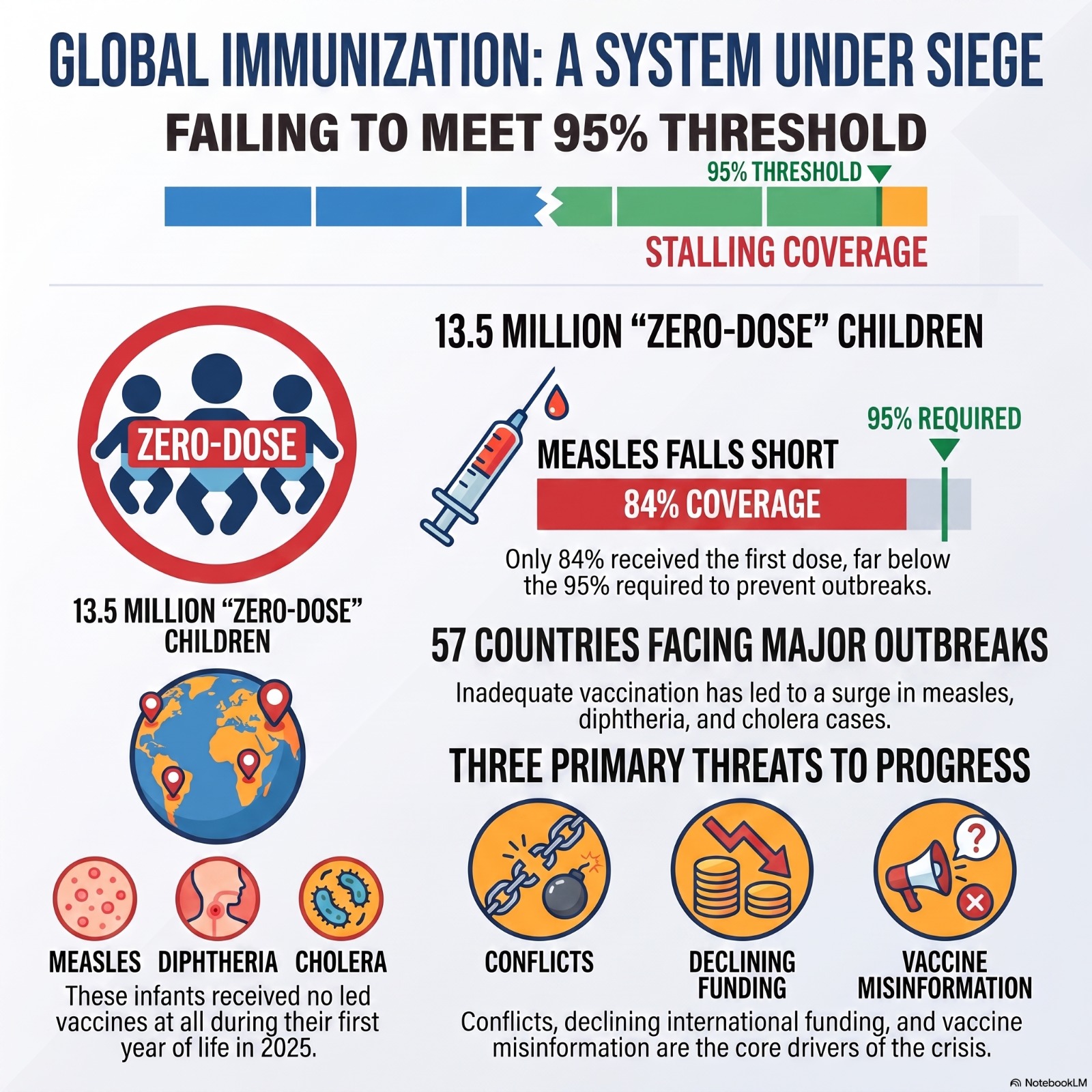
- Around 13.5 million children were zero-dose children, receiving no vaccines in their first year.
- Nearly 7.3 million infants received the first DTP dose but missed the first measles vaccine dose, indicating gaps in completing vaccination schedules.
- Global measles vaccination coverage remains inadequate:
- 84% received the first dose
- 77% received the second dose
- 95% coverage is required to prevent outbreaks.
- 84% received the first dose
- 57 countries reported major measles outbreaks in 2025, along with rising cases of diphtheria and cholera.
- Declining funding and weakened surveillance systems are creating risks for future immunisation programmes.
- 90% of infants globally (nearly 116 million children) received at least one dose of the DTP vaccine in 2025, while 85% completed all three doses.
-
Reasons behind the Crisis:
-
-
- Conflicts and Displacement: Wars and humanitarian crises disrupt healthcare services, damage infrastructure, and prevent children from accessing vaccination programmes.
- Funding Shortages: Declining international aid and financial constraints affect vaccine procurement, cold-chain systems, health workers, and disease surveillance.
- Misinformation and Vaccine Hesitancy: False information regarding vaccine safety has reduced public trust and contributed to vaccination dropouts, particularly in measles immunisation.
- Weak Surveillance Systems: Reduced disease monitoring capacity has affected the ability to detect outbreaks quickly. Only 18 national immunisation surveys were submitted in 2025 compared to 50 earlier.
- Conflicts and Displacement: Wars and humanitarian crises disrupt healthcare services, damage infrastructure, and prevent children from accessing vaccination programmes.
-
India’s Immunisation Efforts:
India has implemented the Universal Immunisation Programme (UIP), one of the world’s largest vaccination programmes. Initiatives like Mission Indradhanush focus on improving coverage among children and pregnant women in low-immunisation areas. Digital platforms developed during COVID-19 have also strengthened vaccine management.
Conclusion:
The warning by the UN highlights that immunisation progress cannot be taken for granted. While global vaccination coverage has improved, conflicts, financial constraints, and misinformation threaten health security. Strengthening immunisation systems is essential for achieving SDG 3 (Good Health and Well-being) and ensuring equitable access to life-saving vaccines for every child.



