
Context:
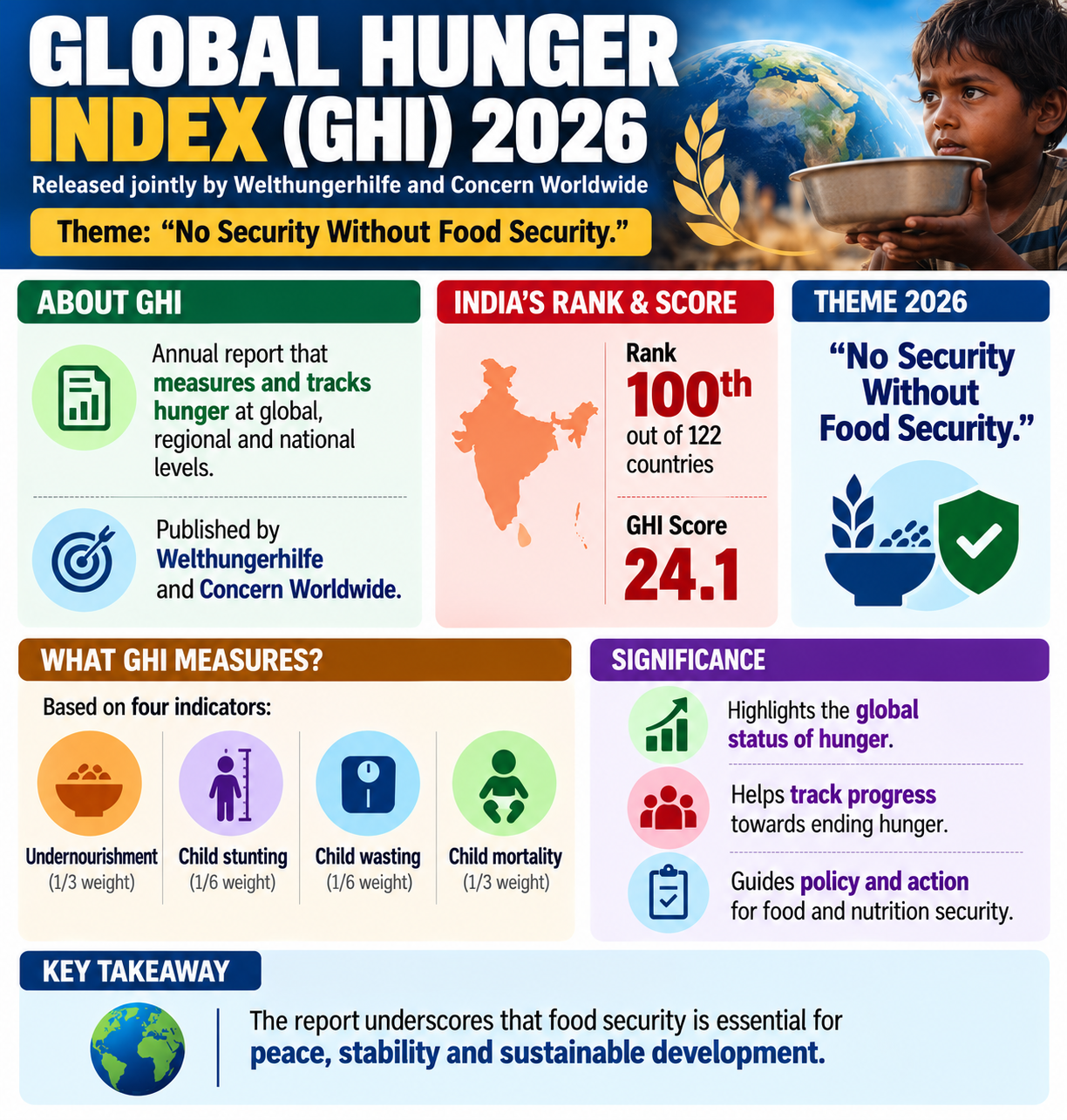
Recently, the Global Hunger Index (GHI) 2026 was jointly released by Welthungerhilfe and Concern Worldwide. The theme of this year's report is “No Security Without Food Security.”
Global Hunger Index (GHI) Methodology:
The Global Hunger Index is calculated on a scale of 0 to 100 based on four key indicators, where 0 represents the best possible score (no hunger) and 100 represents the worst possible score.
-
-
- Undernourishment: The proportion of the population with inadequate calorie intake (as a percentage of the total population).
- Child Stunting: Children under five years of age whose height is low for their age, indicating chronic malnutrition.
- Child Wasting: Children under five years of age whose weight is low for their height, indicating acute malnutrition.
- Child Mortality: The mortality rate among children under five years of age.
- Undernourishment: The proportion of the population with inadequate calorie intake (as a percentage of the total population).
-
Global Scenario:
According to GHI 2026, the progress made towards ending global hunger over the past two decades has stalled, and the situation has deteriorated compared to 2018. In 2026, the global GHI score increased to 18.1, compared to 17.6 in 2018. The key global findings of the report are as follows:
-
-
- Regional Disparities: The most severe levels of hunger have been recorded in Sub-Saharan Africa and South Asia. Both regions fall under the “Serious” category.
- Alarming Situation: Eight countries across the world, including Somalia, Sudan, Yemen, Chad and Burundi, fall under the “Alarming” category of hunger.
- Reasons for the Reversal (3Cs): The major factors contributing to rising global hunger are conflict, climate change and the cost-of-living crisis.
- Regional Disparities: The most severe levels of hunger have been recorded in Sub-Saharan Africa and South Asia. Both regions fall under the “Serious” category.
-
India's Position and Comparative Analysis:
In GHI 2026, India ranks 100th out of 122 countries. India has a GHI score of 24.1, placing it in the “Serious” category. Although India has demonstrated long-term improvement compared to its 2006 score of 37.0, the pace of progress remains unsatisfactory.
|
Country |
2026 GHI Score |
Hunger Category |
Comparative Position (with Reference to India) |
|
Nepal |
14.5 |
Moderate |
In a better position, attributed to sustained public investment in health and nutrition. |
|
Bangladesh |
19.2 |
Moderate |
Ahead of India due to continued improvements in human development indicators. |
|
India |
24.1 |
Serious |
Partial improvement in stunting, but wasting remains a major concern. |
|
Pakistan |
25.5 |
Serious |
Behind India amid economic instability and climate-related shocks. |
Major Challenges Facing India:
-
-
- High Level of Child Wasting: India has a child wasting rate of 19%, which is among the highest in the world. This indicates that acute malnutrition and limited access to healthcare facilities remain major challenges.
- Nutritional Quality: Although the National Food Security Act (NFSA) and the Pradhan Mantri Garib Kalyan Anna Yojana (PMGKAY) have helped ensure access to staple food and calorie availability, deficiencies in micronutrients and protein remain concerns.
- Policy Implementation Gaps: Despite initiatives such as Poshan Abhiyaan and Saksham Anganwadi, data discrepancies at the grassroots level and inadequate infrastructure continue to pose challenges.
- High Level of Child Wasting: India has a child wasting rate of 19%, which is among the highest in the world. This indicates that acute malnutrition and limited access to healthcare facilities remain major challenges.
-
Way Forward:
-
-
- Transition from Food Security to Nutritional Security: Instead of limiting the Public Distribution System (PDS) primarily to wheat and rice, the inclusion and availability of millets, pulses and fortified rice should be expanded in accordance with local needs.
- Strengthening the Integrated Child Development Services (ICDS): Anganwadi centres should be equipped with modern facilities, and the capacity of frontline health workers, including ASHA and Anganwadi workers, should be strengthened.
- Life-Cycle Approach: Special attention should be given to maternal nutrition and healthcare during pregnancy and the first 1,000 days of a child's life.
- Climate-Resilient Agriculture: Farmers should be encouraged to cultivate crops that are resilient to droughts and floods to mitigate the effects of climate change.
- Transition from Food Security to Nutritional Security: Instead of limiting the Public Distribution System (PDS) primarily to wheat and rice, the inclusion and availability of millets, pulses and fortified rice should be expanded in accordance with local needs.
-
Conclusion:
The Global Hunger Index 2026 serves as a policy warning for India. To achieve Sustainable Development Goal 2 (SDG 2: Zero Hunger) by 2030, India needs to adopt a people-centric and multisectoral approach to its socioeconomic policies, integrating food security, nutrition, healthcare, sanitation and sustainable agriculture.



