
Context:
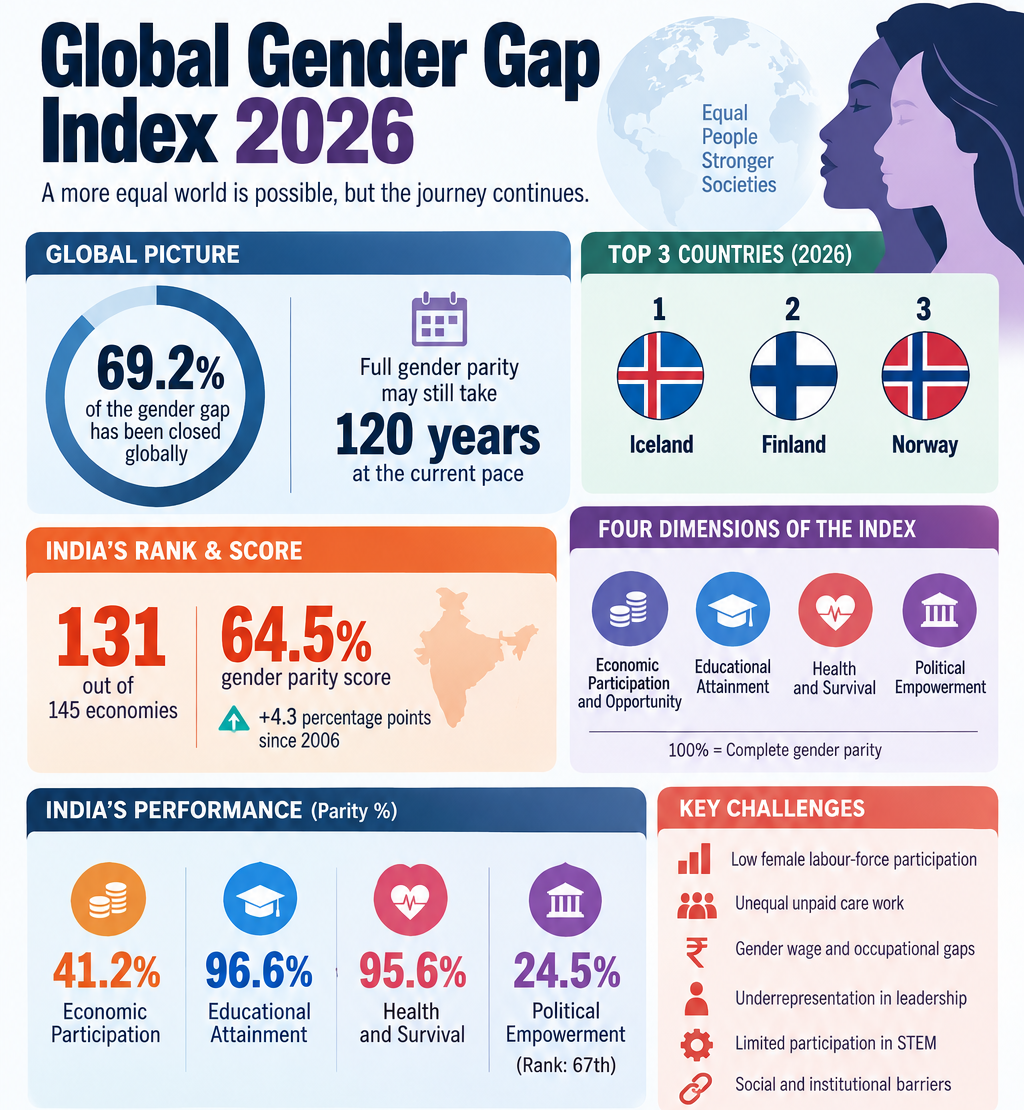
Recently, The World Economic Forum (WEF) released the Global Gender Gap Report 2026, marking the 20th edition of the index. India retained its 131st rank among 145 economies, while Iceland, Finland and Norway occupied the top three positions. Globally, 69.2% of the gender gap has been closed, but the WEF estimates that complete gender parity may still take around 120 years at the present pace.
About the Global Gender Gap Index:
-
-
- Introduced in 2006, the Global Gender Gap Index measures gender disparities between men and women across four dimensions:
- Economic Participation and Opportunity
- Educational Attainment
- Health and Survival
- Political Empowerment
- Economic Participation and Opportunity
- The index uses a parity-based approach, where 100% represents complete gender parity.
- Introduced in 2006, the Global Gender Gap Index measures gender disparities between men and women across four dimensions:
-
India’s Performance:
India's overall gender parity score stood at 64.5%, below the global average. However, India has improved by 4.3 percentage points since 2006, largely due to progress in education.
Economic Participation:
India recorded 41.2% parity in economic participation. Labour-force participation parity stood at 44.1%. Representation of women among professional and technical workers improved significantly, from 26.6% in 2006 to 49.9% in 2026. However, women's representation among legislators, senior officials and managers remained low at 13.1%.
Educational Attainment:
India achieved 96.6% parity in educational attainment, demonstrating substantial progress in women's access to education. However, the persistence of a large economic participation gap indicates that educational gains have not been fully converted into employment and leadership opportunities.
Health and Survival:
India recorded 95.6% parity in this dimension. Nevertheless, the sex ratio at birth remains an area of concern, indicating the persistence of gender-based inequalities.
Political Empowerment:
Political Empowerment was India's strongest-ranked subindex, with 24.5% of the gender gap closed and a global rank of 67th. However, women's representation in Parliament and ministerial positions remains limited.
Key Challenges:
-
-
- Low female labour-force participation
- Unequal burden of unpaid care work
- Gender wage and occupational gaps
- Underrepresentation in leadership positions
- Limited participation in STEM and emerging technologies
- Persistent social and institutional barriers
- Low female labour-force participation
-
Government Initiatives:
India has undertaken several measures including Beti Bachao Beti Padhao, MUDRA, Stand-Up India, SHG programmes under DAY-NRLM, maternity-related labour protections and women's political reservation measures.
Way Forward:
India needs to move from women's development to women-led development by improving childcare infrastructure, workplace safety, flexible employment, skilling, women's entrepreneurship and representation in leadership. Greater investment in STEM education and recognition of unpaid care work can further strengthen women's economic participation.
Conclusion:
The Global Gender Gap Index highlights a crucial paradox: India has made substantial progress in educational gender parity, but economic and political empowerment continues to lag. Converting educational achievements into employment, leadership and decision-making power is essential for achieving inclusive growth and real gender equality.



