
Context:
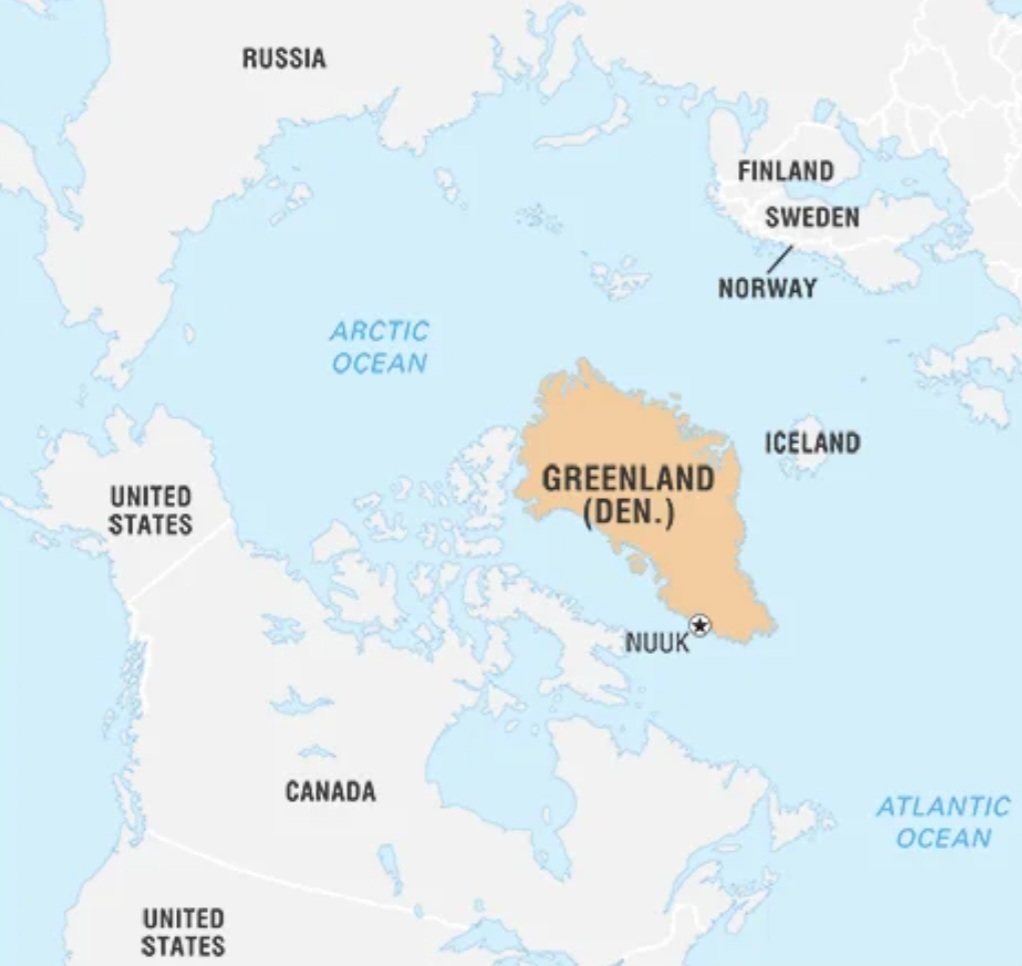
Recently, U.S. President Donald Trump has stated that the United States could take control of Greenland, which is under Danish administration, with the objective of preventing the growing influence of China and Russia in the Arctic region. Owing to its strategic location and abundant natural resources, Greenland has emerged as a major geopolitical focal point globally.
Importance of Greenland:
-
-
-
- Exceptional Natural Resources:
- Greenland is geologically rich in rare earth elements (REEs), lithium, graphite, uranium, and potentially oil and gas—resources that are critical for green technologies, defence industries, and advanced electronics.
- Estimates suggest that Greenland may hold around 1.5 million tonnes of rare earth elements, placing it among the world’s significant repositories of critical minerals, even though no commercial mining operations have yet commenced.
- Greenland is geologically rich in rare earth elements (REEs), lithium, graphite, uranium, and potentially oil and gas—resources that are critical for green technologies, defence industries, and advanced electronics.
- Arctic Climate and Accessibility:
- Climate change has accelerated the melting of ice sheets, partially exposing bedrock that was previously inaccessible. Over time, this could improve access to mineral resources and open new Arctic shipping routes, potentially altering global trade patterns.
- Climate change has accelerated the melting of ice sheets, partially exposing bedrock that was previously inaccessible. Over time, this could improve access to mineral resources and open new Arctic shipping routes, potentially altering global trade patterns.
- Strategic Location:
- Greenland occupies a crucial geopolitical position between North America and Europe. It anchors the northern defence architecture of the Arctic and lies close to critical air and sea corridors, including the GIUK Gap (Greenland–Iceland–United Kingdom), which is central to NATO’s early-warning systems and maritime surveillance.
- Greenland occupies a crucial geopolitical position between North America and Europe. It anchors the northern defence architecture of the Arctic and lies close to critical air and sea corridors, including the GIUK Gap (Greenland–Iceland–United Kingdom), which is central to NATO’s early-warning systems and maritime surveillance.
- Exceptional Natural Resources:
-
-
Why Resource Extraction Is Difficult?
-
-
-
- Despite its resource potential, Greenland faces formidable obstacles to extraction:
- Extremely harsh climate: Much of the island is covered by thick ice sheets, and temperatures can fall below −40°C, severely restricting the duration and feasibility of mining activities.
- Weak infrastructure: Sparse road networks, limited port facilities, and the absence of rail connectivity make transportation, logistics, and construction highly challenging.
- High costs and technological barriers: Complex geology—such as rare earth minerals embedded in silicate rock—raises extraction costs. Additionally, strict environmental regulations and opposition from local communities further complicate development efforts.
- Extremely harsh climate: Much of the island is covered by thick ice sheets, and temperatures can fall below −40°C, severely restricting the duration and feasibility of mining activities.
- These constraints explain why, despite sizeable estimated reserves, Greenland has not yet seen large-scale rare earth mining or oil production.
- Despite its resource potential, Greenland faces formidable obstacles to extraction:
-
-
U.S. Strategic Interest:
-
-
-
- Security rationale: Greater U.S. influence over Greenland would strengthen defence capabilities against Russian and Chinese activities in the Arctic. However, the United States already maintains a military presence through the Pituffik Space Base, established under existing agreements.
- Rare earths and supply chains: The U.S. seeks to diversify critical mineral supply chains that are currently dominated by China, and Greenland’s mineral reserves form an important part of this long-term strategy.
- Geopolitical competition: Analysts interpret U.S. interest as part of a broader great-power contest over the Arctic’s strategic space and resources.
- Security rationale: Greater U.S. influence over Greenland would strengthen defence capabilities against Russian and Chinese activities in the Arctic. However, the United States already maintains a military presence through the Pituffik Space Base, established under existing agreements.
-
-
Implications for Global Politics:
-
-
-
- Great power rivalry: China, Russia, the United States, and the European Union are increasingly engaged in Arctic diplomacy and exploration, transforming the region into a theatre of strategic competition.
- Energy and technology markets: Access to Greenland’s rare earths and other minerals could reshape global supply chains for electronics, renewable energy, and defence manufacturing.
- Environmental concerns: While climate change is making the Arctic more accessible, it simultaneously poses long-term risks to fragile ecosystems and indigenous communities.
- Great power rivalry: China, Russia, the United States, and the European Union are increasingly engaged in Arctic diplomacy and exploration, transforming the region into a theatre of strategic competition.
-
-



