
Context:
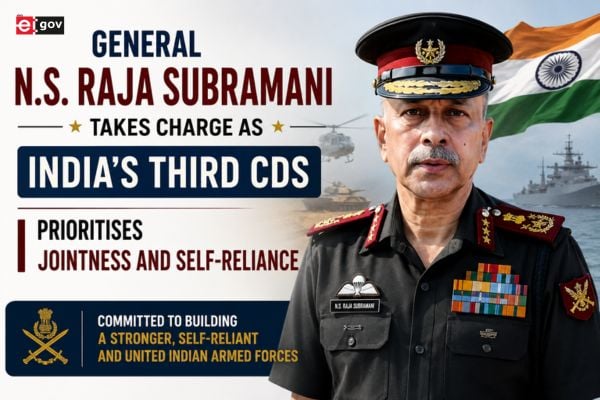
Recently, General N.S. Raja Subramani has assumed charge as India's third Chief of Defence Staff (CDS) and Secretary of the Department of Military Affairs (DMA).
About Chief of Defence Staff (CDS):
-
-
- The Chief of Defence Staff is the highest-ranking military officer in India and serves as:
- Principal Military Adviser to the Defence Minister.
- Permanent Chairman of the Chiefs of Staff Committee (COSC).
- Secretary of the Department of Military Affairs (DMA).
- Facilitator of jointness and integration among the Army, Navy, and Air Force.
- Principal Military Adviser to the Defence Minister.
- The CDS acts as a bridge between the civilian leadership and the armed forces while promoting unified military planning and capability development.
- The Chief of Defence Staff is the highest-ranking military officer in India and serves as:
-
Evolution of the CDS System in India:
-
-
- Kargil Review Committee (1999): Following the Kargil War, the committee headed by K. Subrahmanyam highlighted the need for greater coordination among the armed forces.
- Group of Ministers (2001): Recommended creation of a single-point military adviser to the government.
- Naresh Chandra Committee (2012): Suggested institutional reforms for higher defence management.
- Shekatkar Committee: Reiterated the need for jointness and military reforms.
- Kargil Review Committee (1999): Following the Kargil War, the committee headed by K. Subrahmanyam highlighted the need for greater coordination among the armed forces.
-
Establishment of CDS:
-
-
- Announced by the Government of India in 2019.
- Cabinet approved the post in December 2019.
- General Bipin Rawat became India's first CDS on 1 January 2020.
- Announced by the Government of India in 2019.
-
Objectives behind Creating the CDS:
-
-
- Enhance Jointness
- Improve coordination among the three services.
- Develop integrated planning and operations.
- Promote Theatre Commands
- Restructure service-specific commands into integrated theatre commands.
- Ensure efficient response to modern security challenges.
- Restructure service-specific commands into integrated theatre commands.
- Resource Optimization
- Reduce duplication in procurement and logistics.
- Improve cost-effectiveness of defence spending.
- Reduce duplication in procurement and logistics.
- Strengthen Indigenous Defence Production
- Encourage domestic manufacturing under Atmanirbhar Bharat.
- Reduce dependence on foreign military equipment.
- Encourage domestic manufacturing under Atmanirbhar Bharat.
- Enhance Jointness
-
Significance of the Office of the CDS:
-
-
- Strategic Synergy
- Reduces duplication of resources across the three services.
- Promotes a unified and coordinated approach to addressing national security threats.
- Reduces duplication of resources across the three services.
- Unified Theatre Commands
- Serves as the primary driver for the creation of integrated tri-service theatre commands.
- Facilitates seamless coordination among the Army, Navy, and Air Force.
- Strengthens India's preparedness for modern multi-domain warfare.
- Serves as the primary driver for the creation of integrated tri-service theatre commands.
- Prioritized Defence Acquisition
- Improves the efficiency of capital procurement processes.
- Helps resolve inter-service differences and prioritizes critical capability requirements.
- Ensures that military modernization programs are implemented without unnecessary delays.
- Improves the efficiency of capital procurement processes.
- Strategic Synergy
-
Challenges Associated with the CDS:
-
-
- Inter-Service Rivalries
- Balancing the distinct operational doctrines, priorities, and requirements of the Army, Navy, and Air Force remains a significant challenge.
- Requires continuous consensus-building and institutional cooperation.
- Balancing the distinct operational doctrines, priorities, and requirements of the Army, Navy, and Air Force remains a significant challenge.
- Command Structure Ambiguities
- Overlapping responsibilities among the CDS, Service Chiefs, and the Defence Secretary can create uncertainties in decision-making and command chains.
- Clear delineation of roles is essential for effective military management.
- Overlapping responsibilities among the CDS, Service Chiefs, and the Defence Secretary can create uncertainties in decision-making and command chains.
- Funding Constraints
- Large-scale reforms, such as the establishment of theatre commands and force restructuring, require substantial financial resources.
- Budgetary limitations may affect the pace and scope of implementation.
- Large-scale reforms, such as the establishment of theatre commands and force restructuring, require substantial financial resources.
- Inter-Service Rivalries
-



