
Context:
Recently, External Affairs Minister S. Jaishankar participated in the G20 Foreign Ministers’ Meeting held in Atlanta, Georgia, USA, on 30–31 October 2026, hosted by US Secretary of State Marco Rubio. India raised concerns over terrorism, attacks on civilian shipping, global conflicts and disruptions in international supply chains.
About G20:
-
-
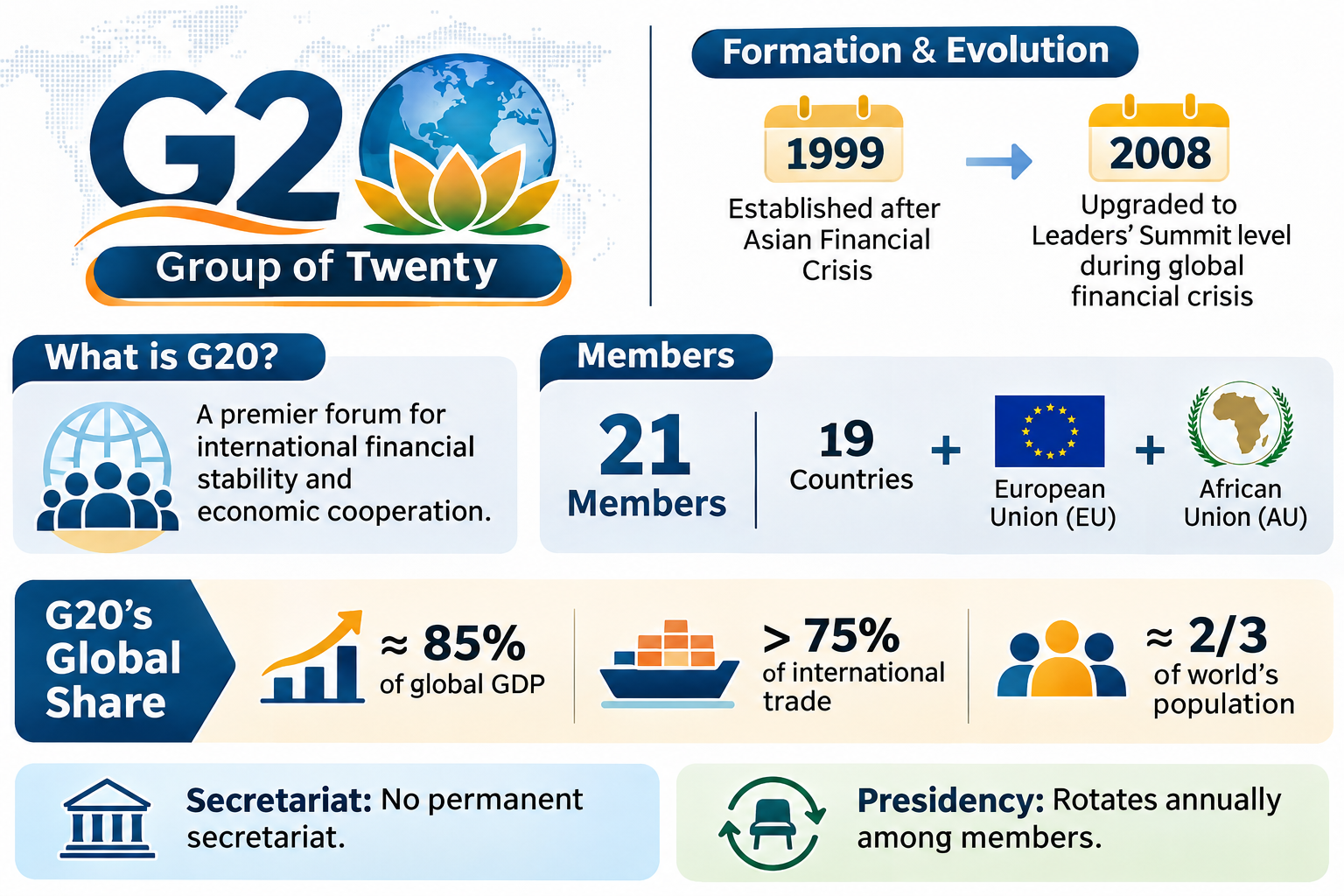
- The Group of Twenty (G20) was established in 1999 following the Asian Financial Crisis to promote international financial stability and economic cooperation. In 2008, it was upgraded to the Leaders’ Summit level in response to the global financial crisis.
- It comprises 19 countries, the European Union (EU) and the African Union (AU), representing 21 members. Collectively, G20 members account for approximately 85% of global GDP, over 75% of international trade and around two-thirds of the world's population. The G20 does not have a permanent secretariat, and its presidency rotates annually.
- The Group of Twenty (G20) was established in 1999 following the Asian Financial Crisis to promote international financial stability and economic cooperation. In 2008, it was upgraded to the Leaders’ Summit level in response to the global financial crisis.
-
Background of the 2026 Meeting:
The United States holds the G20 presidency in 2026. The Atlanta Foreign Ministers’ Meeting was organised ahead of the G20 Leaders’ Summit scheduled for 14–15 December 2026 in Miami, Florida. Major areas of discussion included global economic cooperation, energy security, technological innovation, international stability and resilient supply chains.
Major Issues Discussed:
-
-
- Energy Security: Ministers discussed the need for affordable, reliable and uninterrupted energy supplies. Geopolitical conflicts and disruptions around strategic maritime chokepoints, including the Strait of Hormuz and Bab-el-Mandeb, threaten global energy security.
- Supply Chain Resilience: The meeting highlighted the importance of diversifying supply chains, improving critical mineral availability and reducing excessive dependence on particular countries for essential resources.
- Maritime Security: Freedom of navigation and safe passage through international waterways were emphasised as essential for international trade and economic stability.
- India and Liberia launched the Group of Friends on Safety and Security of Shipping and Seafarers (GoF on S4) on 25 September 2026. It aims to strengthen international cooperation, protect seafarers and discourage attacks on commercial shipping.
- Global Conflicts: Differences over the Russia-Ukraine war, West Asian conflicts, US tariffs and China's activities in the South China Sea affected discussions. The meeting concluded without a joint communiqué; the US issued a Chair's Statement instead.
- Energy Security: Ministers discussed the need for affordable, reliable and uninterrupted energy supplies. Geopolitical conflicts and disruptions around strategic maritime chokepoints, including the Strait of Hormuz and Bab-el-Mandeb, threaten global energy security.
-
India's Key Concerns:
-
-
- India highlighted that terrorism should not be overlooked for short-term strategic interests. He called for diplomacy rather than military solutions to resolve international conflicts.
- India also stressed protecting freedom of navigation and ending attacks on civilian vessels in accordance with international law, particularly UNCLOS. Such attacks disproportionately affect developing countries by increasing the cost and reducing the availability of fuel, food and fertilisers.
- India highlighted that terrorism should not be overlooked for short-term strategic interests. He called for diplomacy rather than military solutions to resolve international conflicts.
-
Challenges and Significance:
Disruptions in maritime routes, weaponisation of supply chains, restricted market access and market distortions threaten the economic security of developing countries. The meeting highlighted the need for alternative connectivity, diversified trade routes and resilient supply chains.
Conclusion:
The G20 Foreign Ministers’ Meeting highlights the importance of international cooperation in addressing terrorism, geopolitical conflicts and economic vulnerabilities. India’s emphasis on diplomacy, maritime security and supply chain resilience reflects its commitment to a stable, inclusive and rules-based international order.



